- Animals
- ›Chordates
- ›Vertebrates
- ›Mammals
- ›Therians
- ›Placental Mammals
- ›Ungulates, Carnivorans, and Allies
- ›Even-toed Ungulates and Cetaceans
- ›Ruminants
- ›Bovids
- ›Antelopes, Goats, and Sheep
- ›Typical Antelopes
- ›Gazella
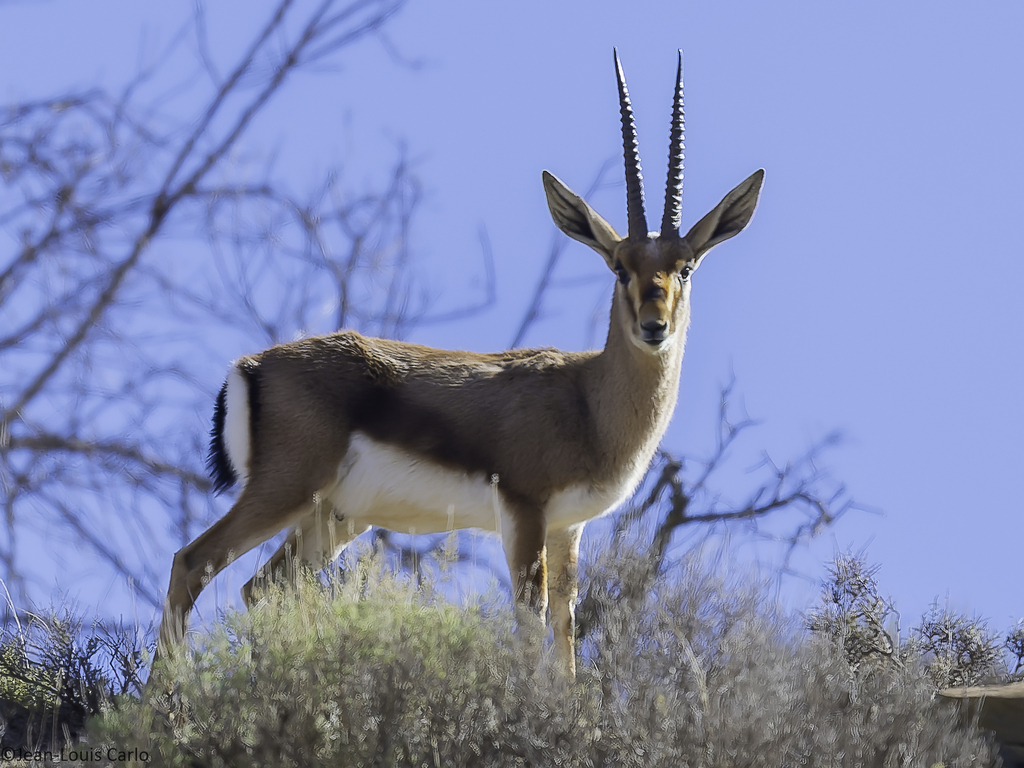
Cuvier's Gazelle
Gazella cuvieri
The Cuvier's gazelle (Gazella cuvieri) is a species of gazelle found in Algeria, Morocco and Tunisia. It is also known as the edmi. It is one of the darkest species of gazelle in coloring, due to its partial woodland habitat. It is sometimes placed in a separate genus, Trachelocele, from other gazelles, together with goitered gazelles and rhim gazelles. It is very rare in the wild with only 2000 individuals.
From the article Cuvier's gazelle on Wikipedia (CC BY-SA), quoted section by section
Description
Cuvier's gazelle is one of the darkest and smallest of the gazelle species, standing 60–69 cm (1.97–2.26 ft) tall, with an average weight of 35 kg (77 lb). It is characterized by a distinctive wide, dark band that runs along the sides of the animal, which separates the brown dorsal parts from the white ventral parts. They possess long, slender ears. While both sexes have horns between 10 and 15 cm (3.9 and 5.9 in) long, the male's horns are more ribbed and have greater mass. The purpose of the dark bands that run parallel along the side of the animal is to aid in countershading, having ventral body pelage that is more lightly colored that the dorsal surface to counteract the effect of the body's self-shadowing.
Wikipedia: “Characteristics”
Range & habitat
Cuvier's gazelle inhabits the Atlas Mountains in Northwestern Africa. It is found in many different types of landscapes. The preference is for sandy or stony hills and plateaus. They also occupy areas of regenerating forests and lush pine forests. During the early morning and late evening they come out of the mountains to graze in the low grasslands. Then in the afternoon, they will travel back up the mountain into the forests and find a cool place to spend the day.
Wikipedia: “Habitat”
What it does
As herbivorous ruminants, the diet of Cuvier's gazelle consists entirely of leaves, grasses, and other vegetation. They will consume large amounts of greenery and find a cool place during the day to finish chewing their cuds, remnant wads of food that return from the stomach (eructation) to be chewed a second time for further digestion. Their main defense is their alertness. When sensing something suspicious, they will set off an alert signal by flicking their tails and performing a strong gait, of jumping into the air and having all four hooves land on the ground at the same time. Along with their alertness, they are also one of the fastest gazelles, reaching and sustaining top speeds over 50 mph. Cuvier's gazelle tend to live in social groups of three or four during mating season, but usually not more than eight. Groups tend to contain one male and up to three females each with up to two offspring. During the mating season, the dominant males will force the younger males out of the social group; they will form bachelor groups. Then, the females will leave the group to give birth. After giving birth, females will join bachelor groups and live the rest of mating season with them.
Wikipedia: “Behavior”
Listen
Looking for field recordings…
Where it lives
Recorded sightings
—
geo-referenced records in GBIF, from museums, herbaria and field observers.
Drag the globe to turn it. Dots are where records exist, not a range map; darker means more records.
In the stacks
Searching the stacks…
Every page naming Gazella cuvieri in the Biodiversity Heritage Library →
This page is assembled live from iNaturalist, GBIF, Wikipedia, the Source Library and the Internet Archive. It is not yet part of the hand-edited codex. iNaturalist taxon 42261.