- Animals
- ›Chordates
- ›Vertebrates
- ›Mammals
- ›Therians
- ›Placental Mammals
- ›Ungulates, Carnivorans, and Allies
- ›Even-toed Ungulates and Cetaceans
- ›Ruminants
- ›Bovids
- ›Antelopes, Goats, and Sheep
- ›Typical Antelopes
- ›Gazella
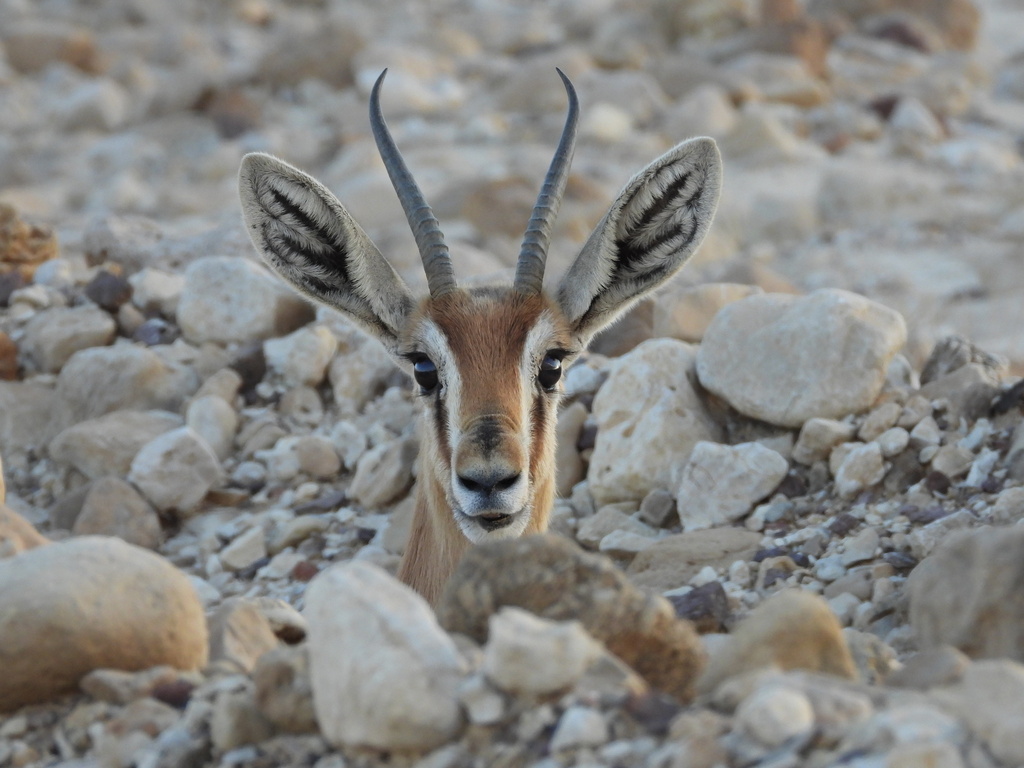
Dorcas Gazelle
Gazella dorcas
The dorcas gazelle (Gazella dorcas), also known as the ariel gazelle, is a small and common gazelle. The dorcas gazelle stands about 55–65 cm (1.8-2.1 ft) at the shoulder, with a head and body length of 90–110 cm (3-3.6 ft) and a weight of 15–20 kg (33-44 lb). The numerous subspecies survive on vegetation in grassland, steppe, wadis, mountain desert and in semidesert climates of Africa and Arabia. About 35,000 - 40,000 exist in the wild. The extinct Saudi gazelle from the...
From the article Dorcas gazelle on Wikipedia (CC BY-SA), quoted section by section
Description
The dorcas gazelle is similar in appearance to, yet smaller than, the closely related mountain gazelle (G. gazella). Dorcas gazelles have longer ears and more strongly curved horns, which bow outwards then turn inwards and forwards at the tips. Individuals belonging to the Saharan subspecies (G. d. osiris) have very pale, fawn-colored coats. The white underside is bordered with a brown stripe, above which is a sandy stripe. The forehead and face are darker than the body. Subspecies from north of the Sahara tend to be more ochre in color, and have dark flanks and facial stripes. Populations in Israel and around the Red Sea are darker and more reddish. In the last century, the populations of dorcas gazelle were partially destroyed in all the countries where it was found. Currently, large populations of dorcas gazelles are found in the Negev and the Arava, with other large populations in Sudan, and the southern part of the Eastern Desert of Egypt. In Israel, only 1000–1500 gazelles remain.
What it does
Dorcas gazelles are highly adapted to life in the desert. They get most of their water from eating succulents, but cannot go their entire lives without drinking water. They look for water sources and drink readily when one is found. They are naturally able to withstand high temperatures and harsh sunlight. Other than evenings when it is very hot, they are active mainly from dusk to dawn. In areas where they face human predation, they tend to be active only at night to avoid falling prey to hunters. These gazelles feed on leaves, flowers, the pods of many species of acacia trees, and the leaves, twigs and fruits of various desert bushes. They occasionally stand on their hind legs to browse through trees and, after rain, have been observed digging bulbs from the ground. Dorcas gazelles can run at speeds up to 80 km/h (50 mph) and may even reach 96 km/h (60 mph). When threatened, they tail-twitch and make bouncing leaps with their heads held high, possibly to announce they have seen a predator.
Wikipedia: “Behaviour”
Listen
Looking for field recordings…
Where it lives
Recorded sightings
—
geo-referenced records in GBIF, from museums, herbaria and field observers.
Drag the globe to turn it. Dots are where records exist, not a range map; darker means more records.
In the stacks
Searching the stacks…
Every page naming Gazella dorcas in the Biodiversity Heritage Library →
This page is assembled live from iNaturalist, GBIF, Wikipedia, the Source Library and the Internet Archive. It is not yet part of the hand-edited codex. iNaturalist taxon 42266.