- Animals
- ›Chordates
- ›Vertebrates
- ›Mammals
- ›Therians
- ›Placental Mammals
- ›Ungulates, Carnivorans, and Allies
- ›Even-toed Ungulates and Cetaceans
- ›Ruminants
- ›Bovids
- ›Antelopes, Goats, and Sheep
- ›Alcelaphines
- ›Damaliscus
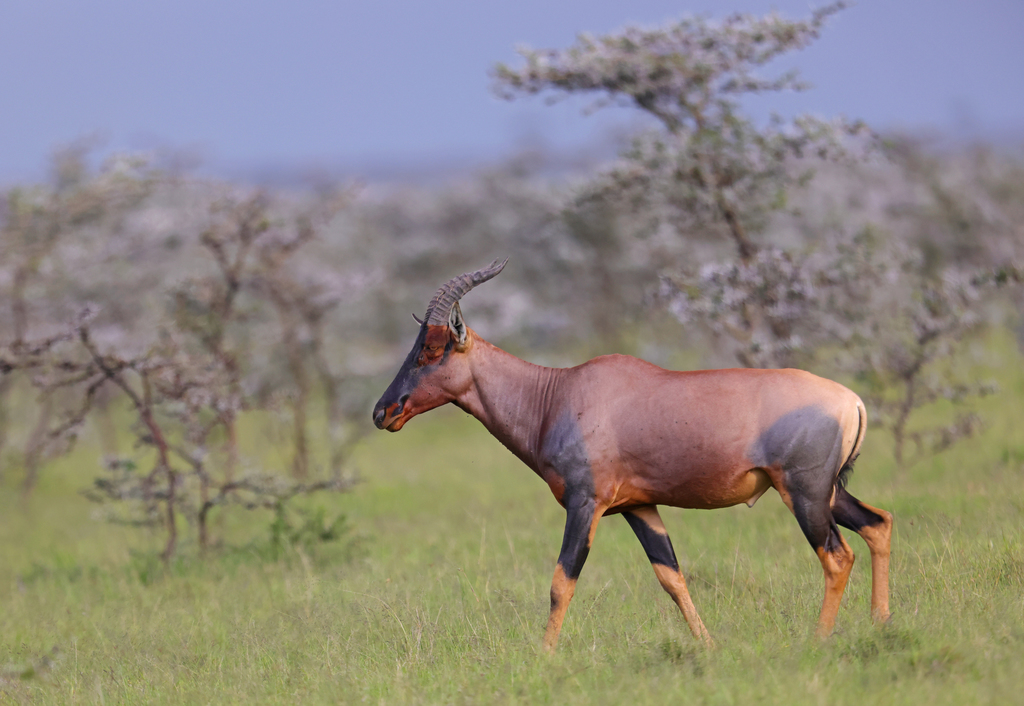
Tsessebe
Damaliscus lunatus
The common tsessebe or sassaby (Damaliscus lunatus lunatus) is one of five subspecies of African antelope Damaliscus lunatus of the genus Damaliscus and subfamily Alcelaphinae in the family Bovidae. It is most closely related to the topi, korrigum, coastal topi and tiang (all subspecies of Damaliscus lunatus), and the bangweulu tsessebe and bontebok in the same genus. Tsessebe are found primarily in Angola, Zambia, Namibia, Botswana, Zimbabwe, Swaziland, and South Africa. Tsessebe can run at a...
From the article Damaliscus lunatus on Wikipedia (CC BY-SA), quoted section by section
Description
Adult topi are 150 to 230 cm in length. They are quite large animals, with males weighing 137 kg and females weighing 120 kg, on average. Their horns range from 37 cm for females to 40 cm for males. For males, horn size plays an important role in territory defence and mate attraction, although horn size is not positively correlated with territorial factors of mate selection. Their bodies are chestnut brown or reddish brown. They have a mask-like dark colouration on the face and their tail tufts are black; the upper forelimbs and thighs have greyish, dark purple or bluish-black-coloured patches. Their hindlimbs are brownish-yellow to yellow and their bellies are white. In the wild, topi usually live a maximum of 15 years, but in general, their average lifespan is much less. Topi resemble hartebeest but have a darker colouration and lack sharply angled horns. They have elongated heads, and a distinct hump at the base of the neck. Their horns are ringed and lyrate-shaped. Their coats are made of short, shiny hairs. They range in mass from 68 to 160 kg (150 to 353 lb). Head-and-body length can range from 150 to 210 cm (59 to 83 in) and the tail measures 40–60 cm (16–24 in). They are a tall species, ranging in height from 100 to 130 cm (39 to 51 in) at the shoulder. Males tend to be larger and darker than females. …
Range & habitat
The topi has a long but patchy distribution in Southern, East and West Africa it prefers certain grasslands in arid and savanna biomes. Human hunting and habitat modification have further isolated the subpopulations. Topi are usually either numerous or absent in an area. Scattered populations do not last long and either increase or die off. The health of topis in a population depends on access to green vegetation. Herds of topi migrate between pastures. A large migration is in the Serengeti, where they join the wildebeests, zebras and gazelles. Topi herds can take the form of "perennially sedentary-dispersion", "perennially mobile-aggregated" or something in between. This depends on the habitat and ecology of the areas they are in. Males establish territories that attract herds of females with their offspring. Depending on the size of the patches, territories can be as large as 4 km2 and sometimes border each other. In more densely populated areas, like those of Queen Elizabeth National Park in Uganda, topis move across the plain and set up territories during resting periods.
Wikipedia: “Distribution”
What it does
Topi are grazing herbivores, their diet is almost exclusively grass. The topi is a selective feeder and uses its elongated muzzle and flexible lips to forage for the youngest blades of grass. Topi are not as capable as other grazers at feeding from short sward, and during the rainy season avoid both long mature grass and very short pasture, whereas in the dry season they move to any area with the most grass. When they have access to enough green vegetation, topi usually do not need to drink. They drink more when relying on dry grass. Topi found in the Serengeti usually feed in the morning between 8:00 and 9:00 am and in the afternoon after 4:00 pm. The periods before and after feeding are spent resting and digesting or watering during dry seasons. Topi can travel up to five kilometres to reach a viable water source. To avoid encounters with territorial males or females, topi usually travel along territorial borders, though it leaves them open to attacks by lions and leopards.
Wikipedia: “Diet”
In human culture
The word tope or topi is Swahili, and was first recorded by the German explorer Gustav Fischer on the ancient city island of Lamu off the Kenyan coast. Other names recorded in East Africa by various German explorers were mhili in Kisukuma and jimäla in Kinyamwezi. The Luganda name was simäla according to Neumann, or nemira according to Lugard.
Wikipedia: “Etymology”
Listen
Looking for field recordings…
Where it lives
Recorded sightings
—
geo-referenced records in GBIF, from museums, herbaria and field observers.
Drag the globe to turn it. Dots are where records exist, not a range map; darker means more records.
In the stacks
Searching the stacks…
Every page naming Damaliscus lunatus in the Biodiversity Heritage Library →
This page is assembled live from iNaturalist, GBIF, Wikipedia, the Source Library and the Internet Archive. It is not yet part of the hand-edited codex. iNaturalist taxon 42276.