- Animals
- ›Chordates
- ›Vertebrates
- ›Mammals
- ›Therians
- ›Placental Mammals
- ›Ungulates, Carnivorans, and Allies
- ›Even-toed Ungulates and Cetaceans
- ›Ruminants
- ›Bovids
- ›Antelopes, Goats, and Sheep
- ›Reduncines
- ›Redunca
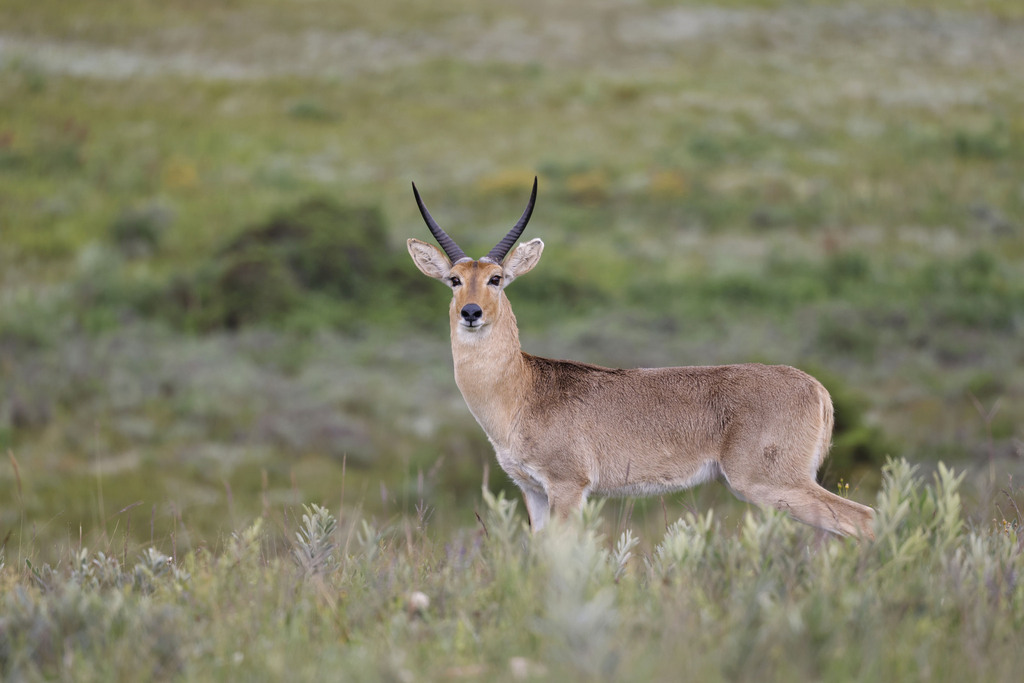
Southern Reedbuck
Redunca arundinum
The southern reedbuck, rietbok or common reedbuck (Redunca arundinum) is a diurnal antelope typically found in southern Africa. It was first described by Pieter Boddaert, a Dutch physician and naturalist, in 1785. It is placed in the genus Redunca and family Bovidae. This antelope has an average mass of 58 kg (128 lb) and a body length of about 134–167 cm (53–66 in).
From the article Southern reedbuck on Wikipedia (CC BY-SA), quoted section by section
Description
The southern reedbuck is larger than the other species in Redunca, namely R. redunca (Bohor reedbuck) and R. fulvorufula (mountain reedbuck). It stands 80–90 cm (31–35 in) at the shoulder. Females weigh 48 kg (106 lb), while the males weigh 68 kg (150 lb). It has distinctive dark lines running down the front of each of its forelegs and lower hindlegs and whitish rings around the eyes. It has a lifespan of 10 years. The coat is silky and almost woolly. The color of its coat ranges between light- and greyish-brown, and may be lighter on the neck and chest. A small, black, bare glandular patch can be noticed at the base of each ear. White fur covers the underparts and the areas near the lips and chin. The tail is white underside, and appears short and bushy. Southern reedbucks measure an average of 85 cm (33 in) at the shoulder. Females lack horns. Males bear forward-curving horns, about 35–45 cm (14–18 in) long, with the base having a distinct band of pale, rubbery tissue.
Range & habitat
Southern reedbucks have a wide distribution, stretching from Gabon and Tanzania to South Africa. Their range seems to extend to the Miombo woodlands on the north. They inhabit moist grasslands with tall grass, reeds, sufficient cover, and water nearby, such as floodplains, pastures, woodlands, and valleys. They are common in seasonally flooded valleys near the Malagarasi River. They also occur in the southern savannas of Tchibanga and Ndende (in Democratic Republic of the Congo). It is native to Angola, Botswana, the Republic of the Congo, the Democratic Republic of the Congo, Gabon, Malawi, Mozambique, Namibia, South Africa, Eswatini, Tanzania, Zambia, and Zimbabwe. It also occurs in protected areas and areas with low to moderate levels of settlement, including significant populations on private land in Zimbabwe, South Africa, and Namibia. In the Republic of Congo, it formerly occurred locally in the savannahs of southern Congo, but it is probably extinct there by now. Its presence is doubted in Lesotho. Major populations occur in areas such as Selous National Park (Tanzania), Kafue National Park (Zambia), Nyika National Park (Malawi), Gorongosa National Park (Mozambique), Okavango National Park (Botswana) and Kruger National Park and Eastern Shores (South Africa).
Wikipedia: “Habitat and distribution”
What it does
Southern reedbucks live in pairs or alone. Sometimes, they form herds consisting of about 20 members. They prefer to lie in grass or reed beds in the heat of the day and feed during sunrise and sunset, or sometimes even at night. Old reedbucks are permanently territorial, with territories around 35-60 hectares, and generally live with a single female, preventing contact with rival males. Females and young males perform an 'appeasement dance' for older males. During the dance, the bucks run around speedily and take considerably long jumps, with the tail curled up and scented air being released from a pocket in the groin at every bounce, making a popping sound. Within this territory, it is active all the time in summer, but it is nocturnal in the wet season. It regularly uses paths to reach good sites to rest, graze, and drink water. Average lifetime home ranges have been estimated as 123 ha for females and 74 ha for males. Their main predators include lions, leopards, cheetahs, spotted hyenas, Cape hunting dogs and Nile crocodiles. They can camouflage themselves in the grasslands due to their coats, which are almost the same color. If startled or attacked, they stand still, then either hide or flee with an odd rocking-horse movement, and cautiously look back to ensure the danger is gone, generally. …
Wikipedia: “Ecology”
In human culture
It was first described by Pieter Boddaert, a Dutch physician and naturalist, in 1785. It is placed in the genus Redunca and family Bovidae. It gets its name from two Latin words: reduncas (meaning bent backwards and curved, while the horns are bent forwards) and arundo (harundo) (meaning a reed; hence arundinum, pertaining to reeds).
Wikipedia: “Taxonomy and etymology”
Listen
Looking for field recordings…
Where it lives
Recorded sightings
—
geo-referenced records in GBIF, from museums, herbaria and field observers.
Drag the globe to turn it. Dots are where records exist, not a range map; darker means more records.
In the stacks
Searching the stacks…
Every page naming Redunca arundinum in the Biodiversity Heritage Library →
This page is assembled live from iNaturalist, GBIF, Wikipedia, the Source Library and the Internet Archive. It is not yet part of the hand-edited codex. iNaturalist taxon 42305.