- Animals
- ›Chordates
- ›Vertebrates
- ›Mammals
- ›Therians
- ›Placental Mammals
- ›Ungulates, Carnivorans, and Allies
- ›Even-toed Ungulates and Cetaceans
- ›Ruminants
- ›Bovids
- ›Antelopes, Goats, and Sheep
- ›Horse-like Antelopes

Oryxes
Oryx
Oryx ( ORR-iks) is a genus consisting of four large antelope species called oryxes. Their pelage is pale with contrasting dark markings in the face and on the legs, and their long horns are almost straight and annulated. The exception is the scimitar oryx, which lacks dark markings on the legs, only has faint dark markings on the head, has an ochre neck, and has horns that are clearly decurved. All oryx species prefer near-desert conditions and can survive without water for long periods.
The Arabian oryx was only saved from extinction through a captive-breeding program and reintroduction to the wild. The scimitar oryx, which was listed as extinct in the wild, also relied on a captive-breeding program for its survival.
4 branches of this genus, most-observed first · about 4 known species
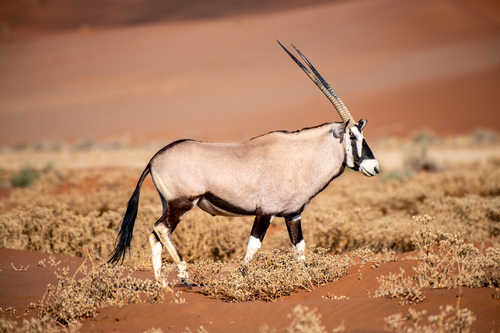
Gemsbok
speciesOryx gazella
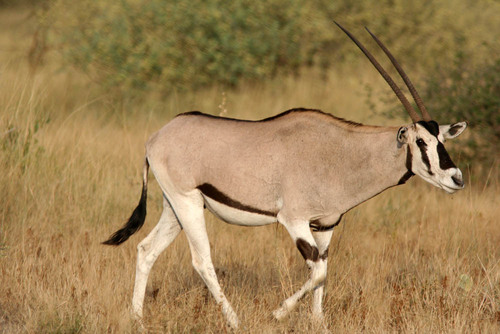
East African Oryx
speciesOryx beisa
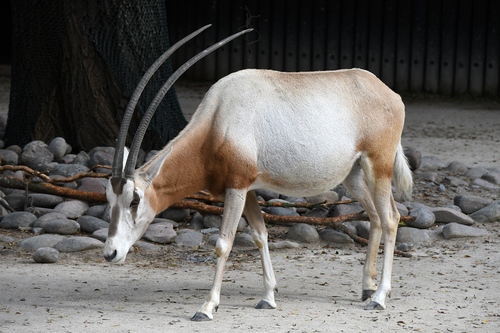
Scimitar-horned Oryx
speciesOryx dammah
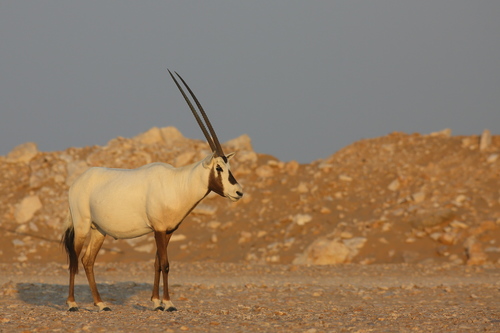
Arabian Oryx
speciesOryx leucoryx
Where it lives
Recorded sightings
—
geo-referenced records in GBIF, from museums, herbaria and field observers.
Drag the globe to turn it. Dots are where records exist, not a range map; darker means more records.
In the old herbals & bestiaries

Ortus sanitatis
1491 · p.574

Garden of Health
1507 · p.468

Garden of Health
1507 · p.442

History of Animals, Book II: On Oviparous Quadrupeds
Conrad Gessner · 1586 · p.537

History of All Cloven-Hoofed Quadrupeds
Ulisse Aldrovandi · 1621 · p.787

Georg Wolfgang Knorr — Deliciae naturae selectae (1771)
Georg Wolfgang Knorr · 1771 · p.329
In the stacks
Searching the stacks…
Every page naming Oryx in the Biodiversity Heritage Library →
This page is assembled live from iNaturalist, GBIF, Wikipedia, the Source Library and the Internet Archive. It is not yet part of the hand-edited codex. iNaturalist taxon 42307.