- Animals
- ›Chordates
- ›Vertebrates
- ›Mammals
- ›Therians
- ›Placental Mammals
- ›Ungulates, Carnivorans, and Allies
- ›Even-toed Ungulates and Cetaceans
- ›Ruminants
- ›Bovids
- ›Bovines
- ›Spiral-horned Antelopes
- ›Tragelaphus
- ›Tragelaphus
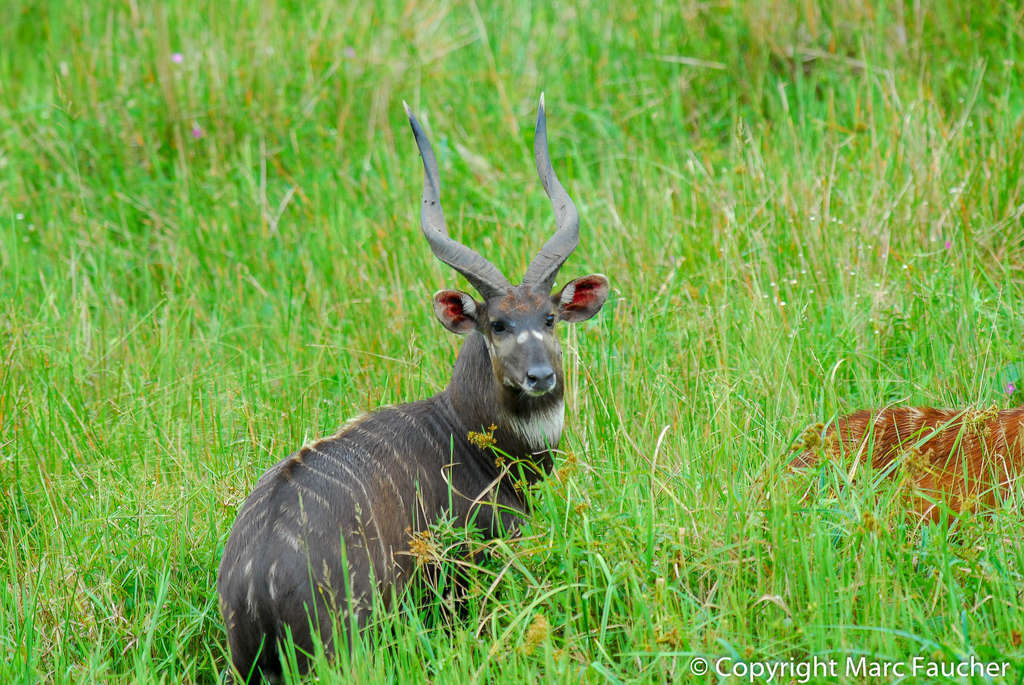
Sitatunga
Tragelaphus spekii
The sitatunga (Tragelaphus spekii) or marshbuck is a swamp-dwelling medium-sized antelope found throughout central Africa, centering on the Democratic Republic of the Congo, the Republic of the Congo, Cameroon, parts of Southern Sudan, Equatorial Guinea, Burundi, Ghana, Botswana, Rwanda, Zambia, Gabon, the Central African Republic, Tanzania, Uganda and Kenya.
The sitatunga is mostly confined to swampy and marshy habitats. They occur in tall and dense vegetation as well as seasonal swamps, marshy clearings in forests, riparian thickets and mangrove swamps.
From the article Sitatunga on Wikipedia (CC BY-SA), quoted section by section
Description
The sitatunga is a medium-sized antelope. It is sexually dimorphic, with males considerably larger than females. The head-and-body length is typically between 136–177 cm (54–70 in) in males and 104–146 cm (41–57 in) in females. Males reach approximately 81–116 cm (32–46 in) at the shoulder, while females reach 72–90 cm (28–35 in). Males typically weigh 76–119 kg (168–262 lb), while females weigh 24–57 kg (53–126 lb). The tail is 14–37 cm (5.5–14.6 in) long. The saucer-shaped ears are 11–17 cm (4.3–6.7 in) long. Only the males possess horns; these are spiral in shape, have one or two twists and are 45–92 cm (18–36 in) long. The sitatunga is almost indistinguishable from the nyala, except in pelage and spoor. Speke pointed out that, though "closely allied" to the waterbuck, the sitatunga lacks stripes and is spotted instead. The coat colour varies geographically, but, in general, is a rufous red in juveniles and chestnut in females. There are white facial markings, as well as several stripes and spots all over, though they are only faintly visible. White patches can be seen on the throat, near the head and the chest. A pair of inguinal scent glands are present. The coats of males darken with age, becoming gray to dark brown. Males develop a rough and scraggy mane, usually brown in colour, and a white dorsal stripe. …
Range & habitat
The sitatunga is an amphibious antelope (meaning it can live on both land and water) confined to swampy and marshy habitats. They occur in tall and dense vegetation of perennial as well as seasonal swamps, marshy clearings in forests, riparian thickets and mangrove swamps. Sitatunga move along clearly marked tracks in their swampy habitat, often leading to reed beds. These tracks, up to 7 m (23 ft) wide, can lead to feeding grounds and nearby riverine forests. The sitatunga hold small home ranges near water bodies In savannas, they are typically found in stands of papyrus and reeds (Phragmites species and Echinochloa pyramidalis). They share their habitat with the Nile lechwe in the Sudd swamps and with the southern lechwe in Angola, Botswana and Zambia. The sitatunga is native to Angola, Benin, Botswana, Burundi, Cameroon, Central African Republic, Chad, The Democratic Republic of the Congo, Equatorial Guinea, Gabon, Gambia, Ghana, Guinea, Guinea-Bissau, Kenya, Mozambique, Namibia, Nigeria, Rwanda, Senegal, South Sudan, Tanzania, Uganda, Zambia and Zimbabwe. It is extinct in Niger, where it formerly occurred in the Lake Chad region, and is feared to be extinct in Togo, where its habitat has been taken over by dense human settlements. …
Wikipedia: “Habitat and distribution”
What it does
Sitatunga are active mainly during the early hours after dawn, the last one or two hours before dusk, and at night, and spend a large part of this time feeding. Basically sedentary, they rest in flat areas and reed beds, especially during the hotter part of the day. They seldom leave their swamp habitat during the daytime. Though sitatunga commonly form pairs or remain solitary, larger groups have also been observed. A study in Kenya recorded a herd of as many as nine individuals, comprising an adult male, four females and four juveniles. Loose groups may be formed but interaction among individuals is very low. Individuals generally associate only with their own sex. The sitatunga is not territorial. Males may engage in locking horns with other males and attacking vegetation using their horns. They may perform feinting by raising their forelegs with the hindlegs rooted in the ground as a threat display. Sitatunga interact with each other by first touching their noses, which may be followed by licking each other and nibbling. Alarmed animals may stand motionless, with the head held high and one leg raised. Sitatunga may occasionally emit a series of coughs or barks, usually at night, which may cause other animals to join in, and these sounds can be heard across the swamp. This barking may be used by females to warn off other females. …
Wikipedia: “Ecology and behaviour”
Listen
Looking for field recordings…
Where it lives
Recorded sightings
—
geo-referenced records in GBIF, from museums, herbaria and field observers.
Drag the globe to turn it. Dots are where records exist, not a range map; darker means more records.
In the stacks
Searching the stacks…
Every page naming Tragelaphus spekii in the Biodiversity Heritage Library →
This page is assembled live from iNaturalist, GBIF, Wikipedia, the Source Library and the Internet Archive. It is not yet part of the hand-edited codex. iNaturalist taxon 42338.