- Animals
- ›Chordates
- ›Vertebrates
- ›Mammals
- ›Therians
- ›Placental Mammals
- ›Ungulates, Carnivorans, and Allies
- ›Even-toed Ungulates and Cetaceans
- ›Ruminants
- ›Bovids
- ›Antelopes, Goats, and Sheep
- ›Goats and Sheep
- ›Capra
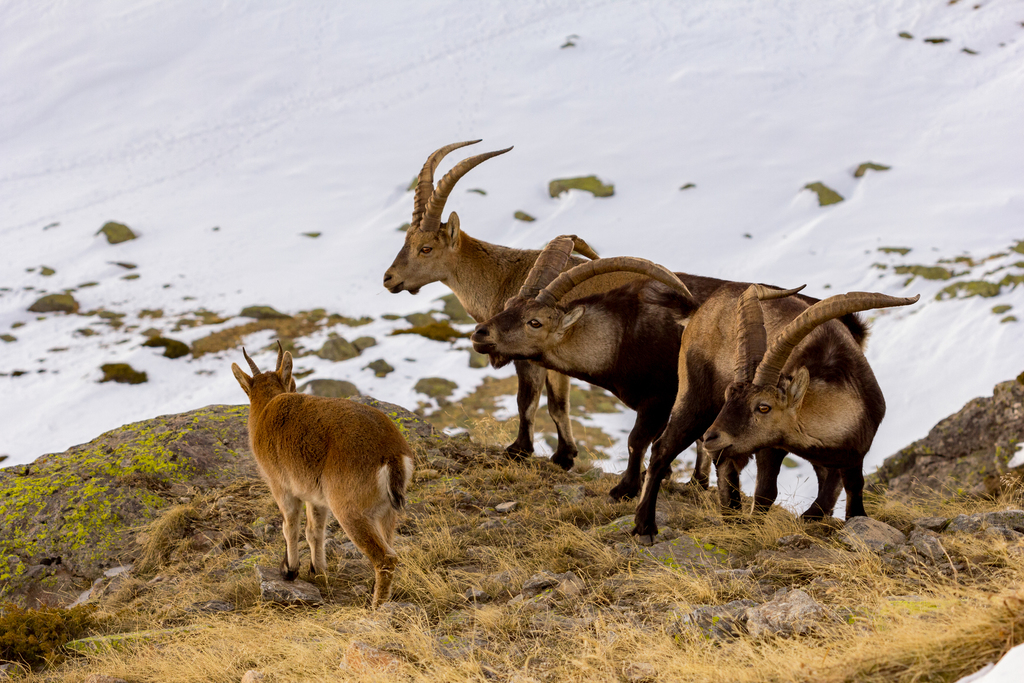
Iberian Ibex
Capra pyrenaica
The Iberian ibex (Capra pyrenaica), also known as the Spanish ibex, Spanish wild goat and Iberian wild goat, is a species of ibex endemic to the Iberian Peninsula. Four subspecies have been described; two are now extinct. The Portuguese ibex became extinct in 1892, and the Pyrenean ibex became extinct in 2000 and in 2003. A project to clone the Pyrenean ibex resulted in one clone being born alive in July 2003, making it the first taxon to become "un-extinct", although the clone died a few minutes after birth due to physical defects in its left lung.
From the article Iberian ibex on Wikipedia (CC BY-SA), quoted section by section
Description
The Iberian ibex is characterized by its large and flexible hooves and short legs. These physical adaptations allow it to run and leap on bare, rocky, rough and steep slopes out of reach of potential predators. The horns of the Iberian ibex curve out and up and then back, inward, and, depending on subspecies, either up again or down. The annual horn growth is influenced principally by age but can also be contributed by environmental factors and the growth made in the previous year. The Iberian ibex also shows sexual dimorphism, with the male being larger in size and weight and also having larger horns than the female. The bones of the female ibex ossify nearly two years before the bones of the male.
Wikipedia: “Characteristics”
Range & habitat
The Iberian ibex populates the Iberian Peninsula and consisted originally of four subspecies. However, with recent extinctions occurring within the last century, only two of the subspecies still exist. Both occur in Spain and in northern Portugal, as well a small reintroduced population in the French Pyrenees. It has been extirpated from Gibraltar and possibly Andorra.
Wikipedia: “Distribution and habitat”
What it does
The Iberian ibex is generally a mixed feeder between a browser and a grazer, depending on the plant availability in their home range. Thus, the percentage of each type of resource that is consumed will vary altitudinally, geographically, and seasonally. The ibex also has a special mechanism in the kidney that stores fat in order to be used as energy during the cold winter times. The highest body storage of kidney fat can be found during the productive warm seasons and the lowest during the cold period. The body storage is characterized by the limited food resources. Foraging in ibexes is also different depending on the season. When food resources are low during the winter, ibexes would reduce their rates of movement when foraging. However, during the spring season, when food is more available, they would increase their rate of movement and become more mobile in finding food. This would be the ideal trend of movement since the spring season is more abundant in food resources meaning that there is more competition for food resources forcing some to trek farther in order to obtain food.
Wikipedia: “Diet”
Listen
Looking for field recordings…
Where it lives
Recorded sightings
—
geo-referenced records in GBIF, from museums, herbaria and field observers.
Drag the globe to turn it. Dots are where records exist, not a range map; darker means more records.
In the stacks
Searching the stacks…
Every page naming Capra pyrenaica in the Biodiversity Heritage Library →
This page is assembled live from iNaturalist, GBIF, Wikipedia, the Source Library and the Internet Archive. It is not yet part of the hand-edited codex. iNaturalist taxon 42350.