- Animals
- ›Chordates
- ›Vertebrates
- ›Mammals
- ›Therians
- ›Placental Mammals
- ›Ungulates, Carnivorans, and Allies
- ›Even-toed Ungulates and Cetaceans
- ›Ruminants
- ›Bovids
- ›Antelopes, Goats, and Sheep
- ›Typical Antelopes
- ›Madoqua
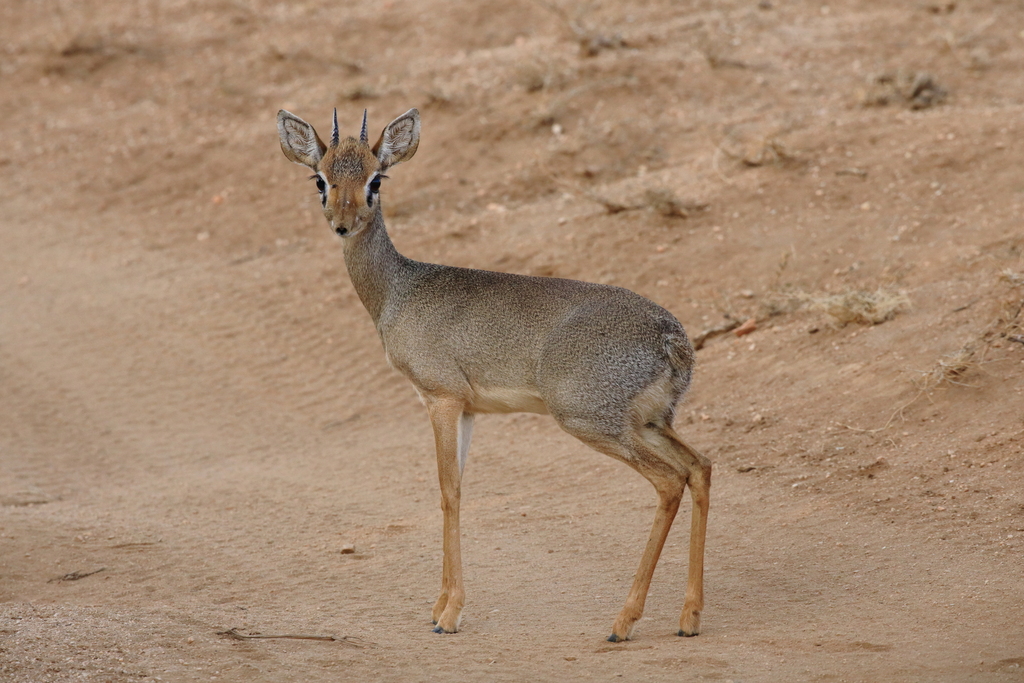
Kirk's Dik-dik
Madoqua kirkii
Kirk's dik-dik (Madoqua kirkii) is a species of small dik-dik antelope native to Eastern and Southern Africa. It is believed to have six subspecies and possibly a seventh existing in southwest Africa. Dik-diks are herbivores, typically of a fawn color that aids in camouflaging themselves in savannah habitats. It is also capable of reaching speeds up to 42 km/h (26 mph). The lifespan of Kirk's dik-dik in the wild is typically 5 years, but may surpass 10 years. In captivity, males have been known to live up to 16.5 years, while females have lived up to 18.4 years.
From the article Kirk's dik-dik on Wikipedia (CC BY-SA), quoted section by section
Range & habitat
Kirk's dik-diks are endemic to savannah areas of eastern and southwestern Africa, occurring primarily in the Somali and Southwest arid biotic zones, but encroaching into the Southern savannah biotic zone. Their distribution can be described as discontinuous and as a result they often occur in dispersed patches due to their unique habitat requirements. In Namibia, Kirk's dik-diks occur in isolated areas along the Fish River and do not reside in the Namib desert, though they may traverse desert thickets along sources of water. They prefer habitats with good cover but lacking tall vegetation. Ideal habitats contain a variety of browse, extensive shade, and an open understory at their eye level. (Tinley, 1969) As a result, they move to different ranges when grass grows too high and obstructs their view. Typical habitats of Kirk's dik-dik consist of thicket mosaics characterized by well-developed shrub layers and scant short grass cover. Dik-diks live in pairs on territories of 2–86 acres, depending on cover and resources. If no unfavorable events occur a pair of Kirk's dik-dik may reside within the same territory for life. Males are the main defenders of territories, as females are unable to maintain territories themselves. …
Wikipedia: “Habitat and territoriality”
What it does
Dik-diks are herbivorous and their diets consist mainly of foliage, fruits, shoots, and berries. Due to their adaptations, dik-diks are water-independent and rely on vegetation as a source of water. Kirk's dik-diks are concentrate selectors, feeding selectively on dicotyledonous plants that can be rapidly fermented and digested. This includes leaves and fruit high in nutrients and water, but low in fiber and cellulose. Grasses are only consumed when they are germinating and Kirk's dik-diks have stomach capacities and mass that consist of 8.5–10.0% of body mass when full and 2.2% when empty". Because of the aforementioned facts and their high food requirements, Kirk's dik-diks feed and ruminate periodically throughout day and night. They consume roughly 3.8% of their body mass daily.
Wikipedia: “Diet”
In human culture
The dik-dik's name is derived from its call. When they feel threatened, dik-diks lie low to prevent detection. If they are discovered, they run in a swift, zigzag-like pattern until they reach refuge in a nearby thicket. During this 'flight', they emit trumpet-like "zik-zik" calls to raise an alarm or to harass predators and publicize the presence of a mated pair. The species is named after a Scottish naturalist John Kirk, who collected the type specimen.
Wikipedia: “Etymology”
Listen
Looking for field recordings…
Where it lives
Recorded sightings
—
geo-referenced records in GBIF, from museums, herbaria and field observers.
Drag the globe to turn it. Dots are where records exist, not a range map; darker means more records.
In the stacks
Searching the stacks…
Every page naming Madoqua kirkii in the Biodiversity Heritage Library →
This page is assembled live from iNaturalist, GBIF, Wikipedia, the Source Library and the Internet Archive. It is not yet part of the hand-edited codex. iNaturalist taxon 42360.