- Animals
- ›Chordates
- ›Vertebrates
- ›Mammals
- ›Therians
- ›Placental Mammals
- ›Ungulates, Carnivorans, and Allies
- ›Even-toed Ungulates and Cetaceans
- ›Ruminants
- ›Bovids
- ›Antelopes, Goats, and Sheep
- ›Typical Antelopes
- ›Saiga
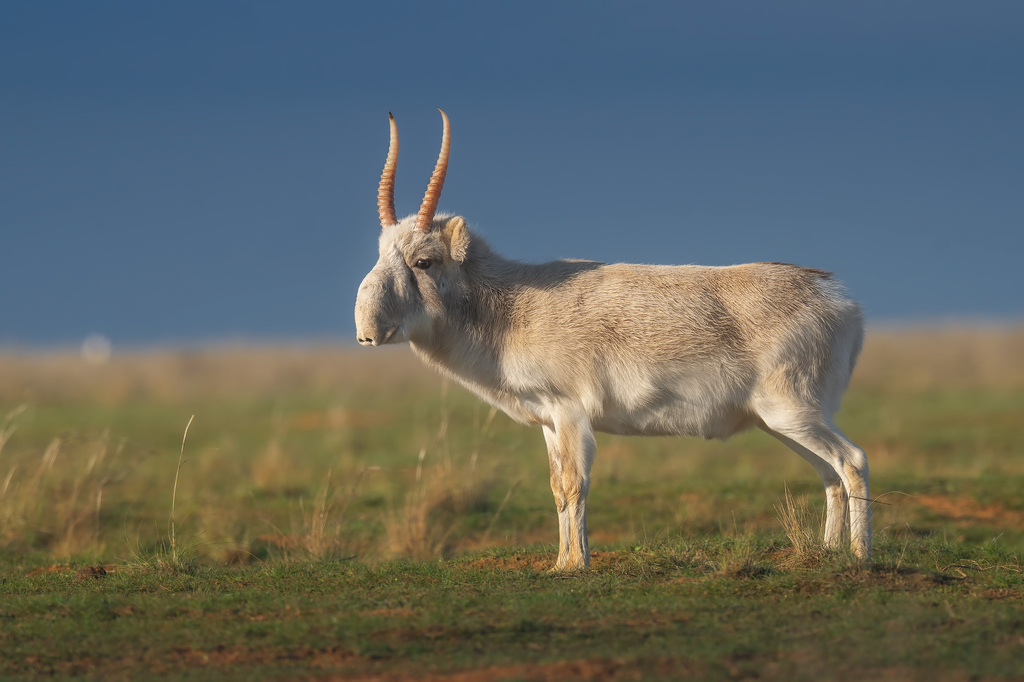
Saiga
Saiga tatarica
The saiga antelope (Saiga tatarica, ), or simply saiga, is a species of antelope which during antiquity inhabited a vast area of the Eurasian steppe, spanning the foothills of the Carpathian Mountains in the northwest and Caucasus in the southwest into Mongolia in the northeast and Dzungaria in the southeast. During the Pleistocene, it ranged across the mammoth steppe from the British Isles to Beringia. Today, the dominant subspecies (S. t. tatarica) only occurs in Kalmykia and Astrakhan Oblast of Russia and in the Ural Mountains, Ustyurt Plateau and Betpak-Dala regions of Kazakhstan. A portion of the Ustyurt population migrates south to Uzbekistan and occasionally to Turkmenistan in winter. It is regionally extinct in Romania, Ukraine, Moldova, China and southwestern Mongolia. The Mongolian subspecies (S. t. mongolica) occurs only in western Mongolia.
From the article Saiga antelope on Wikipedia (CC BY-SA), quoted section by section
Description
A prominent feature of the saiga is the pair of closely spaced, bloated nostrils directed downward. Other facial features include the proboscis, dark markings on the cheeks and the 7–12 cm (2.8–4.7 in) long ears. Its head-and-body length is typically between 100 and 140 cm (39 and 55 in) with a 6–12 cm (2.4–4.7 in) short tail, and it stands 61–81 cm (24–32 in) at the shoulder. It weighs 26–69 kg (57–152 lb). The coat shows seasonal changes. In summer, the coat appears yellow to red, fading toward the flanks. The Mongolian saiga can develop a sandy colour. The coat develops a pale, grayish-brown colour in winter, with a hint of brown on the belly and the neck. The ventral parts are generally white. The hair is 18–30 mm (0.71–1.18 in) long in summer and can grow up to 40–70 mm (1.6–2.8 in) in winter. This forms a 12 to 15 cm (4.7 to 5.9 in) long mane on the neck. Two distinct moults occur, one in spring from April to May and another in autumn from late September or early October to late November or early December. Only males have horns, which are thick and slightly translucent, wax-coloured and show 12 to 20 pronounced rings. With a base diameter of 25–33 mm (0.98–1.30 in), the horns of the Russian saiga measure 28–38 cm (11–15 in) in length; the horns of the Mongolian saiga reach a maximum length of 22 cm (8.7 in).
Wikipedia: “Characteristics”
Range & habitat
The saiga was not present in Europe during the Last Interglacial (130–115,000 years ago). During the last glacial period (115,000–11,700 years ago), it ranged from the British Isles through Central Asia and the Bering Strait into Alaska and Canada's Yukon and Northwest Territories. By the classical age, they were apparently considered a characteristic animal of Scythia, judging from the historian Strabo's description of an animal called the kolos that was "between the deer and ram in size" and was wrongly believed to drink through its nose. Considerable evidence shows the importance of the antelope to Andronovo culture settlements. Illustrations of saiga antelopes can be found among the cave paintings that were dated back to seventh to fifth century BC. Moreover, saiga bones were found among the remains of other wild animals near the human settlements. The fragmented information shows an abundance of saigas on the territory of modern Kazakhstan in the 14th–16th centuries. The migratory routes ranged throughout the country's area, especially the region between the Volga and Ural Rivers was heavily populated. The population's size remained high until the second half of the 19th century, when excessive horn export began. The high price and demand for horns drove radical hunting. The number of animals decreased in all regions and the migratory routes shifted southward. …
Wikipedia: “Former range”
What it does
Saigas form very large herds that graze in semideserts, steppes, grasslands, and possibly open woodlands, eating several species of plants, including some that are poisonous to other animals. They can cover long distances and swim across rivers, but they avoid steep or rugged areas. The mating season starts in November, when stags fight for the acceptance of females. The winner leads a herd of five to ten, occasionally up to 50 females. In springtime, mothers come together en masse to give birth.
Saigas, like the Mongolian gazelles, are known for their extensive migrations across the steppes that allow them to escape natural calamities. Saigas are highly vulnerable to wolves. Juveniles are targeted by foxes, steppe eagles, golden eagles and ravens.
Wikipedia: “Ecology and behaviour”
Listen
Looking for field recordings…
Where it lives
Recorded sightings
—
geo-referenced records in GBIF, from museums, herbaria and field observers.
Drag the globe to turn it. Dots are where records exist, not a range map; darker means more records.
In the stacks
Searching the stacks…
Every page naming Saiga tatarica in the Biodiversity Heritage Library →
This page is assembled live from iNaturalist, GBIF, Wikipedia, the Source Library and the Internet Archive. It is not yet part of the hand-edited codex. iNaturalist taxon 42378.