On eBird ↗
Madagascar Grebe
Live sightings near you, the range map, bar charts of when it is seen, and Macaulay Library photos and recordings.
Madagascar Grebe
Tachybaptus pelzelnii
The Madagascan grebe (Tachybaptus pelzelnii) is a grebe found only in western and central Madagascar. The binomial name commemorates the Austrian ornithologist August von Pelzeln. It is classified as Vulnerable by the IUCN, with a population of less than 5,000. It is threatened by habitat loss, predation by carnivorous fish, and competition with introduced species.
From the article Madagascar grebe on Wikipedia (CC BY-SA), quoted section by section
Description
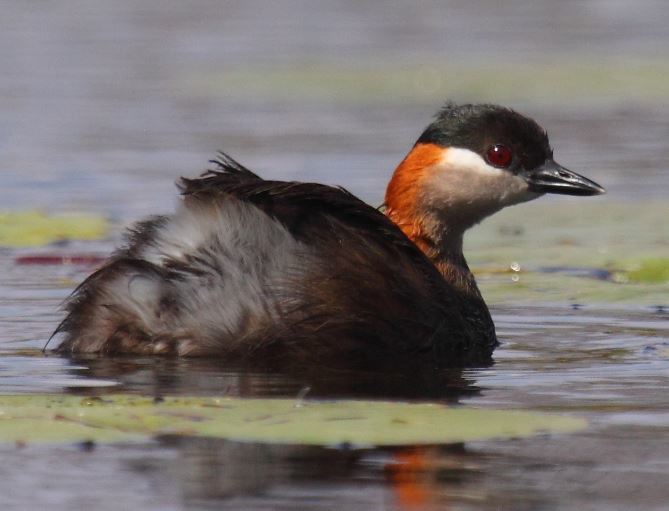
The Madagascar grebe is around 25 cm long. It can be identified in its breeding plumage, consisting of a blackish cap and line down the neck, often reddish rear ear-coverts and sides of the neck, pale grey cheeks, throat and foreneck. Some individuals have a narrow whitish line under the eye between the cap and ear-coverts.
Range & habitat
The species is widespread throughout western and central Madagascar. Pairs can commonly be found near lakes. Surveys in the late 1990s recorded the species at 25 'Important Bird Areas' distributed throughout Madagascar, but it is suspected to be undergoing rapid declines. Numbers on Lake Alaotra have plummeted: in 1985 several hundred individuals were recorded, only 10–20 in 1993, and none in 1999. The forested lakes of the northwest plateau may harbour 100-200 individuals. The current total population may number as few as 1,500-2,500 individuals. T. pelzelnii appears to prefer shallow, freshwater lakes and pools, with a dense covering of lily-pads, but it has also been found in several much deeper lakes. Has occasionally been seen near brackish waters and slow-flowing rivers.
Wikipedia: “Distribution and habitat”
What it does
The Madagascar grebe probably feeds mostly on insects, but is also known to take small fish and crustaceans. It is generally sedentary, but will move in search of more suitable habitat. The breeding season may span the months of August to March. Although breeding pairs are typically territorial, communally nesting groups of 150 individuals have been recorded. Nests are built on a floating structure of aquatic plants, anchored to offshore vegetation, normally waterlilies.
Wikipedia: “Ecology”
Listen
Looking for field recordings…
Where it lives
Recorded sightings
—
geo-referenced records in GBIF, from museums, herbaria and field observers.
Drag the globe to turn it. Dots are where records exist, not a range map; darker means more records.
In the stacks
Searching the stacks…
Every page naming Tachybaptus pelzelnii in the Biodiversity Heritage Library →
This page is assembled live from iNaturalist, GBIF, Wikipedia, the Source Library and the Internet Archive. It is not yet part of the hand-edited codex. iNaturalist taxon 4238.