- Animals
- ›Chordates
- ›Vertebrates
- ›Mammals
- ›Therians
- ›Placental Mammals
- ›Ungulates, Carnivorans, and Allies
- ›Even-toed Ungulates and Cetaceans
- ›Ruminants
- ›Bovids
- ›Antelopes, Goats, and Sheep
- ›Alcelaphines
- ›Alcelaphus
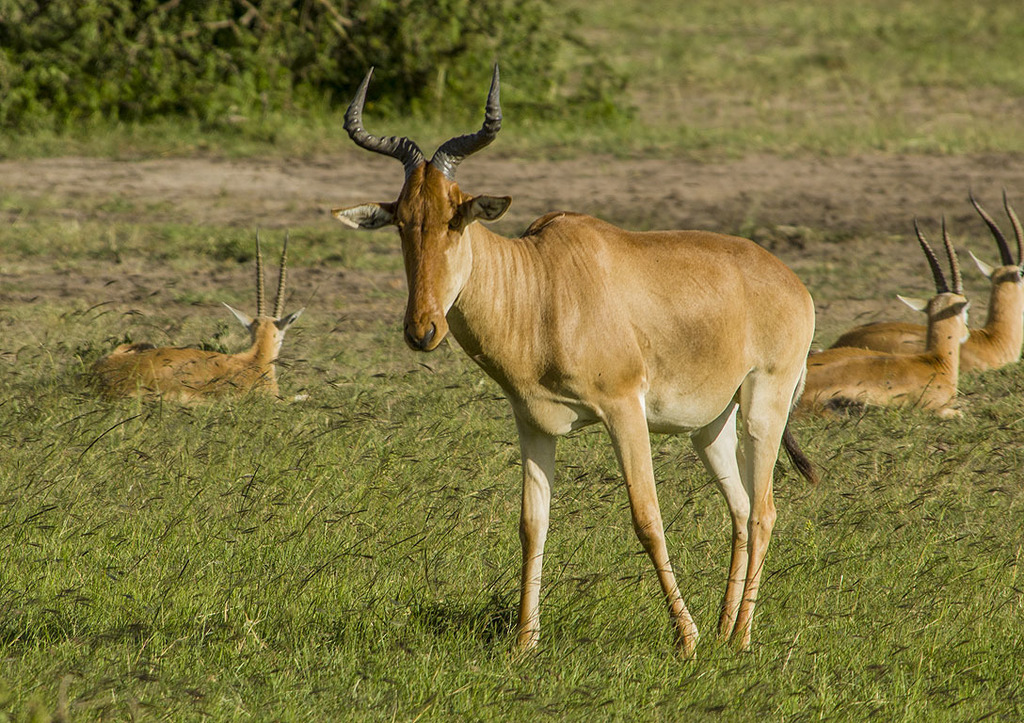
Hartebeest
Alcelaphus buselaphus
The hartebeest (; Alcelaphus buselaphus), also known as kongoni or kaama, is an African antelope. It is the only member of the genus Alcelaphus. Eight subspecies have been described, including two sometimes considered to be independent species. A large antelope, the hartebeest stands just over 1 m (3 ft 3 in) at the shoulder, and has a typical head-and-body length of 2 to 2.50 m (6 ft 7 in to 8 ft 2 in). The weight ranges from 100 to 200 kg (220 to 440 lb). It has a particularly elongated forehead and oddly-shaped horns, a short neck, and pointed ears. Its legs, which often have black markings, are unusually long. The coat is generally short and shiny. Coat colour varies by the subspecies, from the sandy brown of the western hartebeest to the chocolate brown of the Swayne's hartebeest. Both sexes of all subspecies have horns, with those of females being slenderer. Horns can reach lengths of 45–70 cm (18–28 in). Apart from its long face, the large chest and the sharply sloping back differentiate the hartebeest from other antelopes. A conspicuous hump over the shoulders is due to the long dorsal processes of the vertebrae in this region.
Gregarious animals, hartebeest form herds of 20 to 300 individuals. They are very alert and non-aggressive. They are primarily grazers, with their diets consisting mainly of grasses. Mating in hartebeest takes place throughout the year with one or two peaks, and depends upon the subspecies and local factors. Both males and females reach sexual maturity at one to two years of age.
From the article Hartebeest on Wikipedia (CC BY-SA), quoted section by section
Description
A large antelope with a particularly elongated forehead and oddly shaped horns, the hartebeest stands just over 1 m (3 ft 3 in) at the shoulder, and has a typical head-and-body length of 2 to 2.5 m (6 ft 7 in to 8 ft 2 in). The weight ranges from 100 to 200 kg (220 to 440 lb). The tail, 40 to 60 cm (16 to 24 in) long, ends in a black tuft. The other distinctive features of the hartebeest are its long legs (often with black markings), short neck, and pointed ears. A study correlated the size of hartebeest species to habitat productivity and rainfall. The western hartebeest is the largest subspecies, and has a characteristic white line between the eyes. The red hartebeest is also large, with a black forehead and a contrasting light band between the eyes. The large Lelwel hartebeest has dark stripes on the front of its legs. Coke's hartebeest is moderately large, with a shorter forehead and longer tail in comparison to the other subspecies. Lichtenstein's hartebeest is smaller, with dark stripes on the front of the legs, as in the Lelwel hartebeest. The Swayne's hartebeest is smaller than the Tora hartebeest, but both have a shorter forehead and similar appearance. Generally short and shiny, the coat varies in colour according to subspecies. The western hartebeest is a pale sandy-brown, but the front of the legs are darker. The red hartebeest is a reddish-brown, with a dark face. …
Range & habitat
Hartebeest inhabit dry savannas, open plains and wooded grasslands, often moving into more arid places after rainfall. They are more tolerant of wooded areas than other Alcelaphini, and are often found on the edge of woodlands. They have been reported from altitudes on Mount Kenya up to 4,000 m (13,000 ft). The red hartebeest is known to move across large areas, and females roam home ranges of over 1,000 km2 (390 sq mi), with male territories 200 km2 (77 sq mi) in size. Females in the Nairobi National Park (Kenya) have individual home ranges stretching over 3.7–5.5 km2 (1+3⁄8–2+1⁄8 sq mi), which are not particularly associated with any one female group. Average female home ranges are large enough to include 20 to 30 male territories.
Wikipedia: “Habitat”
What it does
Active mainly during daytime, the hartebeest grazes in the early morning and late afternoon, and rests in shade around noon. Gregarious, the species forms herds of up to 300 individuals. Larger numbers gather in places with abundant grass. In 1963, a congregation of 10,000 animals was recorded on the plains near Sekoma Pan in Botswana. However, moving herds are not so cohesive, and tend to disperse frequently. The members of a herd can be divided into four groups: territorial adult males, non-territorial adult males, young males, and the females with their young. The females form groups of five to 12 animals, with four generations of young in the group. Females fight for dominance over the herd. Sparring between males and females is common. At three or four years of age, the males can attempt to take over a territory and its female members. A resident male defends his territory and will fight if provoked. The male marks the border of his territory through defecation.
Hartebeest are remarkably alert and cautious animals with highly developed brains. Generally calm in nature, hartebeest can be ferocious when provoked. While feeding, one individual stays on the lookout for danger, often standing on a termite mound to see farther. At times of danger, the whole herd flees in a single file after an individual suddenly starts off. …
Wikipedia: “Ecology and behaviour”
In human culture
The vernacular name "hartebeest" may have originated from the obsolete Dutch word hertebeest, literally deer beast, based on the resemblance (to early Dutch settlers) of the antelope to deer. The first use of the word "hartebeest" in South African literature was in Dutch colonial administrator Jan van Riebeeck's journal Daghregister in 1660. He wrote: "Meester Pieter ein hart-beest geschooten hadde (Master Pieter [van Meerhoff] had shot one hartebeest)". Another name for the hartebeest is kongoni, a Swahili word. Kongoni is often used to refer in particular to one of its subspecies, Coke's hartebeest.
Wikipedia: “Etymology”
Listen
Looking for field recordings…
Where it lives
Recorded sightings
—
geo-referenced records in GBIF, from museums, herbaria and field observers.
Drag the globe to turn it. Dots are where records exist, not a range map; darker means more records.
In the stacks
Searching the stacks…
Every page naming Alcelaphus buselaphus in the Biodiversity Heritage Library →
This page is assembled live from iNaturalist, GBIF, Wikipedia, the Source Library and the Internet Archive. It is not yet part of the hand-edited codex. iNaturalist taxon 42418.