- Animals
- ›Chordates
- ›Vertebrates
- ›Mammals
- ›Therians
- ›Placental Mammals
- ›Ungulates, Carnivorans, and Allies
- ›Even-toed Ungulates and Cetaceans
- ›Ruminants
- ›Bovids
- ›Antelopes, Goats, and Sheep
- ›Goats and Sheep
- ›Ammotragus
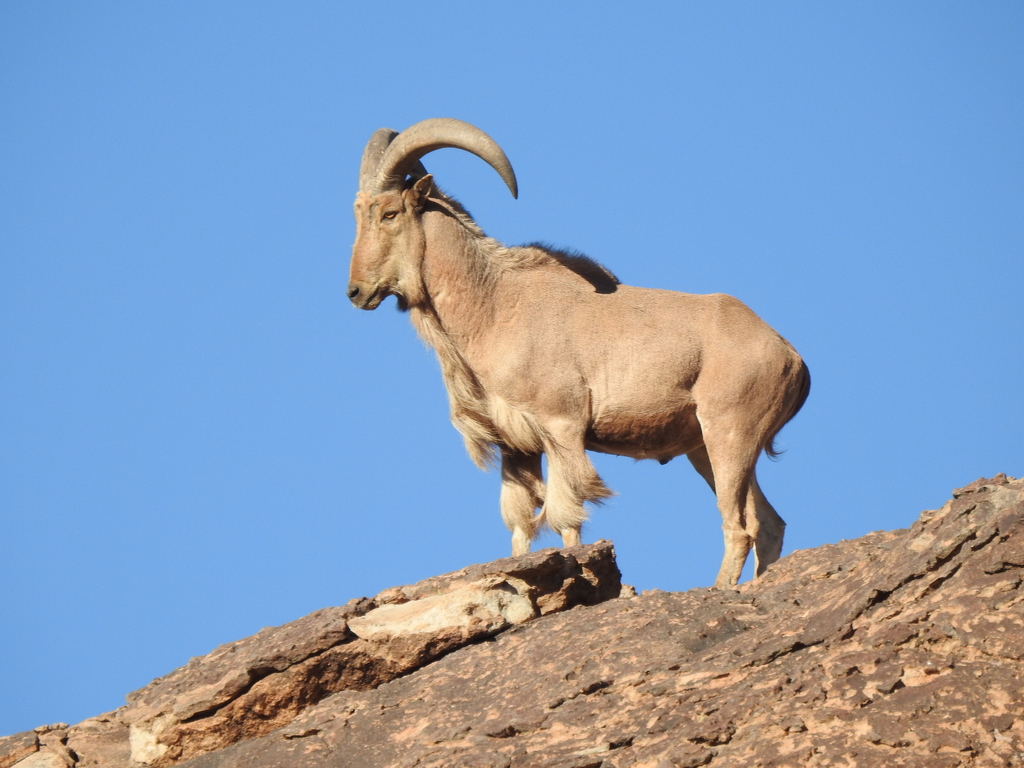
Aoudad
Ammotragus lervia
The Barbary sheep (Ammotragus lervia), also known as aoudad (pronounced [ˈɑʊdæd]), is a species of caprine native to rocky mountains in North Africa and parts of West Africa. While this is the only species in genus Ammotragus, six subspecies have been described. Although it is rare in its native North Africa, it has been introduced to North America, southern Europe, and elsewhere. It is also known in Berber languages as waddan or arwi, and in former French territories as the mouflon.
From the article Barbary sheep on Wikipedia (CC BY-SA), quoted section by section
Description
Barbary sheep stand 75 to 110 cm (2 ft 6 in to 3 ft 7 in) tall at the shoulder, with a length around 1.5 m (5 ft), and weigh 30 to 145 kg (66 to 320 lb). They are sandy-brown, darkening with age, with a slightly lighter underbelly and a darker line along the back. Upper parts and the outer parts of the legs are a uniform reddish- or grayish-brown. Some shaggy hair is on the throat (extending down to the chest in males) with a sparse mane. Their horns have a triangular cross-section. The horns curve outward, backward, then inward, and can exceed 76 cm (30 in) in length. The horns are fairly smooth, with slight wrinkles evident at the base as the animal matures.
Range & habitat
Barbary sheep are endemic to regions of Northern Africa primarily surrounding the barren center of the Sahara. Countries and territories where aoudad may be found include Algeria, Chad (north), Egypt, Libya, Mali (north), Mauritania, Morocco, Niger, Tunisia and Western Sahara. West of the Nile, they can be found in Sudan; east of the Nile, in the Red Sea Hills. The now-extinct Ancient Egyptian corkscrew-horned sheep (Ovis longipes palaeoaegyptiacus) was also thought to be a subspecies of wild barbary sheep. Populations within its native range have been decreasing due to hunting, legal and otherwise, and destruction of habitat.
Wikipedia: “Natural range”
Listen
Looking for field recordings…
Where it lives
Recorded sightings
—
geo-referenced records in GBIF, from museums, herbaria and field observers.
Drag the globe to turn it. Dots are where records exist, not a range map; darker means more records.
In the stacks
Searching the stacks…
Every page naming Ammotragus lervia in the Biodiversity Heritage Library →
This page is assembled live from iNaturalist, GBIF, Wikipedia, the Source Library and the Internet Archive. It is not yet part of the hand-edited codex. iNaturalist taxon 42422.