On eBird ↗
Atitlan Grebe
Live sightings near you, the range map, bar charts of when it is seen, and Macaulay Library photos and recordings.
Atitlán Grebe
Podilymbus gigas
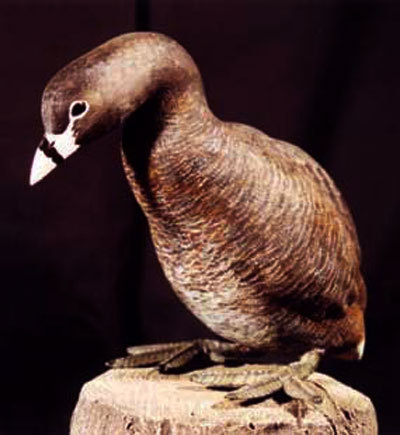
The Atitlán grebe (Podilymbus gigas), also known as the giant grebe, giant pied-billed grebe or poc, is an extinct species of grebe that was endemic to Lago de Atitlán in Guatemala. Closely related to the pied-billed grebe, it inhabited the lake at an elevation of 1,700 m (5,600 ft). The species was described in 1929 by Ludlow Griscom from a specimen collected in 1926. American ecologist Anne LaBastille documented its population decline over a period of 25 years. The Atitlán grebe was declared extinct by 1990.
From the article Atitlán grebe on Wikipedia (CC BY-SA), quoted section by section
Description
The Atitlán grebe measured approximately 46–50 cm (18–20 in) in length. Its appearance and vocalizations were similar to those of the much smaller pied-billed grebe. It had a large, pied bill with coloration that varied seasonally, appearing white in spring and brown during other seasons. The plumage was predominantly dark brown, with white-flecked flanks and grey ear coverts. The underparts were dark grey with white flecking while the head was nearly black. During spring, the neck was glossy and flecked with dark brown, becoming flecked with white in winter. The legs were slaty grey and the bill had a prominent black vertical band across its middle. The irises were brown. The species had relatively small wings and was flightless.
What it does
The Atitlán grebe laid a clutch of four to five white eggs. Both parents participated in rearing the hatchlings.
Wikipedia: “Reproduction”
Listen
Looking for field recordings…
Where it lives
Recorded sightings
—
geo-referenced records in GBIF, from museums, herbaria and field observers.
Drag the globe to turn it. Dots are where records exist, not a range map; darker means more records.
In the stacks
Searching the stacks…
Every page naming Podilymbus gigas in the Biodiversity Heritage Library →
This page is assembled live from iNaturalist, GBIF, Wikipedia, the Source Library and the Internet Archive. It is not yet part of the hand-edited codex. iNaturalist taxon 4248.