- Animals
- ›Chordates
- ›Vertebrates
- ›Reptiles
- ›Snakes and Lizards
- ›Lizards
- ›Wall lizards, amphisbaenians, and allies
- ›Wall Lizards
- ›Lacertinae
- ›Podarcis
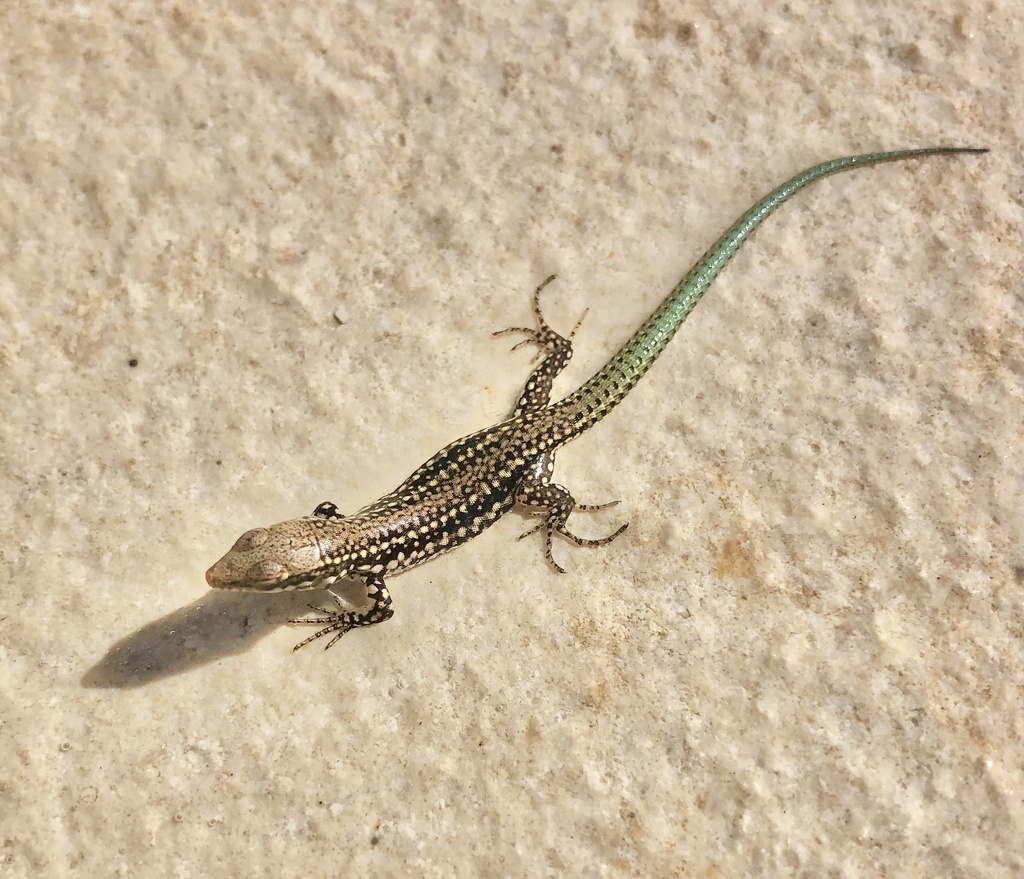
Green Iberian Wall Lizard
Podarcis virescens
Podarcis virescens, or Geniez's wall lizard, is a lizard of the Lacertidae family. Podarcis virescens is commonly found in the Iberian Peninsula, including Spain and Portugal.
From the article Podarcis virescens on Wikipedia (CC BY-SA), quoted section by section
Description
Podarcis virescens is a lizard species of a moderate size, although it can be significantly larger than other lizards in the Podarcis genus, such as Podarcis carbonelli. Podarcis virescens vary significantly in colour, with individuals ranging from white to brown or black. Individuals, particularly males, may change colour to green during the spring, which then disappears in the summer. The underside of the lizard is more yellow than other parts of its body. Podarcis virescens is robust and not flattened compared to other lizard species. Males and females are of around the same size, between 40 mm and 63 mm. Podarcis virescens is considered a robust lizard due to its build. Podarcis lizards vary greatly in colour and build, so Podarcis virescens does not completely share appearance traits with other species of the same genus. This was likely caused by increased diversification in the history of Podarcis lizards, especially during the time period preceding and around the Zanclean flood.
Range & habitat
Podarcis virescens is commonly found in the Iberian Peninsula, including Spain and Portugal, most commonly in the Central and Southern regions of the Iberian Peninsula. However, the lizard is not commonly found in the most southern and eastern portions of Spain. Podarcis virescens can be found near cities and villages including Santa Maria da Feira, in Portugal, and Villanueva de los Escuderos, in Spain. The lizard can sometimes be found near rivers or mountains, although the lizard's habitat can vary greatly and includes human-inhabited areas around cities. Examples of Podarcis virescens sightings include cultivated plains and human roads surrounding Spanish and Portuguese cities.
Urban habitats. As the native habitat of Podarcis virescens in the Iberian Peninsula has become more urbanized by humans, they have adapted to the urban environment and inhabit areas where humans are present such as human gardens. In addition to living on natural ground and rocky areas, Podarcis virescens lizards have adapted to live on artificial structures such as roads, bridges, and buildings. However, when introduced into a new area such as a garden, they are not very likely to spread out far from the location at which they were introduced. This means that the spread of the Podarcis virescens lizard to adapt to new locations may be slow.
Wikipedia: “Habitat and distribution”
What it does
Like most similar lizards, Podarcis virescens mainly rely on small arthropods for food. This includes Coleoptera, Homoptera, and Araneae arthropods. In some cases, cannibalism or preying on similar lizards has been found and documented in similar lizards. Several cases of cannibalism with other Podarcis lizards, like Podarcis atrata, eating eggs and juveniles has been observed. One case of Podarcis virescens preying on Podarcis carbonelli has been observed in Portugal. These cases are predicted to involve high density areas of lizards with low resources resulting in cannibalism. With the Podarcis virescens case, it is possible that the Podarcis virescens was significantly larger than the Podarcis carbonelli lizard as Podarcis virescens lizards are generally larger in size.
Wikipedia: “Diet”
In human culture
Around 20 Mya, Podarcis lizards, also known as wall lizards, began to arise in the Mediterranean region. From 20 Mya to 11 Mya, Podarcis lizards likely expanded to the Iberian Peninsula and other parts of Europe. Approximately 5.3 Mya, the Zanclean Flood ended the Messinan salinity crisis, which led to increased diversification in lizard species, including Podarcis lizards. These genetic changes formed the Podarcis lizard species found today, one of which is Podarcis virescens. Due to the immense diversification during this time, an accurate family tree for Podarcis lizards has been difficult to construct. The exact taxonomy of Podarcis virescens is still being investigated as of 2020. Podarcis virescens was accepted as a species by the Taxonomic Committee of the Societas Europaea Herpetologica in 2020 after a series of studies on the Podarcis genus of lizards. Previously, Podarcis hispanicus included similar Podarcis lizards, including Podarcis virescens and Podarcis guadarramae. After genetic and morphological studies, it was found that there were enough molecular and morphological differences to establish Podarcis virescens as its own species. These species are fairly similar as they all inhabit slightly different regions of the Iberian Peninsula and share other traits such as their appearance and behavior. …
Wikipedia: “History and taxonomy”
Where it lives
Recorded sightings
—
geo-referenced records in GBIF, from museums, herbaria and field observers.
Drag the globe to turn it. Dots are where records exist, not a range map; darker means more records.
In the stacks
Searching the stacks…
Every page naming Podarcis virescens in the Biodiversity Heritage Library →
This page is assembled live from iNaturalist, GBIF, Wikipedia, the Source Library and the Internet Archive. It is not yet part of the hand-edited codex. iNaturalist taxon 424860.