- Animals
- ›Chordates
- ›Vertebrates
- ›Ray-finned Fishes
- ›Spiny-rayed fishes
- ›Gobies, cardinalfishes and allies
- ›Gobies and allies
- ›Gobies
- ›Sea Gobies
- ›Trimma
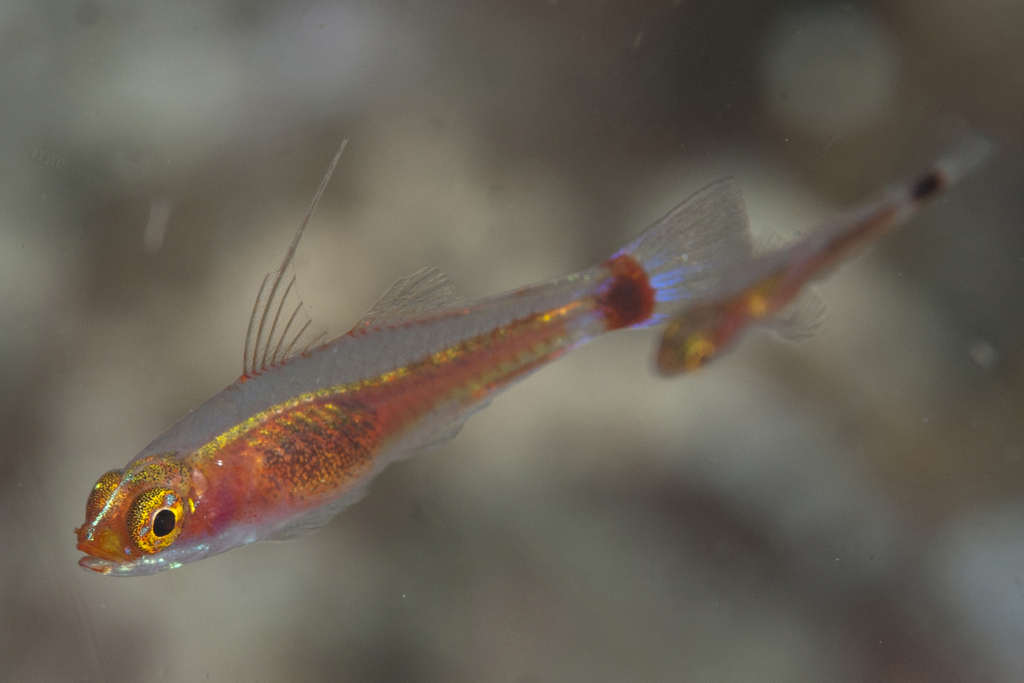
Nasal Pygmygoby
Trimma nasa
Trimma nasa, commonly called the nasal dwarfgoby or nasal pygmy goby, is a species of goby from the Western Pacific. They are small fish, averaging at around 2 cm (0.79 in) in length. They are bright orange and transparent yellow in life, with a white stripe running down from between the eyes to the upper lip and a dark brown spot at the base of the tail fin. They are usually found in large schools in the sloping or vertical drop-offs at coral reef edges.
From the article Trimma nasa on Wikipedia (CC BY-SA), quoted section by section
Description
Like other dwarfgobies, the nasal dwarfgoby are typically very small fish. Maximum recorded lengths are 2.3 cm (0.91 in) for males, and 2 cm (0.79 in) for females. The space between the two eyes (interorbital) is about the same width as the eyeballs. The dorsal (back) fin has seven spines and eight soft rays. The anal fin has one spine and seven to nine soft rays. The fifth and usually fourth ray of the pelvic fin branches into two. The caudal (tail) fin is squarish (truncate) in shape. Two rows of scales are present in front of the pelvic fin. Scales are absent on the cheeks. In life, the body is transparent yellow with bright orange abdominal cavity lining and iridescent blue and green highlights on the fins. There is a large dark brown spot at the base of the tail fin. There is usually a thin white stripe (dark in preserved specimens) on the snout, running from the upper lip to the area between the eyes. It overlies a rounded hump, also from the upper lip to just before the eye orbits. This is the source of their specific name, since it resembles the projecting bar of medieval nasal helmets.
Range & habitat
Nasal dwarfgobies can be found in the Western Pacific coral reefs usually at depths of 0 to 20 m (0 to 66 ft), though they have been known to reach 41 m (135 ft) below the water's surface. They have been recorded in Australia (including the Great Barrier Reef), Fiji, Indonesia, New Caledonia, Palau, Papua New Guinea, the Philippines, the Solomon Islands, and Vanuatu.
Wikipedia: “Distribution”
What it does
Nasal dwarfgobies generally congregate in large, loose schools near coral reef drop-offs pockmarked by caves or recesses. They may school together with related species like the blue-striped cave goby (Trimma tevegae). They usually orient themselves vertically with their heads facing upwards along the coral reef wall and presumably feed on zooplankton traveling down the water column. When threatened they will quickly retreat inside hiding places. Nasal dwarfgobies are very short-lived. The maximum recorded age is only 87 days. Of this, around 34 days are spent as pelagic larvae which is 39% of the total lifespan (in contrast to less than 1% for the vast majority of other reef fish species). They have high mortality rates, averaging at 4.7% per day. Their mating behavior has not been studied, but females are usually larger than males and more numerous (at a ratio of 1 male per 1.6 females). Since no specimens with intermediate gonad morphologies have been collected thus far, it is likely that they are not hermaphroditic as some other goby species are. They have also been observed sheltering in the tentacles of the giant reef corallimorph (Paracorynactis hoplites), with no apparent adverse effects from the stinging cells.
Wikipedia: “Ecology”
Where it lives
Recorded sightings
—
geo-referenced records in GBIF, from museums, herbaria and field observers.
Drag the globe to turn it. Dots are where records exist, not a range map; darker means more records.
In the stacks
Searching the stacks…
Every page naming Trimma nasa in the Biodiversity Heritage Library →
This page is assembled live from iNaturalist, GBIF, Wikipedia, the Source Library and the Internet Archive. It is not yet part of the hand-edited codex. iNaturalist taxon 424868.