- Animals
- ›Chordates
- ›Vertebrates
- ›Mammals
- ›Therians
- ›Placental Mammals
- ›Afromammals
- ›Golden Moles and Tenrecs
- ›Golden Moles
- ›Golden Moles
- ›Chrysochlorinae
- ›Chrysospalax
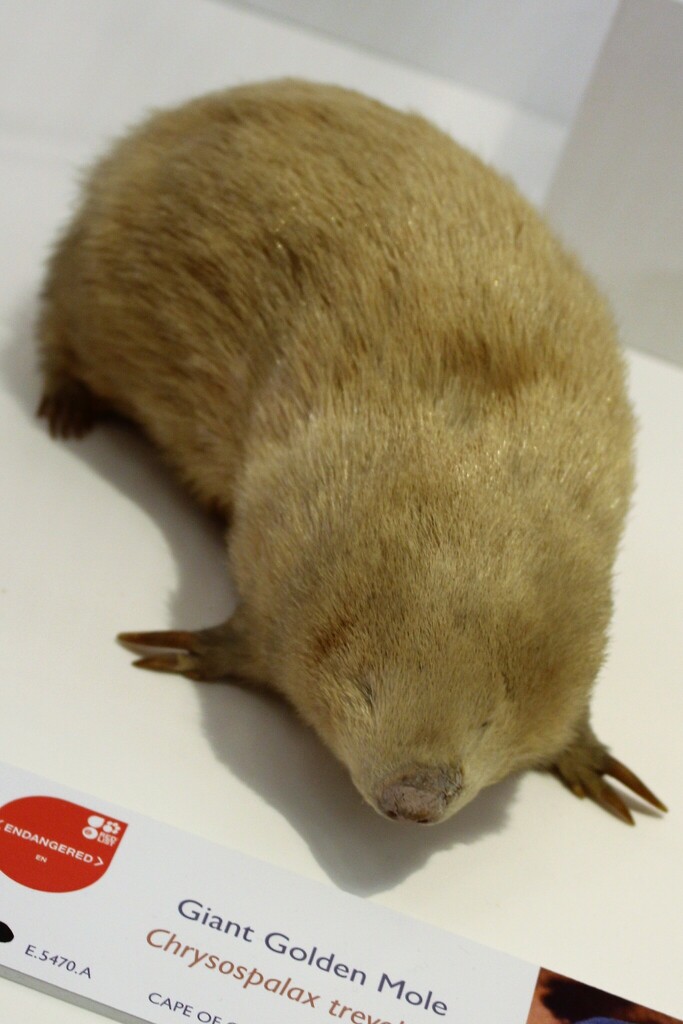
Giant Golden Mole
Chrysospalax trevelyani
Giant Golden mole, a small mammal found in Africa. The Giant Golden Mole is classified in Chrysochloridae family (Chrysospalax trevelyani), it is 23 centimetres in length, the largest of the Golden Mole species. The Giant Golden Mole has dark, glossy brown fur, different to their name, ‘golden’ comes from green-gold Greek word of Chrysochloridae, the family name.
From the article Giant golden mole on Wikipedia (CC BY-SA), quoted section by section
Description
The giant golden mole has a subterranean lifestyle. It has large claws around 17 millimetres (0.67 in) long and 7 millimetres (0.28 in) across the base, powerful forelimbs, no external tail or ears, wedge-shaped head, leather pad, and skin covering the eyes. It is approximately 208–235 millimetres (8.2–9.3 in) in length and 410–500 grams (14–18 oz) in weight. Its skin is dark and brown on the upper parts and faded on the underparts, sometimes with a darker line down the mid-throat. Its coloration is slightly darker on the head, with two dull yellow patches where the eyes would be, and a yellow patch around the ear openings. Its hair is longer and coarser than any other species of golden mole: about 20 millimetres (0.79 in) long, thick, with dense, woolly underfur.
Wikipedia: “Characteristics”
Range & habitat
The giant golden mole is a subterranean small mammal, living in chambers and passages underneath a very specific habitat, forests with soft soil, deep leaf litter layers, and well-developed undergrowth. The giant golden mole is endemic to South Africa, mostly in a restricted area in the Eastern Cape.
Wikipedia: “Habitat”
What it does
The giant golden mole digs semi-permanent tunnels about 10 metres (33 ft) in length linked by surface runways for hunting food and may feed on the surface hiding in the leaf litter. It eats mainly millipedes and giant earthworms, but also crickets, cockroaches, grasshoppers, worms, and snails.
Wikipedia: “Diet”
Listen
Looking for field recordings…
Where it lives
Recorded sightings
—
geo-referenced records in GBIF, from museums, herbaria and field observers.
Drag the globe to turn it. Dots are where records exist, not a range map; darker means more records.
In the stacks
Searching the stacks…
Every page naming Chrysospalax trevelyani in the Biodiversity Heritage Library →
This page is assembled live from iNaturalist, GBIF, Wikipedia, the Source Library and the Internet Archive. It is not yet part of the hand-edited codex. iNaturalist taxon 42500.