- Animals
- ›Chordates
- ›Vertebrates
- ›Mammals
- ›Therians
- ›Placental Mammals
- ›Afromammals
- ›Golden Moles and Tenrecs
- ›Golden Moles
- ›Golden Moles
- ›Chrysochlorinae
- ›Eremitalpa
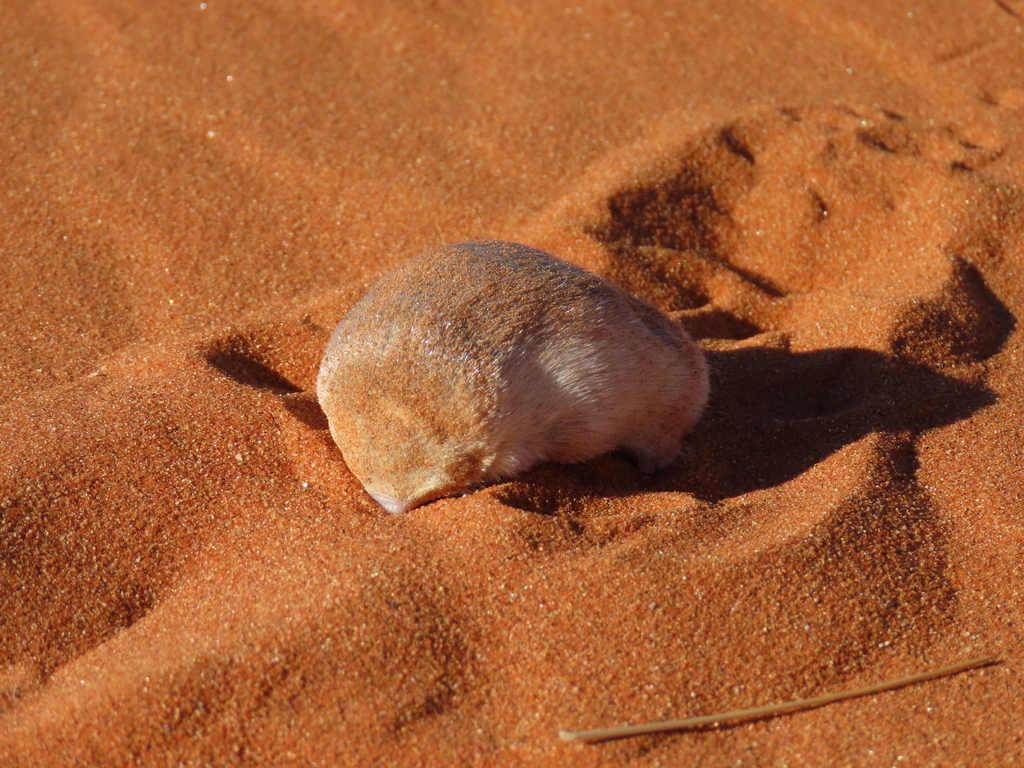
Grant's Golden Mole
Eremitalpa granti
Grant's golden mole (Eremitalpa granti; colloquially also: dune shark) is a golden mole species. It is the only member of the genus Eremitalpa.
From the article Grant's golden mole on Wikipedia (CC BY-SA), quoted section by section
Description
Like all other golden moles, the build of these animals is similar to the moles, though they are not closely related, and are adapted to a life of digging. The front extremities are remodelled to digging claws; in contrast to most other species of its family, they have three claws each. The tail is physically not visible, there are no auricles, the eyes are covered with fur, and the mouth is bearing a leather-like pad, which also serves for digging. Grant's golden moles have long silky fur, which is coloured grey on cubs and sandy on older animals. With a length of 7.5 to 9 cm (3.0 to 3.5 in) and a weight of 15 to 25 g (0.53 to 0.88 oz) it is the smallest member of family Chrysocholoridae.
Range & habitat
Grant's golden mole lives on the western coast of South Africa and in south western Namibia. Its natural habitat is dry areas, mostly sandy deserts.
Wikipedia: “Geographical distribution and habitat”
What it does
In contrast to many other golden moles, Grant's golden mole rarely builds lasting tunnels. It "swims" through the sand just under or on the surface while searching for food. It is mainly a nocturnal animal, resting by day in small caves beneath sheltering plants. It is a solitary animal, with stomping grounds averaging 4.6 ha. When foraging at night, the animal will alternate between moving over the surface sand, dipping its head into the substrate (detecting low frequency vibrations through the ground) and "swimming" through the sand. Besides termites (which constitute the majority of its food) and other invertebrates, its diet consists of reptiles such as skinks.
Wikipedia: “Diet and social behaviour”
Listen
Looking for field recordings…
Where it lives
Recorded sightings
—
geo-referenced records in GBIF, from museums, herbaria and field observers.
Drag the globe to turn it. Dots are where records exist, not a range map; darker means more records.
In the stacks
Searching the stacks…
Every page naming Eremitalpa granti in the Biodiversity Heritage Library →
This page is assembled live from iNaturalist, GBIF, Wikipedia, the Source Library and the Internet Archive. It is not yet part of the hand-edited codex. iNaturalist taxon 42509.