- Animals
- ›Chordates
- ›Vertebrates
- ›Mammals
- ›Therians
- ›Placental Mammals
- ›Afromammals
- ›Golden Moles and Tenrecs
- ›Golden Moles
- ›Golden Moles
- ›Chrysochlorinae
- ›Carpitalpa
Arend's Golden Mole
Carpitalpa arendsi
Arends's golden mole (Carpitalpa arendsi) is a species of mammal in the family Chrysochloridae. It is found in Mozambique and Zimbabwe. Its natural habitats are temperate forests, subtropical or tropical dry forests, subtropical or tropical moist montane forests, temperate grassland, subtropical or tropical dry lowland grassland, arable land, pastureland, plantations, rural gardens, urban areas, and introduced vegetation. It is threatened by habitat loss.
From the article Arends's golden mole on Wikipedia (CC BY-SA), quoted section by section
Description
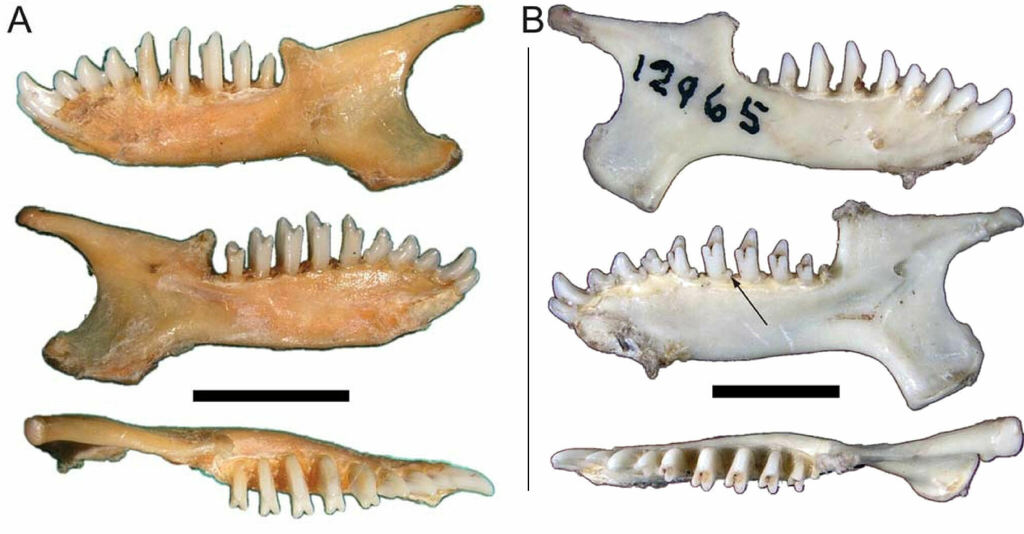
Carpitalpa arendsi is a moderately sized species of golden mole. Its body length ranges between 11.5 and 14 cm (4.5 and 5.5 in). Adult males are heavier than females, averaging just over 50 g (1.8 oz), while females usually weigh a little over 40 g (1.4 oz). The fur on its upper body is dark and glossy, appearing black or deep brown with a metallic bronze tint. Lighter coloring is found on the legs, throat, and along the sides of the face. The belly has a slightly lighter color than the rest of the body and shows a subtle greenish shine. This species is blind and has vestigial eyes covered by a thick layer of skin. Its forelimbs are shaped for digging. The claw on the first toe is small but thick. The second toe is noticeably shorter than the third. The fourth toe is significantly smaller and vestigial. Like other golden moles, Arends' golden mole lacks a visible external tail and has tough, loosely attached skin that helps it move through soil. The Arends' golden mole differs from other members of the genus Chlorotalpa mainly in skull and tooth features. These include a more expanded malleus bone in the middle ear, a stronger stylohyal bone, a longer roof of the mouth, and the absence of fully developed molar talonids.
Range & habitat
Carpitalpa arendsi is found in Mozambique and Zimbabwe, where its range is largely narrowed down to the Inyanga Highlands, with a small extension into the adjacent Vila Perey district. Its natural habitats include high-elevation of up to 4,000 m (13,000 ft) in altitude, grasslands and forested areas along streams and rivers with dense ground cover and leaf litter. The species is found in temperate and subtropical forests, dry and moist mountainous forests, lowland grasslands, and human-altered areas such as agricultural land, pastures, plantations, rural gardens, and urban areas. The species shows a preference for fine, well-drained soils, where it builds tunnels beneath coarse grass. Individuals are occasionally seen moving across the ground surface after rainfall.
Wikipedia: “Distribution and habitat”
What it does
Like other golden moles, Carpitalpa arendsi is adapted to burrowing, spending most of its life underground. It moves through soil using its strong forelimb and snout, which helps push through and excavate tunnels. It is active at different times throughout the day and night, though its activity levels may decrease during colder conditions. Burrow depth differs among golden mole species, with tunnels ranging from near-surface to deep burrows, likely influenced by soil conditions. This species is capable of navigating effectively underground and can return to tunnel openings after moving through its environment. It feeds on small invertebrates, like worms, and insects found in the soil and along the surface after it rains. When in contact with predators or humans, it typically avoids confrontation and will attempt to escape rather than bite. Arends' golden mole is typically polygynous and tends to breed during the winter months, from April to July. The mating pursuit involves vocal sounds and the male chasing the female. Pregnancy lasts four to six weeks and there are two to three young in a litter. They are taken care of and fed by the female in the burrow for two to three months until she evicts them.
Wikipedia: “Behavior”
Listen
Looking for field recordings…
Where it lives
Recorded sightings
—
geo-referenced records in GBIF, from museums, herbaria and field observers.
Drag the globe to turn it. Dots are where records exist, not a range map; darker means more records.
In the stacks
Searching the stacks…
Every page naming Carpitalpa arendsi in the Biodiversity Heritage Library →
This page is assembled live from iNaturalist, GBIF, Wikipedia, the Source Library and the Internet Archive. It is not yet part of the hand-edited codex. iNaturalist taxon 42528.