- Animals
- ›Chordates
- ›Vertebrates
- ›Ray-finned Fishes
- ›Spiny-rayed fishes
- ›Perches, Scorpionfishes, Sticklebacks, and Allies
- ›Sculpins and Allies
- ›Sandfishes
- ›Arctoscopus
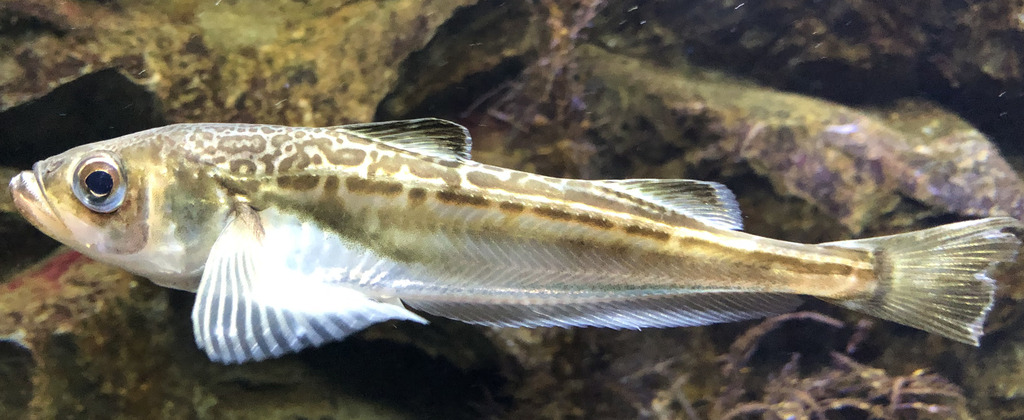
Japanese Sandfish
Arctoscopus japonicus
The Japanese sandfish (Arctoscopus japonicus), also known as the sailfin sandfish, is a species of fish of the Percomorpha (perch-like) clade in the order Trachiniformes, being one of the two genera in the family Trichodontidae, the sandfishes. Known in Japan as hatahata (ハタハタ, 鰰, 鱩, 燭魚), it is a commercially important fish especially for Akita and Yamagata prefectures. Its habitat occurs in sandy-mud bottoms ranging from the Sea of Japan to the Okhotsk Sea.
As a food source, the fish has mostly been sourced locally from the coastal region of the Sea of Japan, and has been designated the official prefectural fish of Akita Prefecture. The fish, which is scaleless, may be prepared whole as braised or grilled fish, and has a mucilaginous consistency. It is also dried to make stockfish; salted, dried, and made into himono; and cured in miso as misozuke. It is the main ingredient of the fish sauce called shottsuru. The egg masses are known as burikko. In Korean the fish is called dorumuk (도루묵).
From the article Japanese sandfish on Wikipedia (CC BY-SA), quoted section by section
Range & habitat
The Japanese sandfish is distributed in the northwestern Pacific Ocean, particularly the Sea of Japan to the Okhotsk Sea, Kurile Islands and Kamchatka Peninsula. Three broad regional population groups had been postulated by Okiyama (1970) based on tagging, and later mitochondrial DNA analysis confirmed these grouping on a genetic basis. The population groups are:
Western Japan (WJ) – This is a group that migrate the coast of the Sea of Japan from Tottori to Akita Prefecture. It comprises the "northern Sea of Japan" and "western Sea of Japan" subgroups. The spawning grounds of the group has been assumed to be off all along the coast, but bulk spawning grounds are absent around the Noto Peninsula and any further west/south, and in fact, it has been reported that the western Sea of Japan group's spawning grounds occur in the east coast of the Korean peninsula. South Hokkaido (SH) – This is a group with breeding grounds in the Pacific Ocean off Hokkaido. It consists of Ishikari Bay, Uchiura Bay, Hidaka, Kushiro, and Nemuro subgroups. Eastern Korea (EK) – This group has breeding grounds in the eastern coast of the Korean Peninsula. Catch production in the Tōhoku region (Northeastern Japan)'s Pacific coast (otherwise known as "Sanriku") is modest, and no regular spawning grounds have been confirmed. …
Wikipedia: “Distribution”
What it does
The Japanese sandfish has a life span of 5 years, attaining a typical fork length of 20 centimetres (7.9 in). It is a deep sea fish that usually inhabits sandy and muddy sea floors in waters 200 to 400 metres (660 to 1,310 ft) (550 metres (1,800 ft)) deep, but migrates from November to January to spawn in shallow rocky beds of seaweed. The males reach sexual maturity at 1+1⁄2 years of age and beyond, and females at the 2-year-old stage; the individuals do not die after single spawning, and have several breeding cycles during their life span. It preys and feeds on amphipods, copepods, mysidacea, krill, squid, and fish.
Distribution. The Japanese sandfish is distributed in the northwestern Pacific Ocean, particularly the Sea of Japan to the Okhotsk Sea, Kurile Islands and Kamchatka Peninsula. Three broad regional population groups had been postulated by Okiyama (1970) based on tagging, and later mitochondrial DNA analysis confirmed these grouping on a genetic basis. The population groups are:
Western Japan (WJ) – This is a group that migrate the coast of the Sea of Japan from Tottori to Akita Prefecture. It comprises the "northern Sea of Japan" and "western Sea of Japan" subgroups. …
Wikipedia: “Life cycle and behavior”
At the table
At one time, dried hatahata was one type of fish-based fertilizer (fish manure) being trafficked in Japan.
Food ingredient. The fish lacks scale, has few small bones, and the spine separates easily from the flesh, so that they are usually poached or broiled whole, or just with the head off. If the fish is fresh, snapping the bone at the base of the tail beforehand, will make it easier for the spine to come off easily after broiling. Fresh hatahata can be served salted and broiled, or be poached in a pot flavored with soy sauce, sake kasu, and especially shottsuru. In Akita, the pot dish would be flavored with shottsuru, a fish sauce traditionally made by curing the fish in brine. Another preparation is the dengaku (slathered with sweet miso paste and broiled), which is eaten not only in Akita but also in the Shōnai region around Sakata, Yamagata.
The fish is preserved in various ways, such as nukazuke (pickled in rice bran and salt), himono (as dried fish), as mirinboshi, (mirin-based flavored dried fish). …
Wikipedia: “Uses”
Where it lives
Recorded sightings
—
geo-referenced records in GBIF, from museums, herbaria and field observers.
Drag the globe to turn it. Dots are where records exist, not a range map; darker means more records.
In the stacks
Searching the stacks…
Every page naming Arctoscopus japonicus in the Biodiversity Heritage Library →
This page is assembled live from iNaturalist, GBIF, Wikipedia, the Source Library and the Internet Archive. It is not yet part of the hand-edited codex. iNaturalist taxon 426174.