- Animals
- ›Chordates
- ›Vertebrates
- ›Mammals
- ›Therians
- ›Marsupials
- ›Opossums
- ›Opossums
- ›Large American Opossums, Mouse Opossums, and Allies
- ›Large New World Opossums
- ›Didelphis
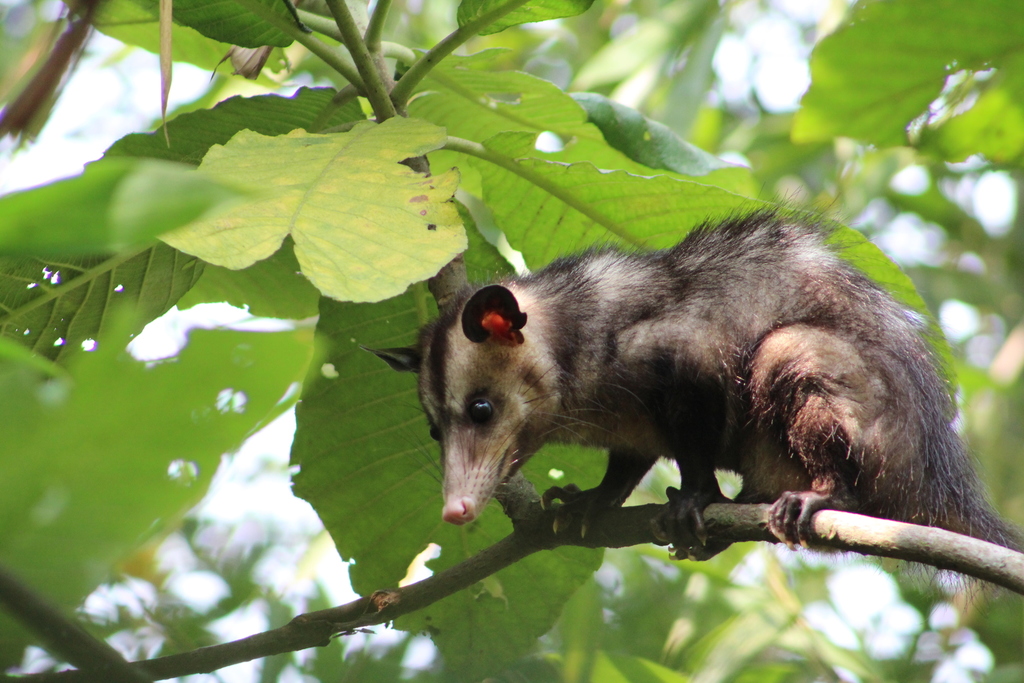
Southern Opossum
Didelphis marsupialis
The common opossum (Didelphis marsupialis), also called the southern or black-eared opossum or gambá, is a mammal species living from the northeast of Mexico to Bolivia (reaching the coast of the South Pacific Ocean to the central coast of Peru), including the Lesser Antilles, where it is called manicou. It prefers the woods, but can also live in fields and cities. The common opossum is sometimes used for food in islands in the West Indies by...
From the article Common opossum on Wikipedia (CC BY-SA), quoted section by section
Description
The common opossum is similar in size to a house cat. The fur of the opossum is actually yellow in the under-fur, but is hidden by the longer black guard-hairs that cover it, while the tail, fingers, and face are lighter with the tail being without fur. It can measure nearly 20 inches (51 cm) long. It has large ears that are usually black, and its face is usually a pale peach in color, with black whiskers and eyes that reflect reddish in light. With a body length of nearly a foot, and a tail that can reach almost two feet, the common opossum is one of the larger members of the Didelphidae family. Adult opossums can weigh more than three pounds.
Range & habitat
The common opossum is found in tropical and subtropical forest, both primary and secondary, at altitudes of up to 2,200 m (7,200 ft). They use a wide range of nest sites. Most commonly, they will create one in the hollow of a tree; However, they will also dig a burrow or nest in any dark location if nothing else is suitable (which often gets them in trouble with humans). Opossums enjoy denning underground, but do not spend as much time underground during the dry season.
Wikipedia: “Habitat and shelter”
What it does
Their activity is mainly nocturnal and terrestrial, with some arboreal exploration and nesting. Outside of mating, they are usually solitary. A male opossum's home range (distance traveled at night) can vary in size from wet to dry seasons, while females have a more stationary home range when they are breeding. Males are most active between 11 pm and 3 am. Common opossums can be considered pests due to their somewhat raccoon-like behavior, such as raiding trash cans, nesting in locations that are not suitable, and causing mayhem if encountered within a human living space. As a result, they are often trapped and killed. Opossums have not been observed to be territorial. The common opossum is a host of the acanthocephalan intestinal parasite Gigantorhynchus lutzi. Common predators of the opossum are great horned owls, American barn owls, bobcats, cougars, domestic dogs, domestic cats, coyotes, and boa constrictors. Similarly to other opossum species, when they are in danger, they act dead, which is referred to as 'playing possum.'
Diet. Common opossums have a broad ability to adapt to environmental changes, and their teeth allow them to eat many different types of food, which they obtain primarily on the ground. …
Wikipedia: “Behavior”
Listen
Looking for field recordings…
Where it lives
Recorded sightings
—
geo-referenced records in GBIF, from museums, herbaria and field observers.
Drag the globe to turn it. Dots are where records exist, not a range map; darker means more records.
In the stacks
Searching the stacks…
Every page naming Didelphis marsupialis in the Biodiversity Heritage Library →
This page is assembled live from iNaturalist, GBIF, Wikipedia, the Source Library and the Internet Archive. It is not yet part of the hand-edited codex. iNaturalist taxon 42649.