- Animals
- ›Chordates
- ›Vertebrates
- ›Mammals
- ›Therians
- ›Marsupials
- ›Opossums
- ›Opossums
- ›Large American Opossums, Mouse Opossums, and Allies
- ›Large New World Opossums
- ›Didelphis
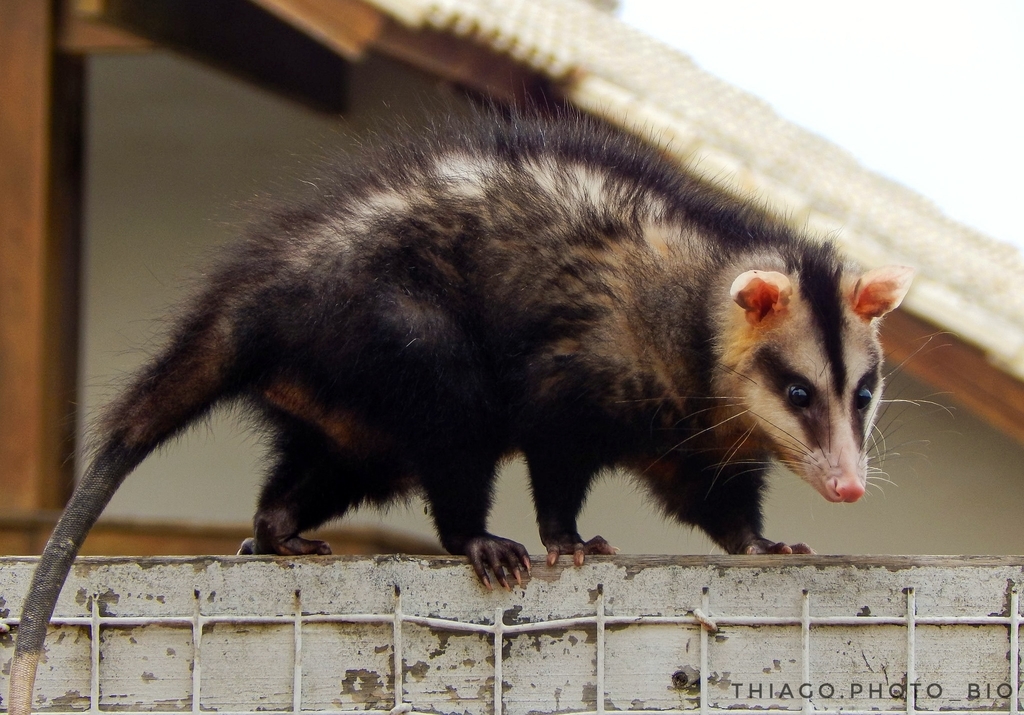
White-eared Opossum
Didelphis albiventris
The white-eared opossum (Didelphis albiventris), known as the timbu and cassaco in northeast Brazil, saruê and sariguê in Bahia, micurê and mucura in northern Brazil and comadreja overa and zarigüeya in Argentina, is an opossum species found in Argentina, Bolivia, Brazil, Paraguay, and Uruguay. It is a terrestrial and, sometimes, arboreal animal, and a habitat generalist, living in a wide range of different habitats.
For some time, this species was incorrectly known by the name D. azarae, correctly applied to the big-eared opossum. This led to azarae's discontinuation as a species name. From 1993 until 2002, this species also included the Guianan white-eared opossum (D. imperfecta) and the Andean white-eared opossum (D. pernigra) as subspecies.
From the article White-eared opossum on Wikipedia (CC BY-SA), quoted section by section
Description
The white-eared opossum is about one to three pounds in weight and has black and grey fur, with white hair covering their ears and face, and dark hair on their long tails. They are omnivorous, feeding on invertebrates, small vertebrates, and fruits.
Range & habitat
White-eared opossums inhabit open areas, mountains, and deciduous forests and are commonly found in Argentina, Paraguay, Uruguay, Bolivia, Brazil, the Andes, and humid forests of Guyana, Suriname, and southern Venezuela. These areas have disparate environmental characteristics such as rainfall, humidity, water balance and temperature. The white-eared opossum often changes its habitat depending on its breeding season. Usually populations are higher in the wetter seasons when the young are weaned and begin venturing out for food. Though normally solitary and nomadic, some will group together in burrows, holes, empty garbage or even under houses.
Wikipedia: “Distribution and habitat”
What it does
South American opossums mainly consume invertebrates such as beetles, diplopods, and opiliones, together with fruit and vertebrates like small birds, mammals, fossorial snakes, and fish. The composition of the diet changes with the seasons and as the animal ages. During the dry season, older opossums prefer to consume vertebrates. On the other hand, the younger opossums consume more invertebrates and fruits during the wet season. These relatively small differences in diet can favour the survival of younger opossums during the wet season because they avoid competition with older animals. The diet of white-eared opossums also makes them effective seed dispersers. Younger opossums consume smaller fruits than older opossums, so usually the adult opossums disperse larger seeds. However, proportionally, smaller seeds have more chance to pass through the gut without damage. Seeds that have commonly been associated in the diet amongst white-eared opossums are from the fruits of Morus nigra, Vassobia breviflora, Rubus rosifolius, Solanum sanctaecatharinae, and Passiflora actinia. Fecal analysis reveals that these seeds are viable for germination after the passage through the digestive tract, making the white-eared opossum an adequate vector for seed dispersal.
== References ==
Wikipedia: “Diet and seed dispersal”
Listen
Looking for field recordings…
Where it lives
Recorded sightings
—
geo-referenced records in GBIF, from museums, herbaria and field observers.
Drag the globe to turn it. Dots are where records exist, not a range map; darker means more records.
In the stacks
Searching the stacks…
Every page naming Didelphis albiventris in the Biodiversity Heritage Library →
This page is assembled live from iNaturalist, GBIF, Wikipedia, the Source Library and the Internet Archive. It is not yet part of the hand-edited codex. iNaturalist taxon 42658.