- Animals
- ›Chordates
- ›Vertebrates
- ›Mammals
- ›Therians
- ›Marsupials
- ›Kangaroos, Possums, Wombats, and Allies
- ›Macropods
- ›Kangaroos, Wallabies and Allies
- ›Kangaroos, Wallabies, Pademelons, and Dorcopsises
- ›Kangaroos and Wallabies
- ›Macropus
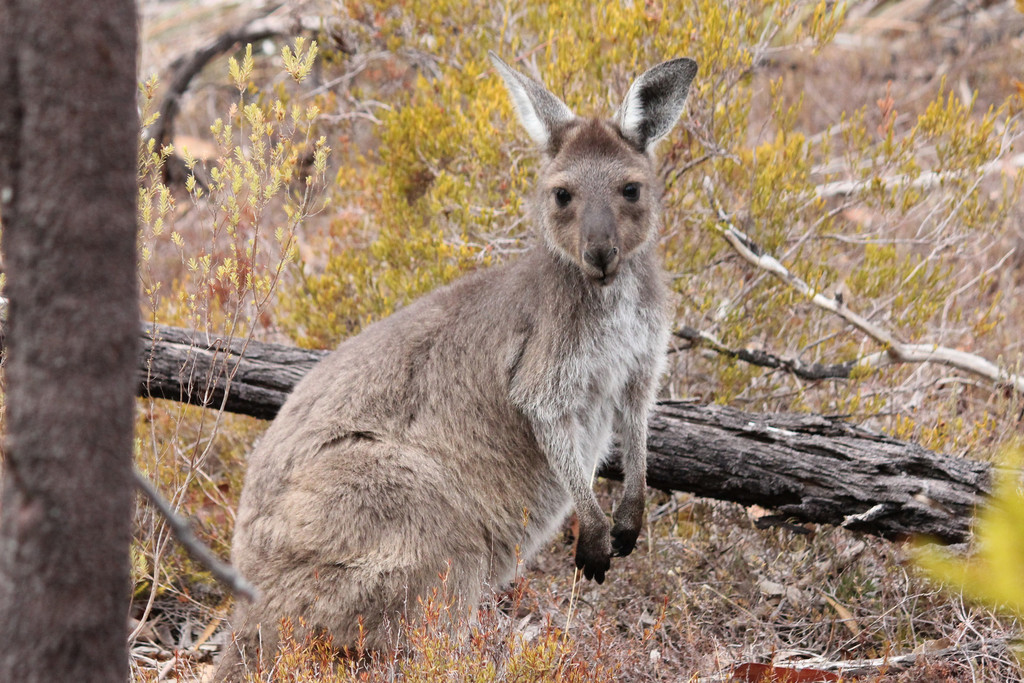
Western Grey Kangaroo
Macropus fuliginosus
The western grey kangaroo (Macropus fuliginosus), also referred to as a western grey giant kangaroo, black-faced kangaroo, mallee kangaroo, sooty kangaroo and (when referring to the Kangaroo Island subspecies) Kangaroo Island grey kangaroo, is a large and very common kangaroo found across almost the entire southern part of Australia, from just south of Shark Bay through coastal Western Australia and South Australia, into western Victoria, and in the entire Murray–Darling basin in New South Wales and Queensland.
From the article Western grey kangaroo on Wikipedia (CC BY-SA), quoted section by section
Description
The western grey kangaroo is one of the largest macropods in Australia. It weighs 28–54 kg (62–120 lb) and its length is 0.84–1.1 m (2 ft 9 in – 3 ft 7 in) with a 0.80–1.0 m (2 ft 7 in – 3 ft 3 in) tail, standing approximately 1.3 m (4 ft 3 in) tall. It exhibits sexual dimorphism with the male up to twice the size of female. It has thick, coarse fur with colour ranging from pale grey to brown; its throat, chest and belly have a paler colour.
This species is difficult to distinguish from its sibling species, the eastern grey kangaroo (Macropus giganteus). However, the western grey kangaroo has darker grey-brown fur, darker colouration around the head, and sometimes has a blackish patch around the elbow.
What it does
It feeds at night, mainly on grasses and forbs but also on leafy shrubs and low trees. During the Late Pleistocene, its diet was more varied and incorporated a greater proportion of C4 plants relative to that of present western grey kangaroos. It has a nickname "stinker" because mature males have a distinctive curry-like odour.
Wikipedia: “Diet”
Listen
Looking for field recordings…
Where it lives
Recorded sightings
—
geo-referenced records in GBIF, from museums, herbaria and field observers.
Drag the globe to turn it. Dots are where records exist, not a range map; darker means more records.
In the stacks
Searching the stacks…
Every page naming Macropus fuliginosus in the Biodiversity Heritage Library →
This page is assembled live from iNaturalist, GBIF, Wikipedia, the Source Library and the Internet Archive. It is not yet part of the hand-edited codex. iNaturalist taxon 42881.