- Animals
- ›Chordates
- ›Vertebrates
- ›Mammals
- ›Therians
- ›Marsupials
- ›Kangaroos, Possums, Wombats, and Allies
- ›Macropods
- ›Kangaroos, Wallabies and Allies
- ›Kangaroos, Wallabies, Pademelons, and Dorcopsises
- ›Tree Kangaroos and Allies
- ›Dendrolagus
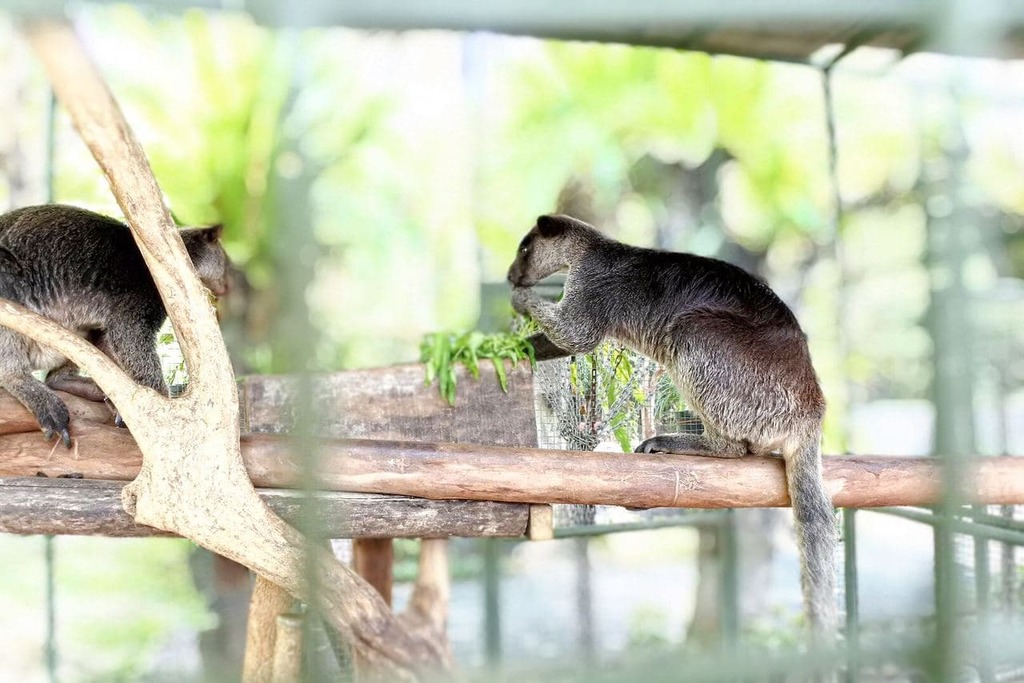
Grizzled Tree Kangaroo
Dendrolagus inustus
The grizzled tree-kangaroo (Dendrolagus inustus) is a furry, long-tailed mammal native to tropical rainforests on the island of New Guinea (split between Indonesia and Papua New Guinea). Like most tree-kangaroos (genus Dendrolagus), it lives in trees and eats leaves, fruit, and bark. It is a member of the macropod family Macropodidae and carries its young in a pouch like other marsupials. The tree-kangaroo is uncommon and threatened by hunting and habitat loss. It is found in foothill forests of northern and western New Guinea and is indigenous to some of the offshore islands.
From the article Grizzled tree-kangaroo on Wikipedia (CC BY-SA), quoted section by section
Description
The grizzled tree-kangaroo grows to a length of about 75 to 90 cm (30 to 35 in) with males being considerably larger than females. It resembles a terrestrial kangaroo and its weight varies between about 8 and 15 kg (18 and 33 lb). The head is small, with a flat muzzle, the arms are powerful for climbing, the hind legs are long and the feet are large for an arboreal animal. The toes are armed with strong claws and the fourth toe is usually longer than the others. The otherwise bushy, cylindrical tail is often hairless at the base, and is used as a prop when climbing. Its colouring is between charcoal grey and chocolate brown with paler underparts. The ears are black and the toes and tail are dark.
Range & habitat
The grizzled tree-kangaroo is native to tropical, foothill rainforests of northern and western New Guinea and some offshore island. It can be found at elevations up to 1,400 m (4,600 ft) above sea level. Its range includes the Foja Mountains and the Bird's Head Peninsula and it occurs on the offshore islands of Yapen, Waigeo, Misool and Salawati, and possibly Batanta. It is present in both primary and secondary forests.
Wikipedia: “Distribution and habitat”
Listen
Looking for field recordings…
Where it lives
Recorded sightings
—
geo-referenced records in GBIF, from museums, herbaria and field observers.
Drag the globe to turn it. Dots are where records exist, not a range map; darker means more records.
In the stacks
Searching the stacks…
Every page naming Dendrolagus inustus in the Biodiversity Heritage Library →
This page is assembled live from iNaturalist, GBIF, Wikipedia, the Source Library and the Internet Archive. It is not yet part of the hand-edited codex. iNaturalist taxon 42903.