- Animals
- ›Chordates
- ›Vertebrates
- ›Mammals
- ›Therians
- ›Marsupials
- ›Kangaroos, Possums, Wombats, and Allies
- ›Macropods
- ›Kangaroos, Wallabies and Allies
- ›Kangaroos, Wallabies, Pademelons, and Dorcopsises
- ›Tree Kangaroos and Allies
- ›Petrogale
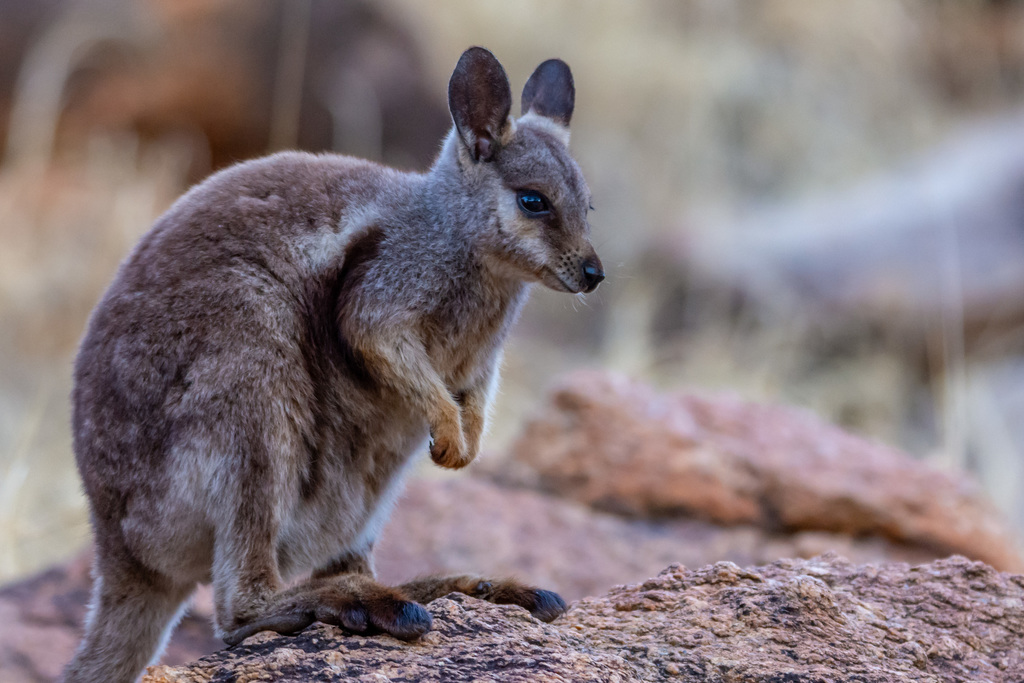
Black-flanked Rock Wallaby
Petrogale lateralis
The black-flanked rock-wallaby (Petrogale lateralis), also known as the black-footed rock-wallaby or warru, is a species of wallaby, one of several rock-wallabies in the genus Petrogale. A shy, nocturnal herbivore, its two main subspecies are found in mostly isolated populations across western and southern Western Australia (WA), the Northern Territory and parts of South Australia (SA). With some subspecies showing a decline in populations in recent years, the whole species is classed as an endangered species under the Commonwealth EPBC Act.
From the article Black-flanked rock-wallaby on Wikipedia (CC BY-SA), quoted section by section
Description
The black-flanked rock-wallaby is generally greyish-brown with a paler belly and chest, a dark stripe running from its head down its spine, and it has a dark tail and feet. Colours may vary slightly among subspecies. It has short, thick, woolly fur that is particularly dense around the base of the tail, rump and flanks. Its long tail, useful for balancing in rocky terrain, is tipped with a brush. Because most of its water comes from its diet, it rarely drinks and can conserve water by taking refuge from the heat in rocky caves.
Range & habitat
In Western Australia, the wallaby lives in mountainous areas with granite outcrops, sandstone cliffs, scree slopes, and hummock grasses with a few trees and shrubs, and also near coastal limestone cliffs. P. lateralis lateralis lives across southern and western WA; P. lateralis hacketti lives on three islands of the Recherche Archipelago in southern WA; P. lateralis (western Kimberley race) is found only in the Edgar Range, Erskine Range, possibly the Grant Range and also nearby areas of the west Kimberley); P. lateralis (MacDonnell Ranges race) used to be widespread in central desert regions across the Northern Territory, SA and WA, but there has been a decline in both distribution and abundance.
Wikipedia: “Distribution and habitat”
What it does
The black-flanked rock-wallaby is a rather shy nocturnal animal, and feeds at night on grasslands that are close to rocky areas for shelter. It lives in groups of 10–100 individuals, and form lifelong pair bonds, although females will mate with other males. They reach sexual maturity at one to two years old, but breeding cycles respond to seasonal rainfall. The species features embryonic diapause, where the embryo's development enters a state of dormancy until environmental conditions are suitable. The gestation period lasts around 30 days, and like other young marsupials, the young are poorly developed and suckle inside the mother's pouch until they are ready to leave. Unlike other kangaroos and wallabies, mothers leave their young in a sheltered place while they feed.
Wikipedia: “Behaviour”
In human culture
The warru is an important part of the local ecosystem, as its consumption of the native vegetation helps to regenerate it. In addition, it is an important symbol in Anangu mythology.
Wikipedia: “Ecological and cultural significance”
Listen
Looking for field recordings…
Where it lives
Recorded sightings
—
geo-referenced records in GBIF, from museums, herbaria and field observers.
Drag the globe to turn it. Dots are where records exist, not a range map; darker means more records.
In the stacks
Searching the stacks…
Every page naming Petrogale lateralis in the Biodiversity Heritage Library →
This page is assembled live from iNaturalist, GBIF, Wikipedia, the Source Library and the Internet Archive. It is not yet part of the hand-edited codex. iNaturalist taxon 42921.