- Animals
- ›Chordates
- ›Vertebrates
- ›Mammals
- ›Therians
- ›Placental Mammals
- ›Ungulates, Carnivorans, and Allies
- ›Shrews, Moles, Hedgehogs, and Allies
- ›Shrews, Moles, and Hedgehogs
- ›Hedgehogs and Gymnures
- ›Hedgehogs
- ›Atelerix
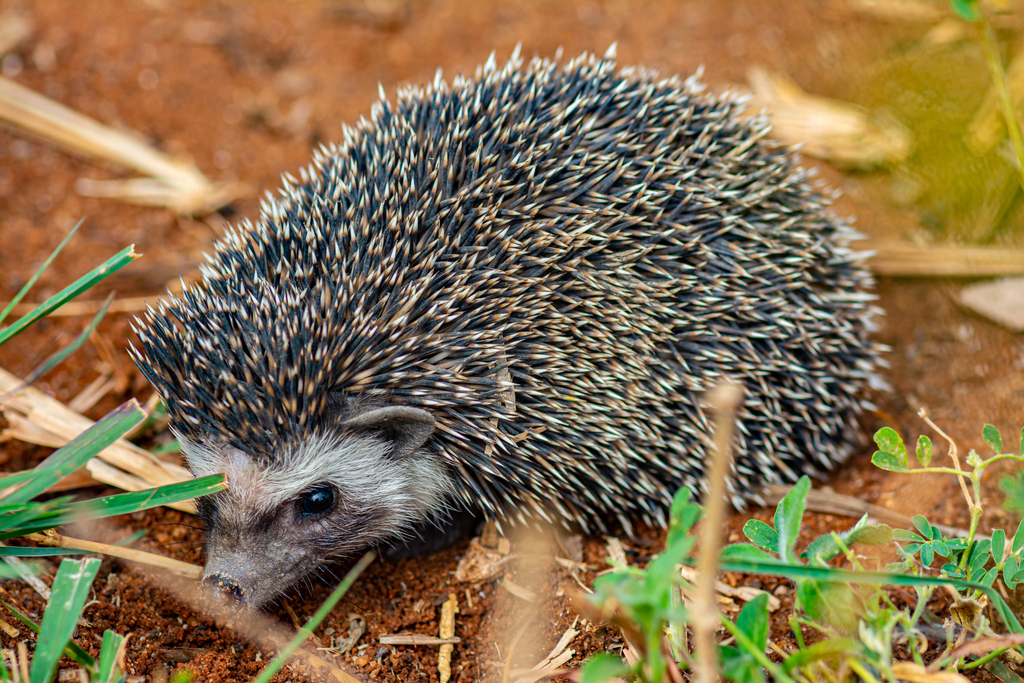
Four-toed Hedgehog
Atelerix albiventris
The four-toed hedgehog (Atelerix albiventris), also known as the African pygmy hedgehog, is a species of hedgehog found throughout much of central and eastern Africa.
Populations tend to be scattered between suitable savannah or cropland habitats, avoiding forested areas. The species common name is derived from the number of toes found on its hind feet. Due to its extensive range and stable wild population, the species is rated as least concern by the IUCN. In addition, the species is a popular small pet in various countries, and has been successfully domesticated and bred in captivity.
From the article Four-toed hedgehog on Wikipedia (CC BY-SA), quoted section by section
Description
The four-toed hedgehog is an oval bodied animal approximately 210 millimetres (8.3 in) in length and weighing between 250 and 600 grams (8.8 and 21.2 oz). Females are typically larger than males. It has short legs, short tail typically around 2.5 centimetres (0.98 in) in length, a long nose, and small beady eyes. The ears and whiskers are both relatively large, implying that the animal has good senses. As its common name implies, and unlike related species, the four-toed hedgehog typically only has four toes on each hind foot, lacking the hallux. However, in some individuals, a small bony lump may be present in place of the hallux, or there may even be a well-developed toe, especially on the hind feet. It can vary greatly in colouration, but typical wild specimens have brown or grey spines with white or cream colored tips. The fur on the body is speckled grey in color, with brown around the muzzle, and white face, legs, and underparts. The upper body is covered in spines varying from 0.5 to 1.7 centimetres (0.20 to 0.67 in) in length, being longest on the upper surface of the head. The spines are variably colored, but always have a white base and tip. Males have an externally visible penis, located in the mid-abdomen, but the testicles are recessed into pouches close to the anus. Females may have anything from two to five pairs of teats.
Range & habitat
The four-toed hedgehog is found across a wide swathe of central Africa, from Gambia and Senegal in the west, to Somalia in the east, and also in eastern Africa, as far south as Mozambique. It prefers grassy environments or open woodland, and is found at elevations as high as 2,000 metres (6,600 ft), although it is more common in lowland areas. Because it prefers to shelter in dry rocky or grassy areas, it avoids dense forest and swampland. The main predators of four-toed hedgehogs within their natural habitat are Verreaux's eagle-owl, jackals, hyenas, and honey badgers. This species tends to prefer temperatures between 24 and 30 °C (75 and 86 °F). When it is hotter than that, it tends to find shelter in a burrow and go into a state of estivation, or when it is colder it goes into a state of hibernation in order to conserve energy.
Wikipedia: “Distribution and habitat”
What it does
The four-toed hedgehog is a solitary, nocturnal animal. It generally moves along the ground, but is capable of both climbing and swimming when the need arises. It is highly energetic, sometimes covering miles of ground in a single night as it forages for insects, grubs, snails, spiders, some plant matter, and even small vertebrates. It has a high tolerance for toxins and has been recorded consuming scorpions and even venomous snakes. The most common sounds made by four-toed hedgehogs are snorts, hisses, and a quiet twittering sound. When attacked, the animal can scream loudly, and males also produce a birdlike call during courtship. Although four-toed hedgehogs do aestivate through the summer, this is not thought to be connected to a rise in temperature, but rather to a lack of available food. Aestivation rarely lasts for more than six weeks. When encountering a predator, its standard defensive reaction is to tense up all the muscles on its back to cause its spines to stand erect, and then roll into a ball protecting its limbs and head. If it is harassed further, it will twitch in an attempt to jab spines into the predator and make snuffling/grunting noises. Its spines are not released into the skin of an attacker, as those of a porcupine. …
Wikipedia: “Behaviour”
Listen
Looking for field recordings…
Where it lives
Recorded sightings
—
geo-referenced records in GBIF, from museums, herbaria and field observers.
Drag the globe to turn it. Dots are where records exist, not a range map; darker means more records.
In the stacks
Searching the stacks…
Every page naming Atelerix albiventris in the Biodiversity Heritage Library →
This page is assembled live from iNaturalist, GBIF, Wikipedia, the Source Library and the Internet Archive. It is not yet part of the hand-edited codex. iNaturalist taxon 43055.