- Animals
- ›Chordates
- ›Vertebrates
- ›Mammals
- ›Therians
- ›Placental Mammals
- ›Ungulates, Carnivorans, and Allies
- ›Shrews, Moles, Hedgehogs, and Allies
- ›Shrews, Moles, and Hedgehogs
- ›Hedgehogs and Gymnures
- ›Hedgehogs
- ›Paraechinus
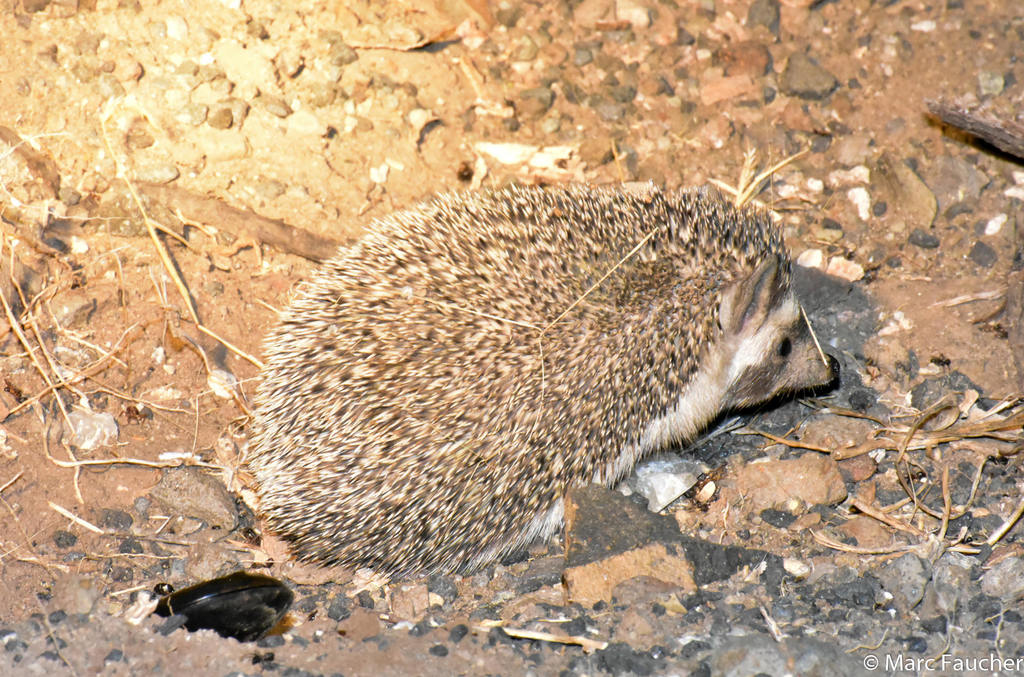
Indian Hedgehog
Paraechinus micropus
The Indian hedgehog (Paraechinus micropus) is a species of hedgehog native to India and Pakistan. It mainly lives in sandy desert areas but can be found in other environments.
From the article Indian hedgehog on Wikipedia (CC BY-SA), quoted section by section
Description
The Indian hedgehog can be compared to the long-eared hedgehog (Hemiechinus auritus) which has a similar lifestyle and appearance. It is known for its masked face, dark with a white top, somewhat similar to a raccoon. It is relatively small with the adult male weighing about 435 grams and the adult female about 312. They are quite fast, although not as fast as the long-eared hedgehog. Its color is predominantly brown with a few lighter shades of brown. The tail is only about 2-4 centimeters long. It has a stocky body with a short head, a long snout, small, dark eyes, and relatively large ears. Its legs are a gray-brown color with 5 digits on each and small but strong claws. Hedgehogs are protected species under Schedule IV of Wildlife Protection Act (1972). Indian hedgehogs also have a lot of acid phosphatase in their medulla oblongata and pons which can affect the way their blood capillaries work in the brain. Their brains also have a lot of enzyme activity going on because of the presence of acetylcholinesterase
What it does
Being a part of the family Erinaceidae, the Indian hedgehog has a very diverse diet consuming insects (preferably beetles), worms, slugs, frogs, toads, bird eggs, snakes, and scorpions. Although it doesn't hibernate, it is still capable of slowing down its metabolism when food is scarce. When danger presents itself, the Indian hedgehog rolls up into a ball. The upper side of the body has spines to protect from predators. The Indian hedgehog is capable of digging burrows about 45 cm long. They use these to sleep in and to stay hidden from danger. Any open burrow is fair game and they inhabit any that are vacant. Like all hedgehogs, these animals go through a process called self-anointing. They spread their own saliva on their spines and fur after tasting or smelling something that is unfamiliar to them. This behavior occurs in both sexes, at all ages, and at any time of the year.
Wikipedia: “Behavior”
Listen
Looking for field recordings…
Where it lives
Recorded sightings
—
geo-referenced records in GBIF, from museums, herbaria and field observers.
Drag the globe to turn it. Dots are where records exist, not a range map; darker means more records.
In the stacks
Searching the stacks…
Every page naming Paraechinus micropus in the Biodiversity Heritage Library →
This page is assembled live from iNaturalist, GBIF, Wikipedia, the Source Library and the Internet Archive. It is not yet part of the hand-edited codex. iNaturalist taxon 43065.