- Animals
- ›Chordates
- ›Vertebrates
- ›Mammals
- ›Therians
- ›Placental Mammals
- ›Afromammals
- ›Hyraxes
- ›Hyraxes
- ›Dendrohyrax
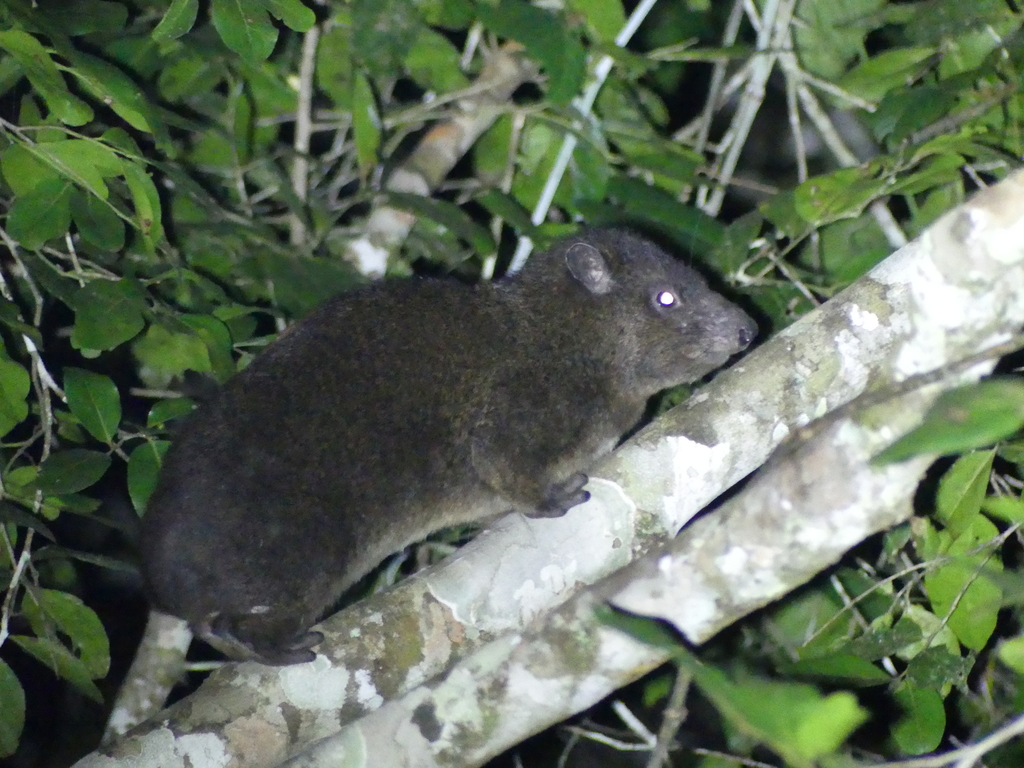
Eastern Tree Hyrax
Dendrohyrax validus
The eastern tree hyrax (Dendrohyrax validus) is a species of mammal within the family Procaviidae. The eastern tree hyrax is the most localized of the tree hyrax species, distributed patchily in a narrow band of lowland and montane forests in Kenya and Tanzania and adjacent islands.
From the article Eastern tree hyrax on Wikipedia (CC BY-SA), quoted section by section
Description
The eastern tree hyrax is a small, rotund guinea pig–like mammal with dense, soft fur and blunt, nailed toes. They weigh on average 2.75 kilograms or 6.1 pounds and have a head-body length of 470 to 558 millimetres (18.5 to 22.0 in). No tail is discernible. Pelage is variable, with dorsal coloration ranging from cinnamon brown to blackish, and a paler underside. Individuals also have a distinctive dorsal scent gland marked by a contrasting, light-colored patch of hairs. Considerable variation exists between subspecies as currently described. The rostrum is relatively long, but well-haired, unlike the related western tree hyrax. Individuals of this species are difficult to distinguish from the related southern tree hyrax, which was previously considered conspecific; however, the fur of southern tree hyrax is usually more grizzled.
Range & habitat
The Eastern tree hyrax is endemic to the East African countries of Tanzania and Kenya; they predominantly inhabit the foothills and montane forests of Mount Kilimanjaro, Mount Meru and the Eastern Arc Mountains. The Eastern Arcs feature an ancient chain of isolated, relict forests, stretching from the Taita Hills of Southern Kenya to the Udzungwa Mountains of Tanzania. Hyraxes are also present on the coast between Tanga Region, Tanzania, and Mombasa, Kenya, as well as on the islands of Zanzibar and Pemba.
Wikipedia: “Distribution”
What it does
The eastern tree hyrax is solitary, living in tree holes, and communicates with other individuals via repetitive vocal calls and scent marking. This is a highly vocal species with numerous high energy calls that may be combined and graded. Most roosts are occupied by only one animal, with the exception of females with one young. They are skilled climbers which feed predominantly in the canopy on tree leaves, and form large middens adjacent to roost trees. In some locations in the coast of Kenya eastern tree hyraxes also inhabit rocky boulders and caves, that resemble rock hyrax habitats. In Pare Mountains Tanzania, eastern tree hyraxes are also inhabiting rocky mountain sides and caves. So tree hyraxes are dependent of their shelter, but they can be flexible of the form of shelter. Tree hyraxes feed on leaves of trees, these trees or bushes may also be small, but they do not feed on exotic trees grown in the tree plantations. Eastern tree hyrax is one of few species that can sing. Singing is most common in February and June.
Wikipedia: “Behavior”
Listen
Looking for field recordings…
Where it lives
Recorded sightings
—
geo-referenced records in GBIF, from museums, herbaria and field observers.
Drag the globe to turn it. Dots are where records exist, not a range map; darker means more records.
In the stacks
Searching the stacks…
Every page naming Dendrohyrax validus in the Biodiversity Heritage Library →
This page is assembled live from iNaturalist, GBIF, Wikipedia, the Source Library and the Internet Archive. It is not yet part of the hand-edited codex. iNaturalist taxon 43091.