- Animals
- ›Chordates
- ›Vertebrates
- ›Mammals
- ›Therians
- ›Placental Mammals
- ›Primates, Rodents, and Allies
- ›Lagomorphs
- ›Hares and Rabbits
- ›Romerolagus
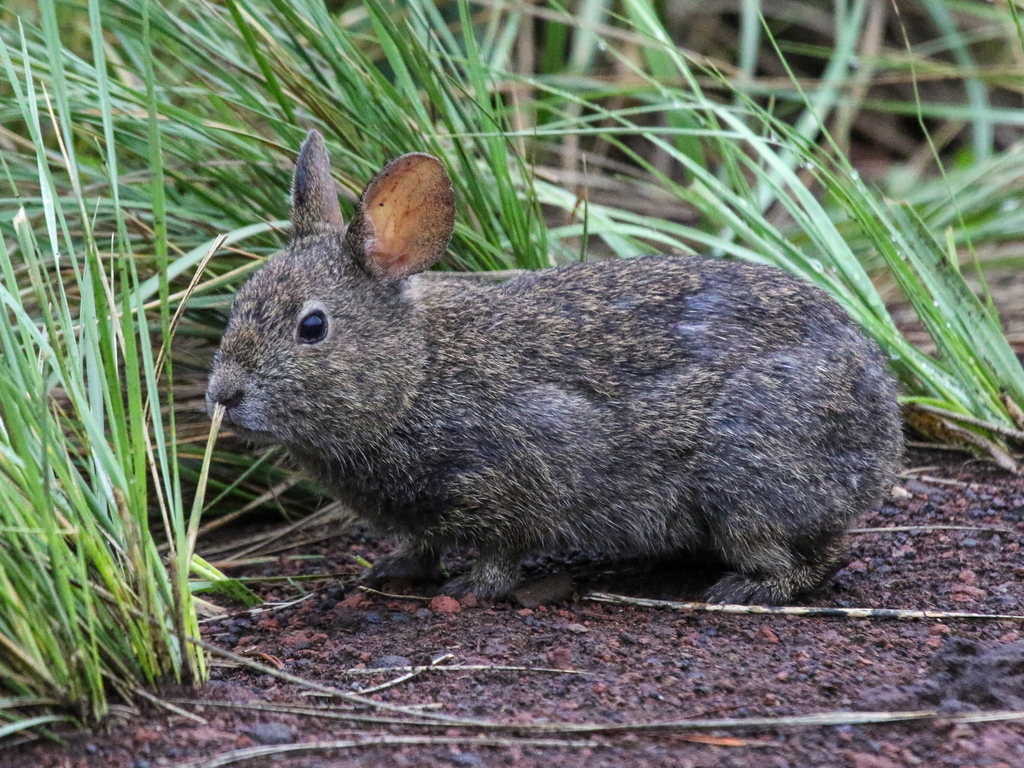
Volcano Rabbit
Romerolagus diazi
The volcano rabbit (Romerolagus diazi) (Spanish: conejo de los volcanes), also known as the teporingo or zacatuche, is a species of small rabbit that lives in pine and alder forests on volcanic slopes in Mexico. It is the only species in the genus Romerolagus and is considered to be the most primitive species among the rabbits and hares. It has small, rounded ears, short legs, a large forehead, and short, thick fur. It is one of the world's smallest rabbits, lives in groups consisting of between two and five members, and makes burrows (underground nests) and runways (worn-down, frequently traveled surface paths) among bunchgrasses. Up to three young are produced per litter, born in nests formed from shallow depressions in the ground lined with fur and plant matter.
Uniquely among the rabbits, the volcano rabbit emits high-pitched sounds to warn other rabbits of danger, a habit common in the related pikas. It is awake and most active in the early morning and evening. Populations have been estimated as approximately 7,000 adult individuals over their entire range. Human developments surrounding the volcano rabbit's habitat—including overgrazing, hunting, and burning of the species' preferred scrublands—have caused significant declines in population, even in protected parks. Both the IUCN and the Mexican government consider the volcano rabbit an endangered species. It is listed on Appendix I of the CITES treaty, which is intended to restrict trade of the animal.
From the article Volcano rabbit on Wikipedia (CC BY-SA), quoted section by section
Description
The volcano rabbit is one of the smallest rabbits in the world, having an adult weight that ranges from 386 to 602 g (0.851 to 1.327 lb) and a total length of 23.4 to 31.1 centimeters (9.2 to 12.2 in). Its ears are small and rounded, measuring less than 4 centimeters (1.6 in) in length, and the hind feet are short, measuring 4.2 to 5.5 centimeters (1.7 to 2.2 in). It has a vestigial tail which is only visible in young rabbits and becomes hidden under the skin in adulthood. Three pairs of mammary glands are present in female rabbits. The volcano rabbit has dense, short fur. Its fur is yellowish brown across all of its body, and is softer on the rabbit's underside. Each hair is black at the base and tip and antimony yellow in the middle. This fur color changes only near the nose, eyes, and at the base of the ears, where it appears more buff. The dark coloration of the volcano rabbit's fur blends in with the volcanic soils in its habitat. This adaptation may help it evade predators. Its coat does not change color from one season to the next. However, it does undergo molting in four stages over the course of the year. First, hair is lost, then melanin disappears, then melanin is deposited at the site of hair loss, after which hair regrows. …
Wikipedia: “Characteristics”
Range & habitat
Volcano rabbits are endemic to an area of only 386 square kilometers (149 sq mi) just southeast of Mexico City, in alpine scrublands surrounding four volcanoes (Cerro Tláloc, Popocatépetl, Iztaccíhuatl, and El Pelado). The largest of these volcanic regions is within the Iztaccíhuatl–Popocatépetl National Park, with other areas including the Chichinautzin and Pelado volcanoes. The highly vegetated Altzomoni peak within the park is noted as being able to sustain a notably large volcano rabbit population compared to other regions. Historically, the volcano rabbit likely occupied larger areas within the Trans-Mexican Volcanic Belt and the Sierra Chichinautzin mountain range. The range of the volcano rabbit has since been fragmented into 16 (later 19) individual patches across these volcanoes due to human disturbance. Volcano rabbits are commonly found at altitudes between 3,150 and 3,400 meters (10,330 and 11,150 ft), but can occur anywhere from 2,800 to 4,250 meters (9,190 to 13,940 ft). The local climate in the volcano rabbit's habitat is temperate and subhumid, with a mean annual temperature of 9.6 °C (49.3 °F). Annual rainfall averages about 1,500 millimeters (59 in). The soil consists mostly of andosols and lithosols, and the vegetation includes varieties from the Nearctic and Neotropical realms, with plants coming from both coniferous forest and tropical communities. …
Wikipedia: “Distribution and habitat”
What it does
Volcano rabbit groups consist of between two and five members. The rabbit creates runways similar to those made by microtine rodents to navigate their habitat. Its burrows consist of tunnels with the entrances beneath dense grass clumps or in cracks in the soil, and can have a length of up to 5 meters (16 ft) and depth of up to 40 centimeters (16 in) under the soil's surface. These burrows may have other entrances to allow for escape, and the tunnels often weave around rocks and roots or split into multiple paths. Volcano rabbits may opportunistically use burrows abandoned by other mammals, such as gophers and badgers, as do some other rabbit species. It is particularly reliant on dense grasses for use as cover to make its nests. As it is a slow mover compared to other rabbits, it is more inclined to seek out cover in higher, less open areas, a behavior also seen in the pygmy rabbit (S. idahoensis). The volcano rabbit produces high-pitched vocalizations to warn others in its group of danger, a behavior seen in pikas that is unique among the rabbits. Little is known about its longevity, and it is expected to have an average lifespan of less than a year in the wild, like other rabbits and hares. It has been described as a diurnal animal, and is most active in the evening and early morning. …
Wikipedia: “Behavior and ecology”
In human culture
Romerolagus diazi was first described by the head of the Mexican Geographical and Exploring Commission, Fernando Ferrari-Pérez, in 1893 as a member of the hares (genus Lepus), using the scientific name Lepus diazi and common name conejo del Volcán (volcano rabbit). The species name diazi honors the Mexican cartographer Agustín Díaz, who published the work where the species was first described. The type specimen was collected on the northeastern slopes of Ixtaccíhuatl, a volcano near San Martín Texmelucan, in the Mexican state of Puebla. It was separately described as the Popocatepetl rabbit, Romerolagus nelsoni, in 1896 by American zoologist Clinton Hart Merriam in an account that did not refer to the earlier work of Ferrari-Pérez. Merriam noted a type specimen that was collected on Popocatépetl at an altitude of 3,350 metres (10,990 feet) by Edward William Nelson, an American naturalist for whom Merriam named the species. Merriam noted several characteristics that differed significantly from any member of the hares, such as its anatomy and means of locomotion (running on all four legs rather than hopping), and gave it the genus name Romerolagus in honor of Matías Romero, Mexican ambassador in the United States and a supporter of the United States Biological Survey in Mexico. American zoologist Gerrit Smith Miller Jr. …
Wikipedia: “Taxonomy and etymology”
Listen
Looking for field recordings…
Where it lives
Recorded sightings
—
geo-referenced records in GBIF, from museums, herbaria and field observers.
Drag the globe to turn it. Dots are where records exist, not a range map; darker means more records.
In the stacks
Searching the stacks…
Every page naming Romerolagus diazi in the Biodiversity Heritage Library →
This page is assembled live from iNaturalist, GBIF, Wikipedia, the Source Library and the Internet Archive. It is not yet part of the hand-edited codex. iNaturalist taxon 43155.