On eBird ↗
Peruvian Pelican
Live sightings near you, the range map, bar charts of when it is seen, and Macaulay Library photos and recordings.
Peruvian Pelican
Pelecanus thagus
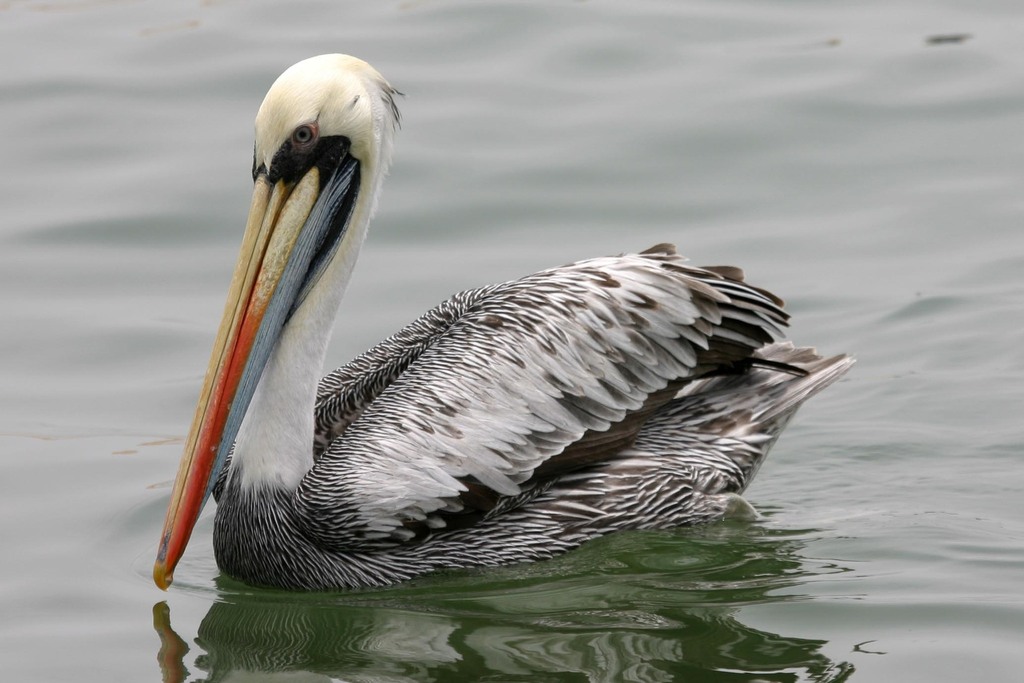
The Peruvian pelican (Pelecanus thagus) is a member of the pelican family. It lives on the west coast of South America, breeding in loose colonies from about 33.5 degrees south in central Chile to Piura in northern Peru, and occurring as a visitor in southern Chile and Ecuador. It used to be considered a subspecies of the brown pelican.
From the article Peruvian pelican on Wikipedia (CC BY-SA), quoted section by section
Description
These birds are dark in colour with a white stripe from the top of the bill up to the crown and down the sides of the neck. They have long tufted feathers on the top of their heads. It was previously considered a subspecies of the brown pelican (Pelecanus occidentalis). The Peruvian pelican is considerably larger, ranging from about 5 to 7 kg (11–15 lb) in weight, 137 to 152 cm (4.5–5.0 ft) in length and with a wingspan of about 228 cm (7.5 ft). Compared to the brown pelican, it also has proportionally longer crest feathers, as well as differences in the colours of the gular pouch, beak, scapulars and greater wing coverts.
What it does
Peruvian pelicans feed on several species of fish. Unlike the brown pelican, they never dive from a great height to catch its food, instead diving from a shallow height or feeding while swimming on the surface. On occasion they may take other food items, such as nestling of imperial shags, young Peruvian diving petrels, gray gulls and cannibalize unrelated chicks of their own species. They also feed on pelagic species such as anchovies. In fact, those in the northern Humboldt Current System feed almost exclusively on one species, the Peruvian anchoveta. The birds feed around cold-water upwellings, being found along the Humboldt Current.
Wikipedia: “Feeding”
Listen
Looking for field recordings…
Where it lives
Recorded sightings
—
geo-referenced records in GBIF, from museums, herbaria and field observers.
Drag the globe to turn it. Dots are where records exist, not a range map; darker means more records.
In the stacks
Searching the stacks…
Every page naming Pelecanus thagus in the Biodiversity Heritage Library →
This page is assembled live from iNaturalist, GBIF, Wikipedia, the Source Library and the Internet Archive. It is not yet part of the hand-edited codex. iNaturalist taxon 4325.