- Animals
- ›Chordates
- ›Vertebrates
- ›Mammals
- ›Therians
- ›Marsupials
- ›Marsupial Moles
- ›Marsupial Moles
- ›Notoryctes
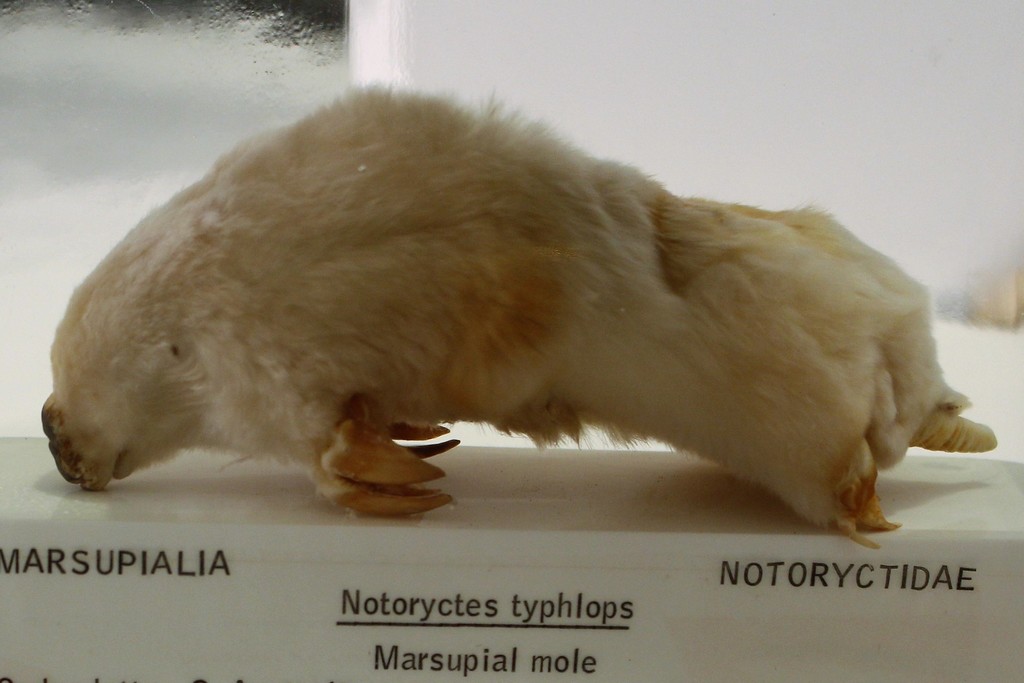
Central Desert Marsupial Mole
Notoryctes typhlops
The southern marsupial mole (Notoryctes typhlops), also known as the itjaritjari (pronounced [ˈɪɟɐrɪɟɐrɪ]) or itjari-itjari, is a mole-like marsupial found in the western central deserts of Australia. It is extremely adapted to a burrowing way of life. It has large, shovel-like forepaws and silky fur, which helps it move easily. It also lacks complete eyes as it has little need for them. It feeds on earthworms and larvae.
From the article Southern marsupial mole on Wikipedia (CC BY-SA), quoted section by section
Description
The southern marsupial mole is small in size, with a head and body length of 121–159 mm (4.8–6.3 in), a tail length of 21–26 mm (0.83–1.02 in) and a weight of 40–70 g (1.4–2.5 oz). The body is covered with short, dense, silky fur with a pale cream to white color often tinted by the iron oxides from the soil which gives it a reddish chestnut brown tint. It has a light brownish pink nose and mouth and no vibrissae. The cone shaped head merges directly with the body, and there is no obvious neck region. The limbs are short and powerful, and digits III and IV of the manus have large spade-like claws. The dentition varies with individuals and, because the molars have a root of only one third of the length, it has been assumed that moles cannot deal with hard food substances. The dorsal surface of the rostrum and the back of the tail have no fur and the skin is heavily keratinized. There is no external evidence of the eyes, and the optic nerve is absent. It does, however, have a pigment layer where the eyes should be, probably a vestige of the retina. Both lachrymal glands and Jacobson's organ are well developed, and it has been suggested that the former plays a role in lubricating the nasal passages and Jacobson's organ. The external ear openings are covered with fur and do not have pinnae. The nostrils are small vertical slits right below the shield-like rostrum. …
Wikipedia: “Morphology”
Range & habitat
The habitat of the southern marsupial mole is not well known, and is generally based on scattered records. It has been often recorded in sandy dunes or flats, usually where spinifex is present. Its habitat seems to be restricted to areas where the sand is soft, as it cannot tunnel through harder materials. Although little is known about its exact distribution, sightings, aboriginal informants and museum records indicate that it lives in the central sandy desert regions of Western Australia, northern South Australia and the Northern Territory. Recent studies indicate that its habitat also includes Great Victoria and Gibson Deserts.
Wikipedia: “Habitat and distribution”
What it does
Due to the lack of any field studies regarding the marsupial moles, there is little known about their behavior. Observations of captive animals are limited since most of the moles do not survive much longer than a month after capture.
Surface behavior. It sometimes wanders above the surface where traces of several animals have been found. While most evidence indicates that it does this seldom and moves just a few meters before burrowing back underground, on some occasions multiple tracks were found suggesting that one or more animals have moved above ground for several hours. According to Aboriginal sources, marsupial moles may surface at any time of day, but seem to prefer to do so after rain and in the cooler season. Captive animals have been observed to feed above ground and then return underground to sleep. Occasionally it has been recorded to suddenly "faint" on the surface without waking up for several hours until disturbed. Above the ground it moves in a sinuous fashion, using its powerful forelimbs to haul the body over the surface and its hind limbs to push forward. The forelimbs are extended forward in unison with the opposite hind limb. Moles move about the surface with frantic haste but little speed, as one observer once likened it to a "Volkswagen Beetle heaving its way through the sand".
Burrowing behavior. …
Wikipedia: “Behavior”
In human culture
Although the southern marsupial mole was probably known by Aboriginal Australians for thousands of years, the first specimen examined by the scientific community was collected in 1888. Stockman W. Coulthard made the discovery on Idracowra Pastoral Lease in the Northern Territory by following some unusual prints that led him to the animal lying under a tussock. Not knowing what to do with the strange creature, he wrapped it in a kerosene soaked rag, placed it in a revolver cartridge box and forwarded it to E. C. Stirling, the Director of the South Australian Museum. Due to the poor transportation conditions of the time, the specimen reached its destination in a badly decomposed state. Hence, Stirling was unable to find any evidence of the pouch or epipubic bones and decided the creature was not a marsupial. Nineteenth century scientists believed that marsupials and eutherians had evolved from the same primitive ancestor and were looking for a living specimen that would serve as the missing link. Because the marsupial mole closely resembled the golden moles of Africa, some scientists concluded that the two were related and that they had found the proof. This, however, is not the case, as became obvious by examining better-preserved specimens that had a marsupial pouch. The striking similarities of the two species are, in fact, the result of convergent evolution.
Wikipedia: “History of discovery”
Listen
Looking for field recordings…
Where it lives
Recorded sightings
—
geo-referenced records in GBIF, from museums, herbaria and field observers.
Drag the globe to turn it. Dots are where records exist, not a range map; darker means more records.
In the stacks
Searching the stacks…
Every page naming Notoryctes typhlops in the Biodiversity Heritage Library →
This page is assembled live from iNaturalist, GBIF, Wikipedia, the Source Library and the Internet Archive. It is not yet part of the hand-edited codex. iNaturalist taxon 43256.