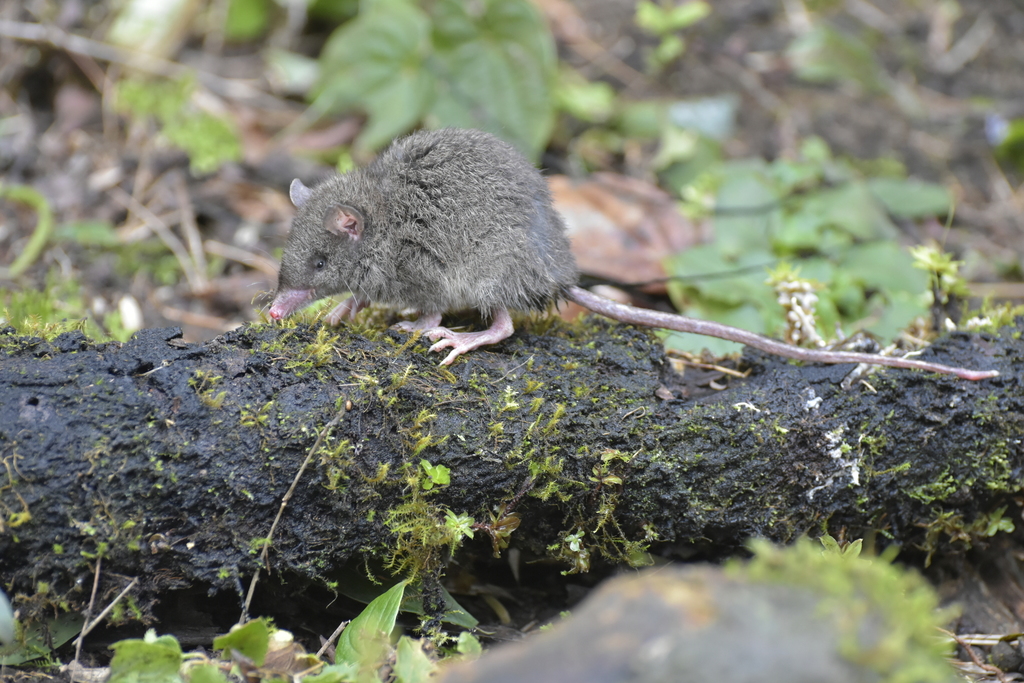
Gray-bellied Shrew Opossum
Caenolestes caniventer
The gray-bellied caenolestid (Caenolestes caniventer), or grey-bellied shrew opossum, is a shrew opossum found in humid, temperate forests and moist grasslands of western Ecuador and northwestern Peru. It was first described by American zoologist Harold Elmer Anthony in 1921. Little is known about the behavior of the gray-bellied caenolestid. It appears to be terrestrial (land-living) and crepuscular (active around twilight) or nocturnal (active at night). Diet consists of invertebrate larvae, small vertebrates and plant material. The IUCN classifies the gray-bellied caenolestid as near threatened.
From the article Gray-bellied caenolestid on Wikipedia (CC BY-SA), quoted section by section
Range & habitat
The gray-bellied caenolestid inhabit cool, moist areas with good cover; it is known from humid, temperate forests at altitudes of up to 2,900 metres (9,500 ft), and moist grasslands in the subtropics. It occurs in small tunnels under tree roots by streams. The range covers western Ecuador and northwestern Peru. The IUCN classifies the gray-bellied caenolestid as near threatened. Its population has decreased by nearly 20% since the 1990s; numbers are feared to be declining due to deforestation and agricultural expansion. The gray-bellied caenolestid occurs in Cajas National Park and Mazán Ecological Reserve.
== References ==
Wikipedia: “Distribution and status”
What it does
Little is known about the behavior of the gray-bellied caenolestid. It appears to be terrestrial (land-living) and crepuscular (active around twilight) or nocturnal (active at night). It appears to be an "opportunistic feeder". Analysis of stomach contents of individuals from Peru suggested a diet comprised largely (up to 75%) by invertebrate larvae (such as arachnids and centipedes); small vertebrates and plant material are also consumed. A pregnant female captured in Ecuador was found to have two fetuses in its womb.
Wikipedia: “Ecology and behavior”
In human culture
The gray-bellied caenolestid is one of the five members of Caenolestes, and is placed in the family Caenolestidae (shrew opossums). It was first described by American zoologist Harold Elmer Anthony in 1921. In the latter part of 20th century, scientists believed that Caenolestes is closely related to Lestoros (the Incan caenolestid). Over the years, it became clear that Lestoros is morphologically different from Caenolestes. A 2013 morphological and mitochondrial DNA-based phylogenetic study showed that the Incan caenolestid and the long-nosed caenolestid (Rhyncholestes raphanurus) form a clade sister to Caenolestes. The cladogram below is based on this study.
Caenolestid fossils date to as early as the early Eocene (nearly 55 mya). The generic name Caenolestes derives from the Greek words kainos ("new") and lestes ("robber", "pirate").
Wikipedia: “Taxonomy and etymology”
Listen
Looking for field recordings…
Where it lives
Recorded sightings
—
geo-referenced records in GBIF, from museums, herbaria and field observers.
Drag the globe to turn it. Dots are where records exist, not a range map; darker means more records.
In the stacks
Searching the stacks…
Every page naming Caenolestes caniventer in the Biodiversity Heritage Library →
This page is assembled live from iNaturalist, GBIF, Wikipedia, the Source Library and the Internet Archive. It is not yet part of the hand-edited codex. iNaturalist taxon 43265.