- Animals
- ›Echinoderms
- ›sea urchins and sea cucumbers
- ›Sea Cucumbers
- ›Actinopoda
- ›Synallactida
- ›Stichopodidae
- ›Australostichopus
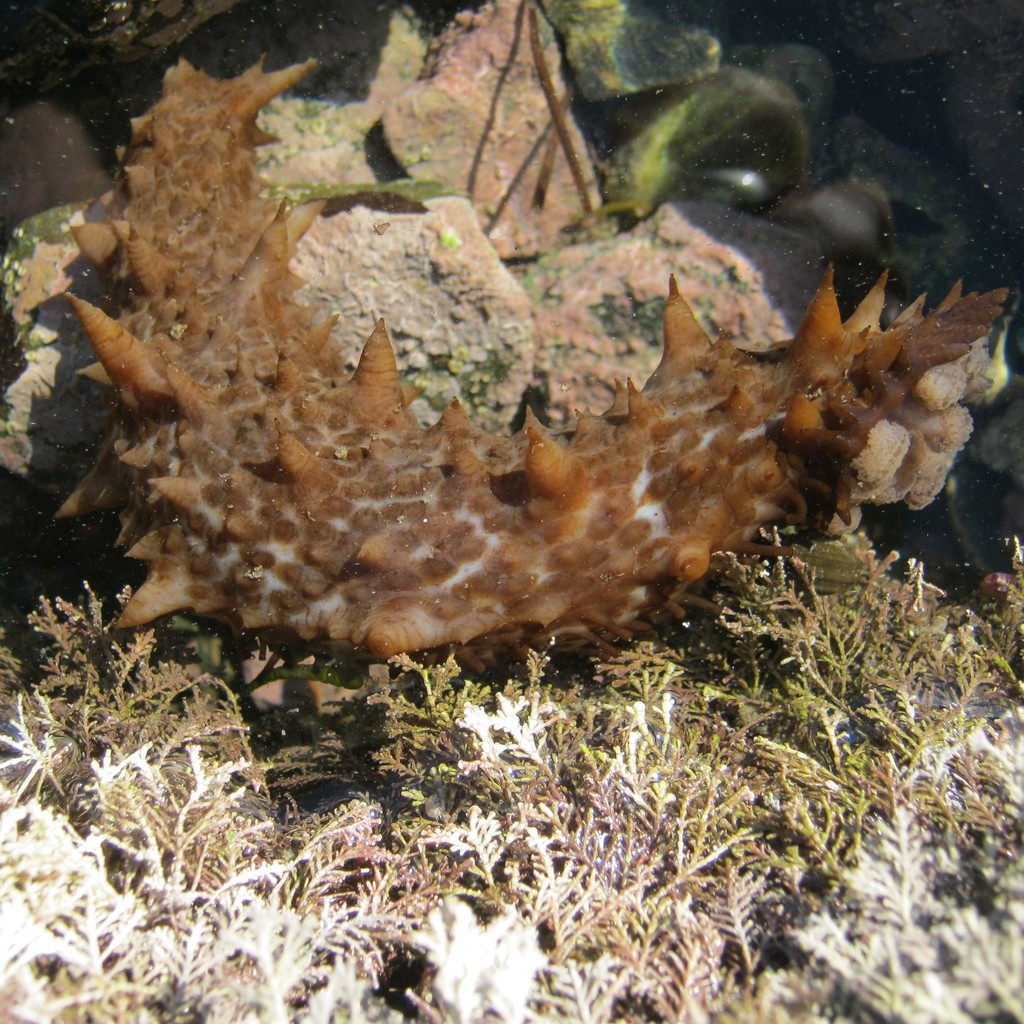
Australasian Brown Sea Cucumber
Australostichopus mollis
Australostichopus is a genus of sea cucumbers in the family Stichopodidae. It is monotypic, being represented by the single species Australostichopus mollis, commonly known as the brown sea cucumber or Australasian sea cucumber. This species has stimulated interest for its fishery potential in the Southern Hemisphere, and for its capability to reduce waste produced by aquaculture. Despite its ecological role and abundance in New Zealand coastal waters, the scarcity of knowledge regarding A. mollis biology and ecology has hindered the development of a stable fishery industry. Importantly, A. mollis represents promising business potential within an important Asian market. Recently its potential as a functional food has been evaluated, highlighting the nutritious components
From the article Australostichopus on Wikipedia (CC BY-SA), quoted section by section
Description
Adult size is typically from 13 to 25 cm. Body is soft, and colour varies from light mottled brown to black. A tube foot is present ventrally or extending up the whole body. Tentacles (20) with disc shaped tips surround the slit-like mouth. Retractor muscles are absent. Dorsally, A. mollis has pointed papillae which can be reduced on preservation.
Wikipedia: “Anatomy”
Range & habitat
In New Zealand, A. mollis is found around the entire coast line of the country, sometimes co-existing with reef structures; and from New South Wales to south Western Australia. The species principally inhabits the littoral at low tide level on sand, as well as in mud in protected areas. Their vertical range goes from shallows waters on the coast to around 200 metres of depth.
Wikipedia: “Distribution”
What it does
Described as detritivores, A. mollis mainly capture particles of organic matter from the substrata, which is highly nutritious.
Wikipedia: “Feeding”
In human culture
Considering the detritus-feeding characteristic of holothurians, and their role on coastal marine systems, several studies have focussed on their grazing effect on sediments. These studies have calculated declines in total organic carbon and chlorophyll a and phaeopigment accumulation, positioning A. mollis as an effective tool to avoid, restore and control pollutive impacts of coastal bivalve aquaculture. In terms of evaluating the feasibility of polycultures, this has been evaluated in the field under Greenshell mussel and Pacific oysters' farms. In land based systems, according to the energetic requirements of adult sea cucumbers, results have inferred that waste production of an industry standard-type abalone lacks sufficient energy to meet A. mollis metabolic needs. However, there is suggestion that feeding juveniles from these wastes could be feasible. Conversely, waste generation from fresh mussels have proven to be the source of enough energy to sustain juvenile stocks, assuming a suitable scale to ensure the supply. Sea cucumbers also have been used as bioremediation units in scenarios of high organic waste pollution from farming, such as salmon. In this instance, this carbon source is transformed into body tissue; an example of efficiently using supplies and producing an alternative culture.
== References ==
Wikipedia: “Polycultures”
Where it lives
Recorded sightings
—
geo-referenced records in GBIF, from museums, herbaria and field observers.
Drag the globe to turn it. Dots are where records exist, not a range map; darker means more records.
In the stacks
Searching the stacks…
Every page naming Australostichopus mollis in the Biodiversity Heritage Library →
This page is assembled live from iNaturalist, GBIF, Wikipedia, the Source Library and the Internet Archive. It is not yet part of the hand-edited codex. iNaturalist taxon 432816.