- Animals
- ›Chordates
- ›Vertebrates
- ›Mammals
- ›Therians
- ›Marsupials
- ›Bandicoots and Bilbies
- ›Bandicoots
- ›Australian Bandicoots
- ›Isoodon
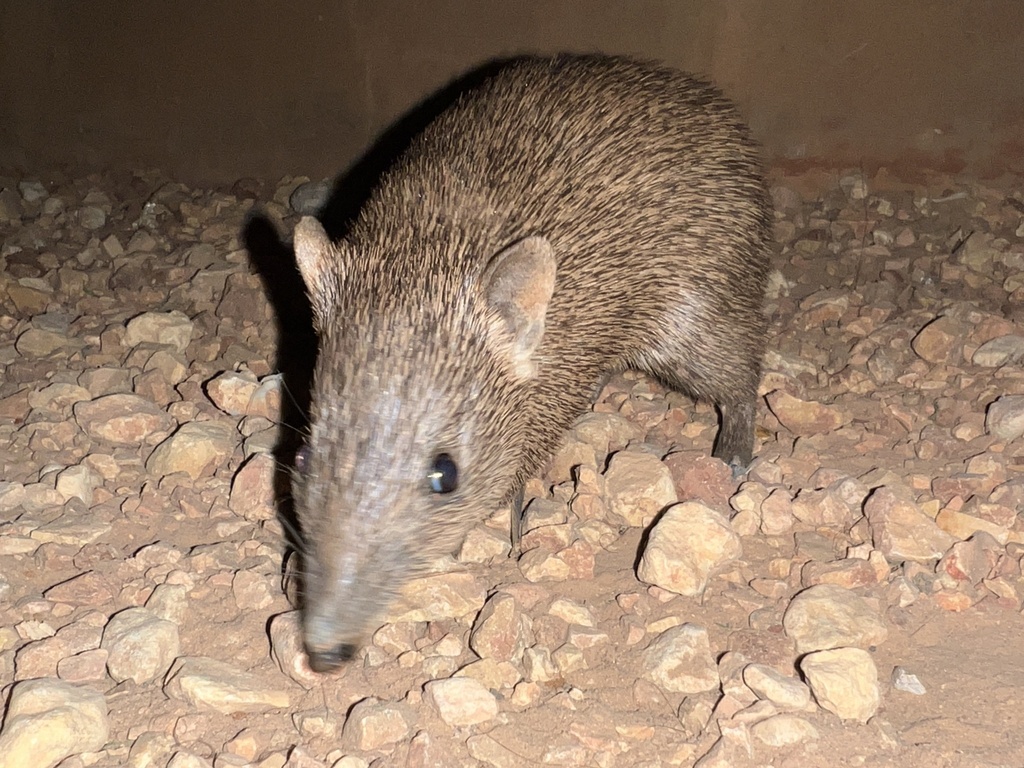
Golden Bandicoot
Isoodon auratus
The golden bandicoot (Isoodon auratus; Yolngu: Wan'kurra) is a short-nosed bandicoot found in northern Australia. It is the smallest of its genus, and is distinguished from the brown bandicoots by its golden colouring and much smaller size.
It was once found throughout much of northern, central and western Australia, into south-western New South Wales, but it is now restricted to a few areas in Western Australia (WA) and the Northern Territory (NT). The I. auratus auratus subspecies, also known as the golden bandicoot (mainland), is found in the Kimberley region of WA, and on three of the Wessel Islands, NT: Marchinbar, Raragala, and Guluwuru Islands. Another subspecies, I. auratus barrowensis or golden bandicoot (Barrow Island), is found on Augustus, Barrow and Middle Islands off Western Australia (I. auratus barrowensis). As of 2023 the classification into subspecies is debated; however the whole species is classed as vulnerable species.
From the article Golden bandicoot on Wikipedia (CC BY-SA), quoted section by section
Range & habitat
The golden bandicoot was once found across most of northern, central and western Australia, as far as south-western New South Wales to the east. Some had also been sighted NSW/SA border, However, numbers declined sharply within a few decades after European settlement of Australia, and was gone from the central deserts by around 1950. By 1983 the only populations on the mainland remained in the Prince Regent National Park in the Kimberley region. It occurs in stable numbers on Barrow, Middle, and Augustus Islands, and by 1995 it was known to live in the Yampi Peninsula in northern Kimberley, as well as and Marchinbar Island in the Northern Territory. The subspecies I. a. arnhemensis was recorded in Arnhem Land from the 1930s to 1980s, but this is now thought to be I. a. auratus. After the population was restricted to Marchinbar Island, groups were translocated and populations have been established on Raragala and Guluwuru Islands, also in the Wessel chain. The largest golden bandicoot population lives on Barrow Island, because no cats or foxes have been introduced to the island, and other populations exist on Middle, Marchinbar, Augustus Islands. Small populations on mainland Australia are located in the Northern Territory and Western Australia. …
Wikipedia: “Range”
What it does
Breeding occurs throughout the year and peaks during the wet season (December–January) and the dry season (August). Amongst marsupials, the golden bandicoot is known to have one of the highest reproductive rates, and it has one of the shortest gestation periods for mammals, only about 12 days. There are about 2–3 young per litter, and they remain in the pouch of the mother for up to 8 weeks. After this, there is little to no parental care, which allows the golden bandicoot to be such a prolific breeder.
Wikipedia: “Reproduction”
In human culture
The animal, known as Wan'kurra in the Yolngu language, features prominently in song-cycles in the ceremonies of the Gumatj people of Arnhem Land. It is a common motif in the work of artist Nancy Gaymala Yunupingu, often running through scrubland. It used to be referred to as "old people's food" by some Aboriginal people, because of their slow pace.
Wikipedia: “In indigenous Australian culture”
Listen
Looking for field recordings…
Where it lives
Recorded sightings
—
geo-referenced records in GBIF, from museums, herbaria and field observers.
Drag the globe to turn it. Dots are where records exist, not a range map; darker means more records.
In the stacks
Searching the stacks…
Every page naming Isoodon auratus in the Biodiversity Heritage Library →
This page is assembled live from iNaturalist, GBIF, Wikipedia, the Source Library and the Internet Archive. It is not yet part of the hand-edited codex. iNaturalist taxon 43297.