- Animals
- ›Echinoderms
- ›sea urchins and sea cucumbers
- ›Sea Cucumbers
- ›Actinopoda
- ›Synallactida
- ›Stichopodidae
- ›Parastichopus
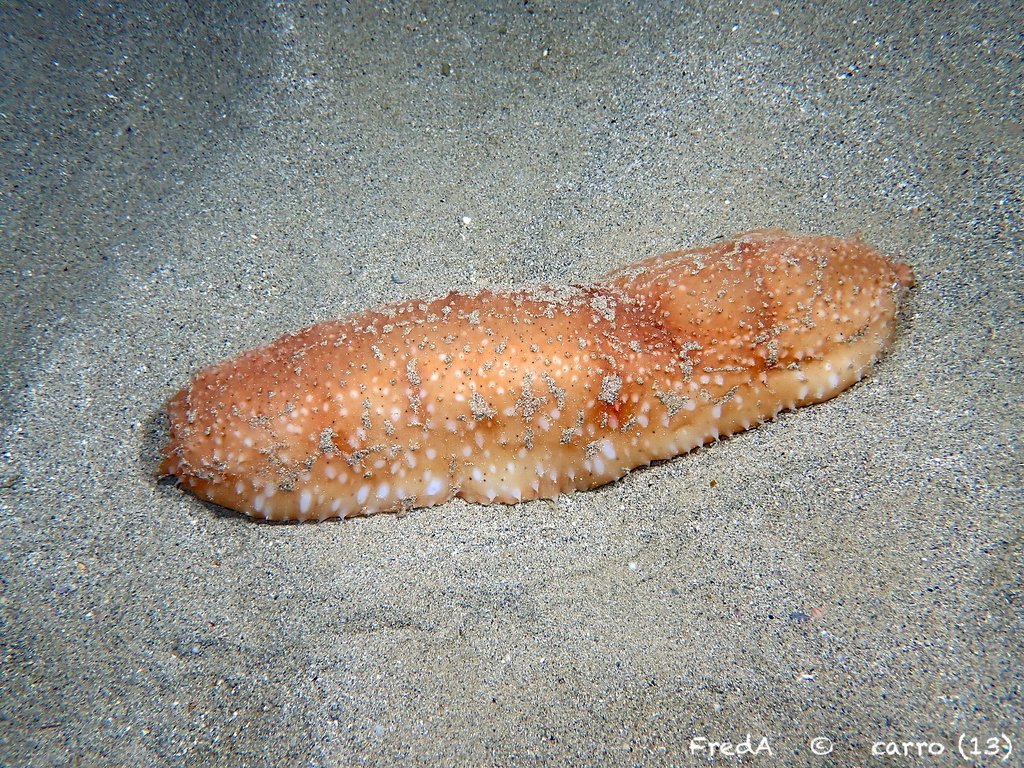
Parastichopus regalis
Parastichopus regalis, also known as the royal sea cucumber, is a species of sea cucumber in the family Stichopodidae.
From the article Parastichopus regalis on Wikipedia (CC BY-SA), quoted section by section
Description
Parastichopus regalis grows to a length of about 20 cm (8 in). The body is soft and somewhat flattened, and a clearly incised lateral fold with large papillae separates the dorsal surface from the ventral surface. The dorsal surface is mottled brown, and the ventral surface is rather paler, with a darker longitudinal streak in the centre. The bony sclerites that strengthen the integument include tables, terminal plates and perforated plates; the sclerites in the tentacles that surround the mouth include elongated, branched, perforated and arched rods.
Range & habitat
Parastichopus regalis is found in the Mediterranean Sea, along the coasts of Africa in the eastern Atlantic Ocean, and in the tropical and subtropical western Atlantic Ocean, including the Gulf of Mexico. It is typically found on sand or other soft substrates, at depths down to about 800 m (2,600 ft); it is commonest in the 100 to 300 m (300 to 1,000 ft) depth range.
Wikipedia: “Distribution and habitat”
What it does
In a commensal arrangement, Parastichopus regalis is often host to the pearlfish Carapus acus, which enters the sea cucumber's respiratory tree via its anus. The fish lives inside the sea cucumber during the day, emerging into the open water at night to feed. Two fish may occupy a single host, and a pair have been known to breed inside their host. When stressed, it autotomises its internal organs, regenerating them again later.
Wikipedia: “Ecology”
Where it lives
Recorded sightings
—
geo-referenced records in GBIF, from museums, herbaria and field observers.
Drag the globe to turn it. Dots are where records exist, not a range map; darker means more records.
In the stacks
Searching the stacks…
Every page naming Parastichopus regalis in the Biodiversity Heritage Library →
This page is assembled live from iNaturalist, GBIF, Wikipedia, the Source Library and the Internet Archive. It is not yet part of the hand-edited codex. iNaturalist taxon 433004.