- Animals
- ›Chordates
- ›Vertebrates
- ›Mammals
- ›Therians
- ›Placental Mammals
- ›Ungulates, Carnivorans, and Allies
- ›Odd-toed Ungulates
- ›Rhinoceroses
- ›Dicerorhinus
Sumatran Rhinoceros
Dicerorhinus sumatrensis
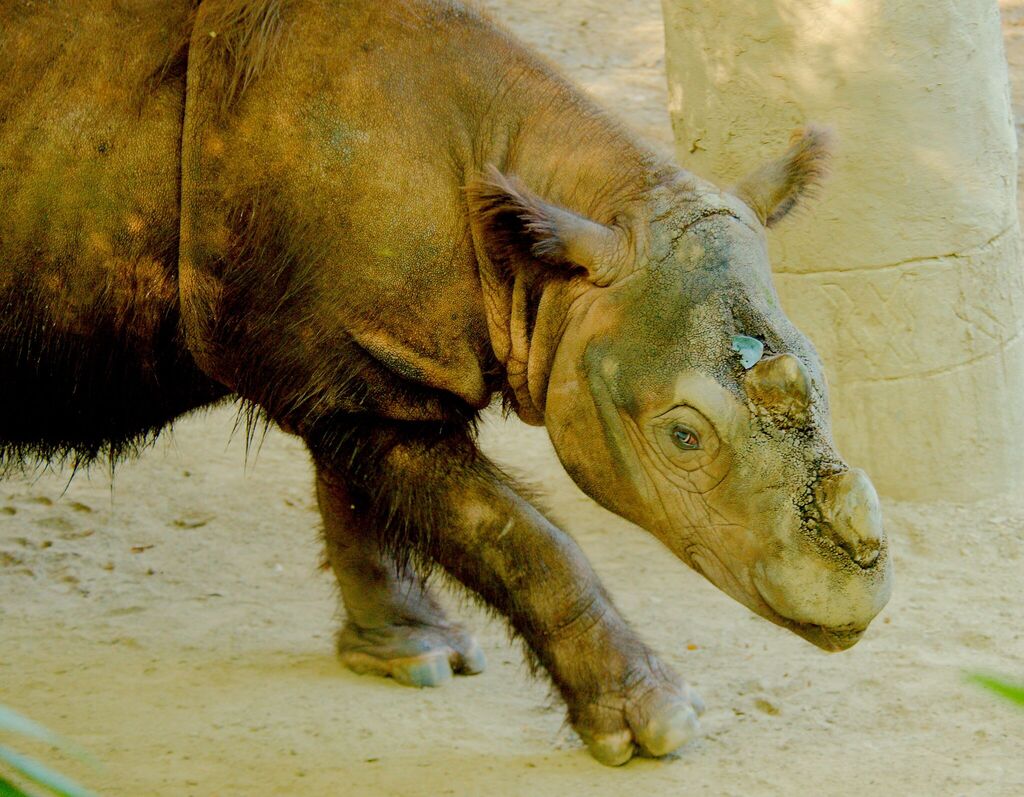
The Sumatran rhinoceros (Dicerorhinus sumatrensis), also known as the Sumatran rhino, hairy rhinoceros or Asian two-horned rhinoceros, is a rare member of the family Rhinocerotidae and one of five extant species of rhinoceros; it is the only extant species of the genus Dicerorhinus. It is the smallest rhinoceros, although it is still a large mammal; it stands 112–145 cm (44–57 in) high at the shoulder, with a head-and-body length of 2.36–3.18 m (7 ft 9 in – 10 ft 5 in) and a tail of 35–70 cm (14–28 in). The weight is reported to range from 500–1,000 kg (1,100–2,200 lb), averaging 700–800 kg (1,540–1,760 lb). Like both African species, it has two horns; the larger is the nasal horn, typically 15–25 cm (5.9–9.8 in), while the other horn is typically a stub. A coat of reddish-brown hair covers most of the Sumatran rhino's body.
The Sumatran rhinoceros once inhabited rainforests, swamps and cloud forests in India, Bhutan, Bangladesh, Myanmar, Laos, Thailand, Malaysia, Indonesia and southwestern China, particularly in Sichuan. It is now critically endangered, with only five substantial populations in the wild: four in Sumatra and one in Borneo, with an estimated total population of fewer than 80 mature individuals. The species was extirpated in Malaysia in 2019, with the last known bull and cow dying in May and November, respectively, and one of the Sumatran populations may already be extinct. In 2015, researchers announced that the Bornean rhinoceros had become extinct in the northern part of Borneo in Sabah, Malaysia.
From the article Sumatran rhinoceros on Wikipedia (CC BY-SA), quoted section by section
Description
A mature Sumatran rhino stands about 112–145 cm (3.67–4.76 ft) high at the shoulder, has a body length of around 236–318 cm (7.74–10.43 ft), and weighs 500–800 kg (1,100–1,760 lb), though the largest individuals in zoos have been known to weigh as much as 2,000 kg (4,410 lb). Like the two African species, it has two horns. The larger is the nasal horn, typically only 15–25 cm (5.9–9.8 in), though the longest recorded specimen was much longer at 81 cm (32 in). The posterior horn is much smaller, usually less than 10 cm (3.9 in) long, and often little more than a knob. The larger nasal horn is also known as the anterior horn; the smaller posterior horn is known as the frontal horn. The horns are dark grey or black in color. The bulls have larger horns than the cows, though the species is not otherwise sexually dimorphic. The Sumatran rhino lives an estimated 30–45 years in the wild, while the record time in captivity is a female D. lasiotis, which lived for 32 years and 8 months before dying in the London Zoo in 1900. Two thick folds of skin encircle the body behind the front legs and before the hind legs. The rhino has a smaller fold of skin around its neck. The skin itself is thin, 10–16 mm (0.39–0.63 in), and in the wild, the rhino appears to have no subcutaneous fat. Hair can range from dense (the most dense hair in young calves) to scarce, and is usually a reddish brown. …
Range & habitat
Remains of Sumatran rhinoceros have been found in Chinese Neolithic sites of Zhejiang, Henan, Fujian, and the northeastern Tibetan Plateau. A revision of Rhinoceros sinensis fossils from Chongqing also identified previously misdiagnosed Sumatran rhinoceros remains among them, proving that the species was already present in Southern China during the Pleistocene. The Sumatran rhinoceros was the most common species in ancient and medieval China, where it coexisted with the rarer Javan rhinoceros. In Southeast Asia, the Sumatran rhinoceros lives in both lowland and highland secondary rainforest, swamps, and cloud forests. It inhabits hilly areas close to water, particularly steep upper valleys with copious undergrowth. The Sumatran rhinoceros once inhabited a continuous range as far north as Myanmar, eastern India, and Bangladesh. Unconfirmed reports also placed it in Cambodia, Laos, and Vietnam. All known living animals occur in the island of Sumatra. Some conservationists hope Sumatran rhinos may still survive in Burma, though it is considered unlikely. Political turmoil in Burma has prevented any assessment or study of possible survivors. …
Wikipedia: “Distribution and habitat”
What it does
Sumatran rhinos are solitary creatures except for pairing before mating and during offspring rearing. Individuals have home ranges; bulls have territories as large as 50 km2 (19 mi2), whereas cows' ranges are 10–15 km2 (3.9–5.8 mi2). The ranges of cows appear to be spaced apart; bulls' ranges often overlap. No evidence indicates Sumatran rhinos defend their territories through fighting. Marking their territories is done by scraping soil with their feet, bending saplings into distinctive patterns, and leaving excrement. The Sumatran rhino is usually most active when eating, at dawn, and just after dusk. During the day, they wallow in mud baths to cool down and rest. In the rainy season, they move to higher elevations; in the cooler months, they return to lower areas in their range. When mud holes are unavailable, the rhino will deepen puddles with its feet and horns. The wallowing behaviour helps the rhino maintain its body temperature and protect its skin from ectoparasites and other insects. Captive specimens, deprived of adequate wallowing, have quickly developed broken and inflamed skins, suppurations, eye problems, inflamed nails, and hair loss, and have eventually died. One 20-month study of wallowing behavior found they will visit no more than three wallows at any given time. After two to 12 weeks using a particular wallow, the rhino will abandon it. …
Wikipedia: “Behavior and ecology”
In human culture
Aside from those few individuals kept in zoos and pictured in books, the Sumatran rhinoceros has remained little known, overshadowed by the more common Indian, black and white rhinos. Recently, however, video footage of the Sumatran rhinoceros in its native habitat and in breeding centers has been featured in several nature documentaries. Extensive footage can be found in an Asia Geographic documentary The Littlest Rhino. Natural History New Zealand showed footage of a Sumatran rhino, shot by freelance Indonesian-based cameraman Alain Compost, in the 2001 documentary Forgotten Rhino, which featured mainly Javan and Indian rhinos. Though they were documented by droppings and tracks, pictures of the Bornean rhinoceros were first taken and widely distributed by modern conservationists in April 2006, when camera traps photographed a healthy adult in the jungles of Sabah in Malaysian Borneo. On 24 April 2007, it was announced that cameras had captured the first-ever video footage of a wild Bornean rhino. The night-time footage showed the rhino eating, peering through jungle foliage, and sniffing the film equipment. The World Wildlife Fund, which took the video, has used it in efforts to convince local governments to turn the area into a rhino conservation zone. …
Wikipedia: “Cultural depictions”
Listen
Looking for field recordings…
Where it lives
Recorded sightings
—
geo-referenced records in GBIF, from museums, herbaria and field observers.
Drag the globe to turn it. Dots are where records exist, not a range map; darker means more records.
In the stacks
Searching the stacks…
Every page naming Dicerorhinus sumatrensis in the Biodiversity Heritage Library →
This page is assembled live from iNaturalist, GBIF, Wikipedia, the Source Library and the Internet Archive. It is not yet part of the hand-edited codex. iNaturalist taxon 43343.