- Animals
- ›Chordates
- ›Vertebrates
- ›Mammals
- ›Therians
- ›Placental Mammals
- ›Primates, Rodents, and Allies
- ›Primates
- ›Monkeys, Apes, and Tarsiers
- ›Monkeys and Apes
- ›New World Monkeys
- ›Marmosets and Tamarins
- ›Callithrix
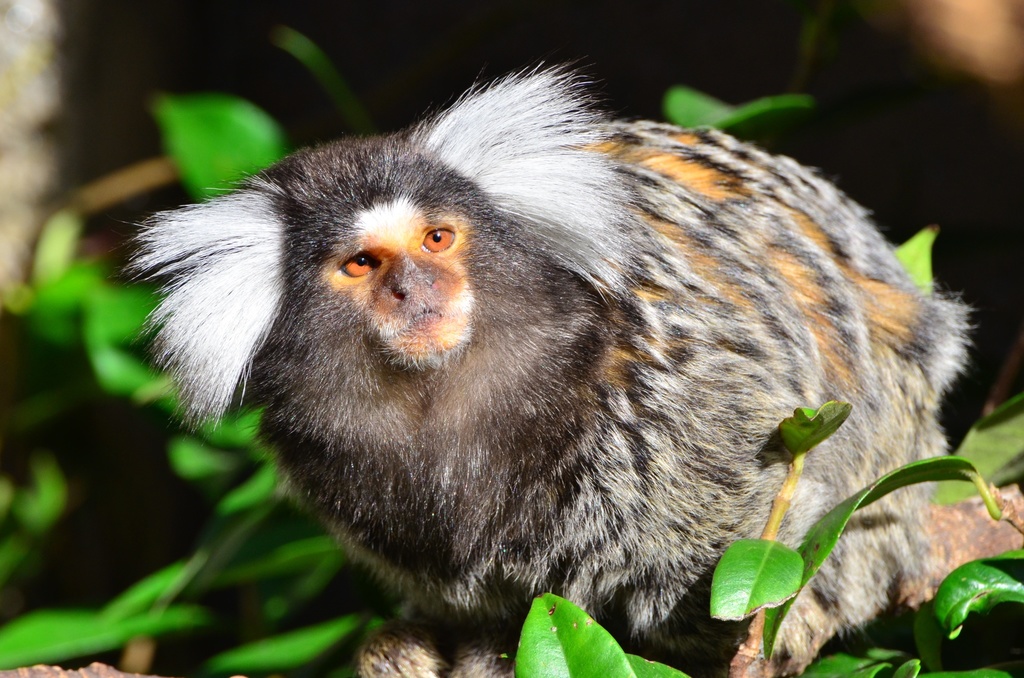
Common Marmoset
Callithrix jacchus
The common marmoset (Callithrix jacchus), also called white-tufted marmoset or white-tufted-ear marmoset, is a New World monkey. It originally lived on the northeastern coast of Brazil, in the states of Piauí, Paraíba, Ceará, Rio Grande do Norte, Pernambuco, Alagoas, and Bahia. Through release (both intentional and unintentional) of captive individuals, it has expanded its range since the 1920s to Southeast Brazil (its first sighting in the wild for Rio de Janeiro was in 1929), where it became an invasive species, raising concerns about genetic pollution of similar species, such as the buffy-tufted marmoset (Callithrix aurita), and predation upon bird nestlings and eggs.
The whole genome sequence of a female common marmoset was published on 20 July 2014. It became the first New World monkey to have its genome sequenced.
From the article Common marmoset on Wikipedia (CC BY-SA), quoted section by section
Range & habitat
Common marmosets are native only to east-central Brazil. They have been introduced into other areas and live within the cities of Rio de Janeiro and Buenos Aires, Argentina. Marmosets can be found in a number of forest habitats. They live in Atlantic coastal forests as well as semideciduous forests farther inland. They can also inhabit savanna forests and riverine forests. Marmosets are successful in dry secondary forests and edge habitats.
Diet. The common marmoset's claw-like nails, incisor shape, and gut specialization reflect their unique diet, which is primarily made of plant exudates and insects. Common marmosets feed on gum, sap, latex, and resin. They use their nails to cling to the side of a tree, and with their long lower incisors, chew a hole in the tree. The marmoset then licks up the exudates or swoops them with the teeth. From 20 to 70% of the marmoset's feeding behavior includes eating exudates. Exudates provide marmosets with a reliable food source in their seasonal habitat. They rely on these foods particularly between January and April, when fruit is not abundant. A marmoset may visit a tree hole multiple times, including those made by other animals. In addition to exudates, insects also prove an important food source for marmosets, making up 24-30% of their food. The small size of marmosets allows them to stalk and ambush them. …
Wikipedia: “Range and ecology”
What it does
Common marmosets have a complex mating system. They were thought to be monogamous, but both polygamy and polyandry have been observed. Nevertheless, most matings are monogamous. Even in groups with two breeding females, the subordinate female often mates with males from other groups. Subordinate females usually do not give birth to fit offspring. Mating with extra-group males may allow the female to find potential mates in the future. Females that mate successfully but lose their young move to other groups and may gain dominant breeding positions.
The breeding individuals in a group need the other members to help raise their young. Thus, the pair behaviorally and physiologically suppresses the reproduction of the other members of the group. Since these suppressed individuals are likely related to the breeding pair, they have an incentive to care for the young, as they share genes with them. In addition, the presence of a related male affects female ovulation. Female ovulation does not occur when their fathers are around, but does occur when an unrelated male is nearby, instead. They also display aggressive behavior towards their mothers, possibly to displace them. When conditions are right for them to breed, adult females breed regularly for the rest of their lives. Females flick their tongues at males to solicit mating. …
Wikipedia: “Reproduction and parenting”
Listen
Looking for field recordings…
Where it lives
Recorded sightings
—
geo-referenced records in GBIF, from museums, herbaria and field observers.
Drag the globe to turn it. Dots are where records exist, not a range map; darker means more records.
In the old herbals & bestiaries

In the stacks
Searching the stacks…
Every page naming Callithrix jacchus in the Biodiversity Heritage Library →
This page is assembled live from iNaturalist, GBIF, Wikipedia, the Source Library and the Internet Archive. It is not yet part of the hand-edited codex. iNaturalist taxon 43373.