- Animals
- ›Chordates
- ›Vertebrates
- ›Mammals
- ›Therians
- ›Placental Mammals
- ›Primates, Rodents, and Allies
- ›Primates
- ›Monkeys, Apes, and Tarsiers
- ›Monkeys and Apes
- ›New World Monkeys
- ›Marmosets and Tamarins
- ›Leontopithecus
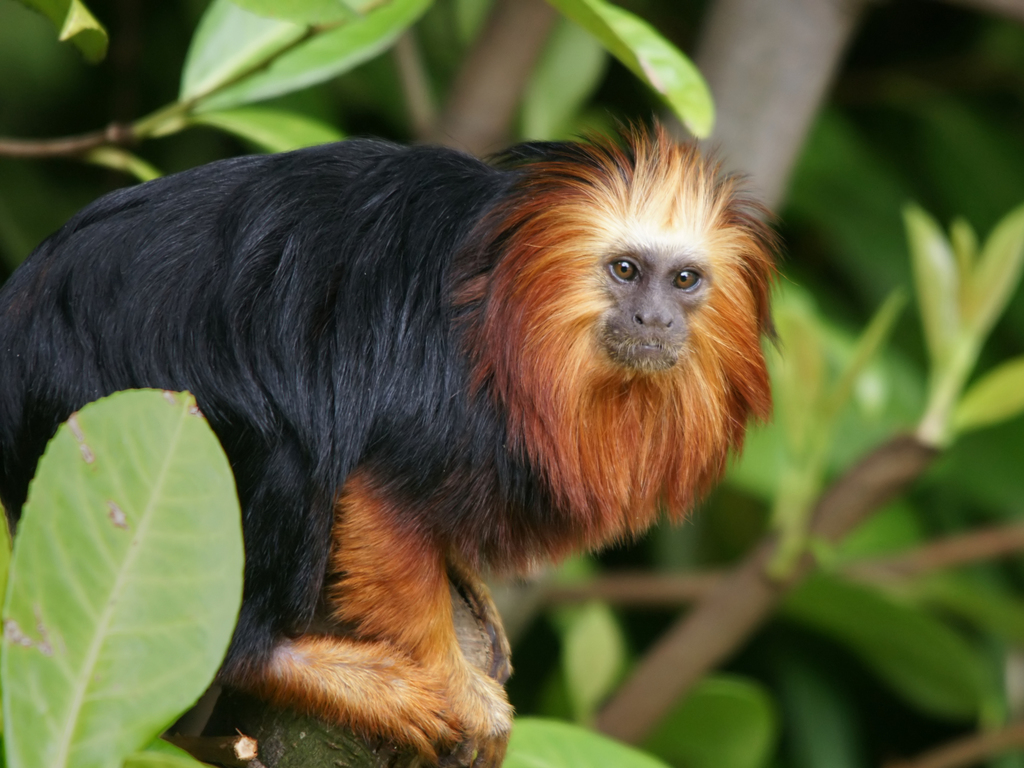
Golden-headed Lion Tamarin
Leontopithecus chrysomelas
The golden-headed lion tamarin (Leontopithecus chrysomelas), also the golden-headed tamarin, is a lion tamarin endemic to Brazil. It is found only in the lowland and premontane tropical forest fragments in the state of Bahia, and therefore is considered to be an endangered species. It lives at heights of 3–10 metres (9.8–32.8 ft). Its preferred habitat is within mature forest, but with habitat destruction this is not always the case. Several sources seem to have different information on the number of individuals within a group, and the type of social system that may be apparent. The golden-headed lion tamarin lives within group sizes ranging from 2 to 11 individuals, with the average size ranging from 4 to 7. According to various sources, the group may consist of two adult males, one adult female, and any immature individuals, one male and one female and any immature individuals, or there may be one producing pair and a varying number of other group members, usually offspring from previous generations. There is not much known on its mating system, but according to different sources, and information on the possible social groups, it can be assumed that some may practice monogamous mating systems, and some may practice polyandrous mating systems. Both males and females invest energy in caring for the young, and all members of the group also help with juvenile care.
From the article Golden-headed lion tamarin on Wikipedia (CC BY-SA), quoted section by section
Range & habitat
Its home range may be large in order to provide a sufficient amount of easily depletable fruit and prey foraging sites over the long term. On average it defended home ranges that are 123 hectares. Space is not necessarily used exclusively, and golden-headed lion tamarin groups may occupy areas that overlap to some extent at their borders
Wikipedia: “Range”
What it does
Raboy and Dietz, who completed a study at Una Biological Reserve on diet and foraging patterns, observed that the golden-headed lion tamarin tends to defend a large home range relative to its small body size, (ranging from 40–320 hectares). It has a very wide diet; it eats plants, fruits, flowers, nectar, insects and small invertebrates; which include insect larvae, spiders, snails, frogs, lizards, bird eggs and small snakes. Typically, fruits are eaten shortly after awaking, as the fruit sugars provide quick energy for hunting later on. It searches for animal prey within epiphytic bromeliads; if its home range does not contain many bromeliads, then it will also forage in crevices, holes in trees, between palm fronds and in leaf litter. It occasionally eats gum, but this behavior is rare in this species of tamarin. Since its habitat is fairly stable within the rainforest, its preferred food is available year-round and they do not need to resort to the low nutritional value of exudates.
Wikipedia: “Diet”
Listen
Looking for field recordings…
Where it lives
Recorded sightings
—
geo-referenced records in GBIF, from museums, herbaria and field observers.
Drag the globe to turn it. Dots are where records exist, not a range map; darker means more records.
In the stacks
Searching the stacks…
Every page naming Leontopithecus chrysomelas in the Biodiversity Heritage Library →
This page is assembled live from iNaturalist, GBIF, Wikipedia, the Source Library and the Internet Archive. It is not yet part of the hand-edited codex. iNaturalist taxon 43394.