- Animals
- ›Chordates
- ›Vertebrates
- ›Mammals
- ›Therians
- ›Placental Mammals
- ›Primates, Rodents, and Allies
- ›Primates
- ›Monkeys, Apes, and Tarsiers
- ›Monkeys and Apes
- ›New World Monkeys
- ›Spider, Howler, and Woolly Monkeys
- ›Spider and Woolly Monkeys
- ›Ateles
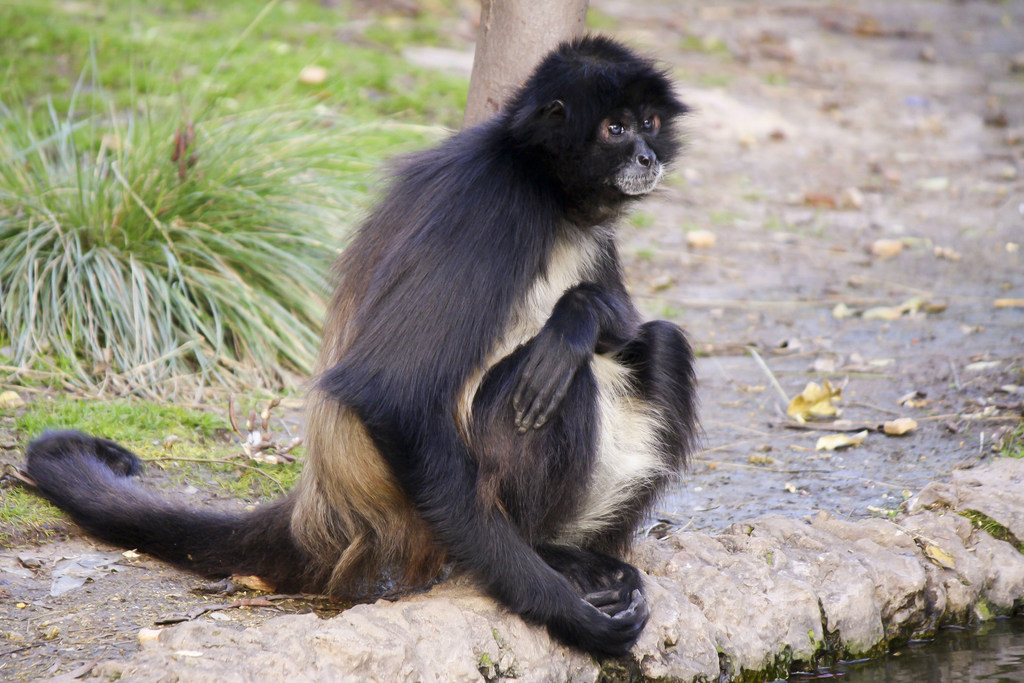
White-bellied Spider Monkey
Ateles belzebuth
The white-bellied spider monkey (Ateles belzebuth), also known as the white-fronted or long-haired spider monkey, is an endangered species of spider monkey, a type of New World monkey. It is found in the north-western Amazon in Colombia, Ecuador, Venezuela, Peru and Brazil, ranging as far south as the lower Ucayali River and as far east as the Branco River. In the past, the Peruvian, brown and white-cheeked spider monkeys have been treated as subspecies of A. belzebuth. As presently defined, the white-bellied spider monkey is monotypic. It has a whitish belly and a pale patch on the forehead, which, despite its common name, often is orange-buff, though this might be due to dirt and other stainers. They live in groups of 20 to 40 individuals, splitting into small parties of 1 to 9 when in activity.
Vernacular names include mono prieto, mico prieto and marimonda (Colombia).
From the article White-bellied spider monkey on Wikipedia (CC BY-SA), quoted section by section
What it does
White-bellied spider monkeys are important long-distance seed dispersal agents for many fruit-bearing species. They are a dominant disperser for Oenocarpus bataua, a species of palm. A. belzebuth often occupies a large territory and will utilize multiple nesting trees throughout their territory. Seeds of preferred species are often dispersed below sleeping trees. They live in social groups that operate using fission-fusion dynamics. These groups are characterized by fragmenting into subgroups that travel, feed and sleep together. These groups display great fluidity and will often change composition, sometimes changing several times each day. The composition of these groups can be influenced by the reproductive status of females. Females are usually more solitary than males, but females with dependent offspring are more likely to join a large group than those without dependent offspring. Females will also usually remain in small core ranges within their home territories with their offspring while males will utilize more of their home range. These subgroups are brought together with long distance vocalizations. These long distance vocalizations can be up to a kilometer away. …
Wikipedia: “Ecology”
Listen
Looking for field recordings…
Where it lives
Recorded sightings
—
geo-referenced records in GBIF, from museums, herbaria and field observers.
Drag the globe to turn it. Dots are where records exist, not a range map; darker means more records.
In the stacks
Searching the stacks…
Every page naming Ateles belzebuth in the Biodiversity Heritage Library →
This page is assembled live from iNaturalist, GBIF, Wikipedia, the Source Library and the Internet Archive. It is not yet part of the hand-edited codex. iNaturalist taxon 43406.