- Animals
- ›Chordates
- ›Vertebrates
- ›Mammals
- ›Therians
- ›Placental Mammals
- ›Primates, Rodents, and Allies
- ›Primates
- ›Monkeys, Apes, and Tarsiers
- ›Monkeys and Apes
- ›New World Monkeys
- ›Spider, Howler, and Woolly Monkeys
- ›Spider and Woolly Monkeys
- ›Ateles
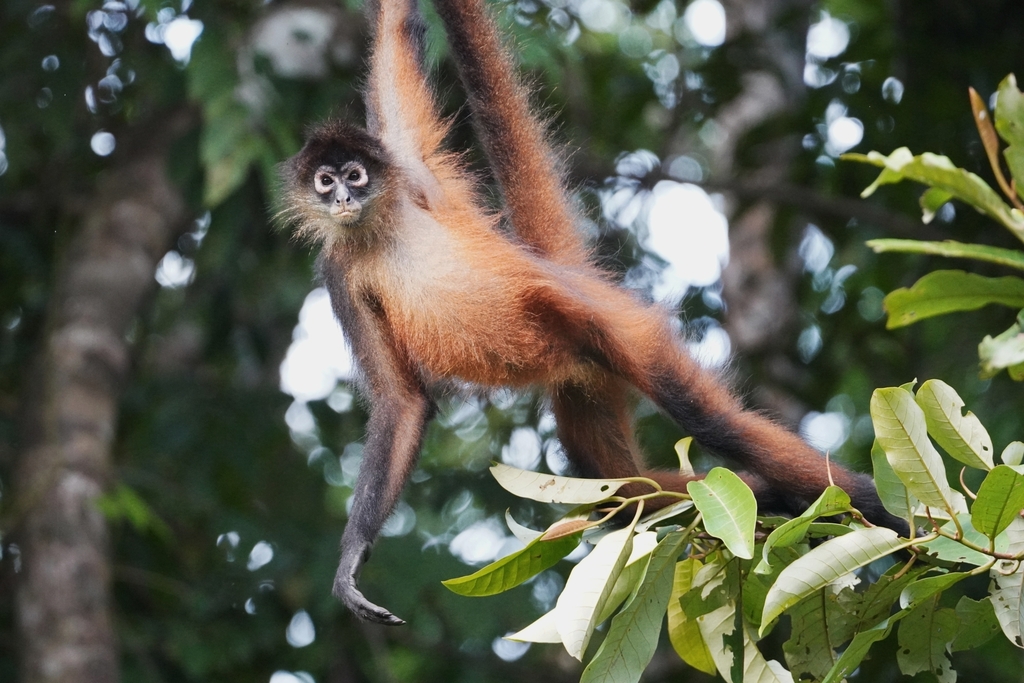
Central American Spider Monkey
Ateles geoffroyi
Geoffroy's spider monkey (Ateles geoffroyi), also known as the black-handed spider monkey or the Central American spider monkey, is a species of spider monkey, a type of New World monkey, from Central America, parts of Mexico and possibly a small portion of Colombia. There are at least five subspecies. Some primatologists classify the black-headed spider monkey (A. fusciceps), found in Panama, Colombia, and Ecuador as the same species as Geoffroy's spider monkey.
It is one of the largest New World monkeys, often weighing as much as 9 kg (20 lb). Its arms are significantly longer than its legs, and its prehensile tail can support the entire weight of the monkey and is used as an extra limb. Its hands have only a vestigial thumb, but long, strong, hook-like fingers. These adaptations allow the monkey to move by swinging by its arms beneath the tree branches.
From the article Geoffroy's spider monkey on Wikipedia (CC BY-SA), quoted section by section
Range & habitat
The range of this species extends over much of Central America, encompassing Panama, Costa Rica, Nicaragua, Guatemala, Honduras, El Salvador, Belize and the south and much of the eastern portion of Mexico. Observations by local people indicate the southernmost subspecies, the hooded spider monkey, A. g. grisescens, may also occur in the portion of Colombia near the Panama border. In western Colombia and northeast Panama, it is replaced by the black-headed spider monkey, A. fusciceps, which is considered by some primatologists to be a subspecies of Geoffroy's spider monkey. Geoffroy's spider monkey lives in various types of forest, including rainforest, semideciduous and mangrove forests. Higher densities of Geoffroy's spider monkeys are generally found in areas containing evergreen forest.
Wikipedia: “Distribution and habitat”
What it does
Geoffroy's spider monkey is arboreal and diurnal, and mostly inhabits the upper portion of the forest. However, it comes to the ground more frequently than other spider monkey species. It lives in fission–fusion societies, large groups with a typical 20 to 42 members, which split into smaller subgroups to forage during the day. Subgroups typically number two to six members, and sometimes the subgroups remain separate from the main group even through the night. Geoffroy's spider monkey forages over large tracts of forest in search of food. Home ranges for groups can exceed 900 hectares (2,200 acres). Monkeys can range about 2,000 metres (6,600 ft) each day. Males tend to cover a larger day range than females, and dominant individuals tend to have larger day ranges. Geoffroy's spider monkey sometimes rubs a mixture of saliva and ground lime tree Citrus aurantifolia leaves on its fur. This is believed to act as an insect repellent. In some locations, Geoffroy's spider monkey interacts with the white-headed capuchin. These interactions can include mutual grooming. In addition to walking or running on four limbs and climbing, Geoffroy's spider monkey uses several forms of suspensory locomotion. Brachiation, or swinging from the arms with assistance from the prehensile tail, is the most common form of suspensory locomotion. …
Wikipedia: “Behavior”
In human culture
The Mexican painter Frida Kahlo's Self-Portrait with Monkey 1938 portrays this species; the artist kept several of them as pets.
Wikipedia: “In culture”
Listen
Looking for field recordings…
Where it lives
Recorded sightings
—
geo-referenced records in GBIF, from museums, herbaria and field observers.
Drag the globe to turn it. Dots are where records exist, not a range map; darker means more records.
In the stacks
Searching the stacks…
Every page naming Ateles geoffroyi in the Biodiversity Heritage Library →
This page is assembled live from iNaturalist, GBIF, Wikipedia, the Source Library and the Internet Archive. It is not yet part of the hand-edited codex. iNaturalist taxon 43411.