- Animals
- ›Chordates
- ›Vertebrates
- ›Mammals
- ›Therians
- ›Placental Mammals
- ›Primates, Rodents, and Allies
- ›Primates
- ›Monkeys, Apes, and Tarsiers
- ›Monkeys and Apes
- ›Apes and Old World Monkeys
- ›Old World Monkeys
- ›Cercopithecines
- ›Baboons, Macaques, and Mangabeys
- ›Macaca
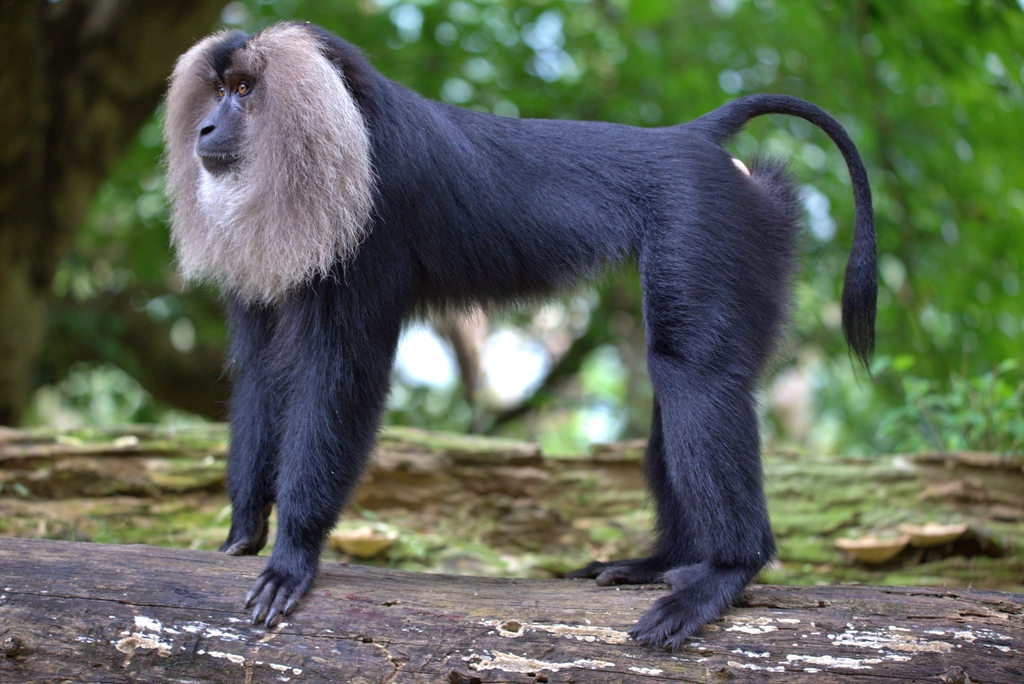
Lion-tailed Macaque
Macaca silenus
The lion-tailed macaque (Macaca silenus)(known as സിംഹവാലൻ കുരങ്ങ് in Malayalam), or the wanderoo, is an Old World monkey endemic to the Western Ghats of South India.
From the article Lion-tailed macaque on Wikipedia (CC BY-SA), quoted section by section
Description
Lion-tailed macaques are covered in black fur, and have a striking gray or silver mane that surrounds the face in both sexes. The face itself is hairless and black in adults, but pinkish in infants less than a year old. Infants are born with no mane, which begins to growth about two months after birth. They are named not for their mane, but for their tail, which is long, thin, and naked, with a lion-like, black tail tuft at the tip. The size of their tail is about 25 cm (9.8 in) in length. Their eyes are a shade of hazelnut with highlighting black eyelids. Lion-tailed macaques, like other macaques, have deep cheek pouches used for storing food, and are quadrupedal with opposable digits. The mane that surrounds its face gives this monkey its German name Bartaffe – "beard ape". With a head-body length of 42–61 cm (17–24 in) and a weight of 2–10 kg (4.4–22.0 lb), it ranks among the smaller macaques species.
Wikipedia: “Characteristics”
What it does
The lion-tailed macaque is a rainforest dweller, often found in the upper canopy of tropical moist evergreen forests or monsoon forests. It is diurnal, meaning it is active exclusively in daylight hours. When active, they will spend half the day foraging, and the other half will be spent resting or finding new areas to forage. This species tends to avoid humans more than other macaques, however, habitat loss has led to increased habituation and conflict with humans. In group behavior, the lion-tailed macaque is much like other macaques, living in hierarchical groups of usually 10 to 20 members, which usually consist of few males, typically 1–3 (including the dominant alpha), and many females. They have a polygynous mating system with no specific breeding season. While there is no specific breeding season, they tend to breed in the wet season, when resources are most abundant. Little time is spent grooming or playing with others in the group. Lion-tailed macaques are a territorial animal, defending their area first with loud cries and bared teeth towards the invading troops. If this proves to be fruitless, it brawls aggressively, which can result in severe injuries due to lacerations from their large canines. …
Wikipedia: “Behavior and ecology”
Listen
Looking for field recordings…
Where it lives
Recorded sightings
—
geo-referenced records in GBIF, from museums, herbaria and field observers.
Drag the globe to turn it. Dots are where records exist, not a range map; darker means more records.
In the old herbals & bestiaries

In the stacks
Searching the stacks…
Every page naming Macaca silenus in the Biodiversity Heritage Library →
This page is assembled live from iNaturalist, GBIF, Wikipedia, the Source Library and the Internet Archive. It is not yet part of the hand-edited codex. iNaturalist taxon 43446.