- Animals
- ›Chordates
- ›Vertebrates
- ›Mammals
- ›Therians
- ›Placental Mammals
- ›Primates, Rodents, and Allies
- ›Primates
- ›Monkeys, Apes, and Tarsiers
- ›Monkeys and Apes
- ›Apes and Old World Monkeys
- ›Old World Monkeys
- ›Cercopithecines
- ›Baboons, Macaques, and Mangabeys
- ›Macaca
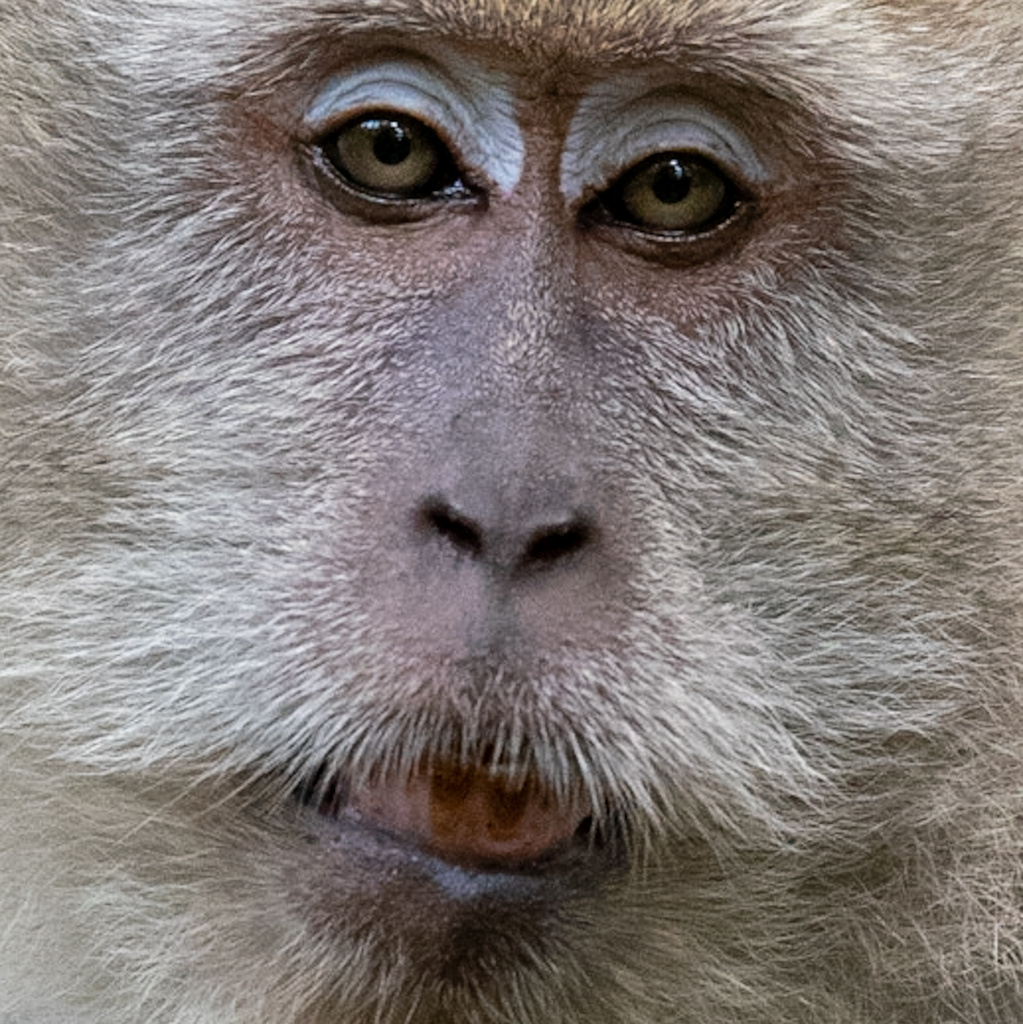
Long-tailed Macaque
Macaca fascicularis
Macaca fascicularis, variously known by common names such as crab-eating macaque, long-tailed macaque, or cynomolgus monkey, is a macaque species native to Southeast Asia. As a synanthropic species, the crab-eating macaque thrives near human settlements and in secondary forests. The crab-eating macaque has developed a variety of cultural perceptions, from being smart and adaptive, to being sacred, to even being pests in some cases.
The crab-eating macaque is omnivorous and frugivorous. It lives in matrilineal groups ranging from 10 to 85 individuals, with groups exhibiting female philopatry and males emigrating from natal group at puberty. The crab-eating macaque is the only old-world monkey known to use stone tools in their daily foraging, and it engages in a robbing and bartering behavior in some tourist locations.
From the article Macaca fascicularis on Wikipedia (CC BY-SA), quoted section by section
Description
The crab-eating macaque is sexually dimorphic, with males weighing between 4.7 and 8.3 kg (10 and 18 lb) and females weighing 2.5–5.7 kg (5.5–12.6 lb). The height of an adult male is between 412–648 mm (16.2–25.5 in) and 385–505 mm (15.2–19.9 in) for adult females. Its tail is the length of its head and body combined. Dorsal pelage is generally greyish or brownish with a white underbelly with black and white highlights around the crown and face. The face skin is brownish to pinkish except for the eyelids which are white. Adults are usually bearded on and around the face, except for around the snout and eyes. Older females have the fullest beards, with males' being more whisker like. Subspecies on islands seem to have black coloration of their pelage, and large island and mainland subspecies are lighter.
Wikipedia: “Characteristics”
Range & habitat
The crab-eating macaque's native range encompasses most of mainland Southeast Asia, through the Malay Peninsula and Singapore, the Maritime Southeast Asia islands of Sumatra, Java, and Borneo, offshore islands, the islands of the Philippines, and the Nicobar Islands in the Bay of Bengal. This primate is a rare example of a terrestrial mammal that violates the Wallace line, being found out across the Lesser Sunda Islands. It lives in a wide variety of habitats, including primary lowland rainforests, disturbed and secondary rainforests, shrubland, and riverine and coastal forests of nipa palm and mangrove. It also easily adjusts to human settlements and is considered sacred at some Hindu temples and on some small islands, but as a pest around farms and villages. Typically, it prefers disturbed habitats and forest periphery.
Introduction to other regions. Humans have transported crab-eating macaques to at least five islands: Mauritius, Western New Guinea, Ngeaur, Tinjil Island near Java, and Kabaena Island off of Sulawesi, and to Kowloon Hills of Hong Kong. There was no indigenous human population on Mauritius. Early exploration of Mauritius by Phoenicians, Swahili people and Arab merchants has been suggested but it was not until the early 16th century that there is hard evidence of human presence on the island, with the Portuguese using it as a refreshing post. …
Wikipedia: “Distribution and habitat”
What it does
The crab-eating macaque is highly adaptive, living near and benefiting from humans and environmental modifications.
Group size and structure. Crab-eating macaques live in matrilineal groups ranging from 10 to 85 members, but most often fall in the range of 35–50. Group size varies greatly, especially between non-provisioned and provisioned groups. Large groups live in secondary forest, savanna and thorn scrub vegetation, and urban habitats and temples. Smaller groups live in primary forest, swamp and mangrove forests. Groups will break into subgroups during the day throughout their range. Composition of groups is multi-male/multi-female but females outnumber males with the sex ratio varying between 1:5–6 and 1:2. Groups exhibit female philopatry with males emigrating from natal group at puberty. Males leave natal group as late juveniles or subadults before the age of seven. On average, adult females and juveniles in groups are related at the level of cousins, whereas adult males are unrelated. Higher relatedness in females is expected due to female philopatry.
Social organization. Macaque social groups have a clear dominance hierarchy among females, these ranks are stable over a female's lifetime and the matriline's rank may be sustained for generations. …
Wikipedia: “Behavior and ecology”
In human culture
Macaca comes from the Portuguese word macaco, which was derived from makaku, a word in Ibinda, a language of Central Africa (kaku means monkey in Ibinda). The specific epithet fascicularis is Latin for a small band or stripe. Sir Thomas Raffles, who gave the animal its scientific name in 1821, did not specify what he meant by the use of this word. In Indonesia and Malaysia, the crab-eating macaque and other macaque species are known generically as kera. The crab-eating macaque has several common names. It is often referred to as the long-tailed macaque due to its tail, which is the length of their body and head combined. The name crab-eating macaque refers to it being seen foraging beaches for crabs. Another common name for M. fascicularis, often used in laboratory settings, is the cynomolgus monkey which derives from Greek Kynamolgoi meaning "dog milkers". It has also been suggested that cynomolgus refers to a race of humans with long hair and handsome beards who used dogs for hunting according to Aristophanes of Byzantium, who seemingly derived the etymology of the word cynomolgus from the Greek κύων, cyon 'dog' (gen. cyno-s) and the verb ἀμέλγειν, amelgein 'to milk' (adj. amolg-os), by claiming that they milked female dogs.
Wikipedia: “Etymology”
Listen
Looking for field recordings…
Where it lives
Recorded sightings
—
geo-referenced records in GBIF, from museums, herbaria and field observers.
Drag the globe to turn it. Dots are where records exist, not a range map; darker means more records.
In the stacks
Searching the stacks…
Every page naming Macaca fascicularis in the Biodiversity Heritage Library →
This page is assembled live from iNaturalist, GBIF, Wikipedia, the Source Library and the Internet Archive. It is not yet part of the hand-edited codex. iNaturalist taxon 43459.