- Animals
- ›Chordates
- ›Vertebrates
- ›Mammals
- ›Therians
- ›Placental Mammals
- ›Primates, Rodents, and Allies
- ›Primates
- ›Monkeys, Apes, and Tarsiers
- ›Monkeys and Apes
- ›Apes and Old World Monkeys
- ›Old World Monkeys
- ›Colobines
- ›Langurs, Surilis, and Lutungs
- ›Trachypithecus
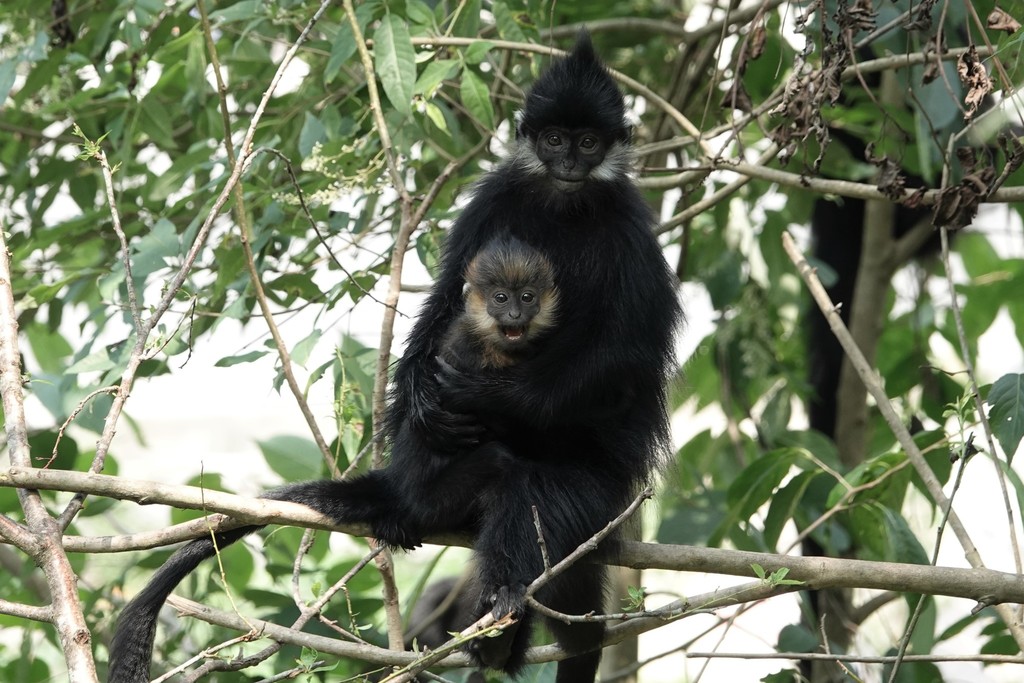
François' Lutung
Trachypithecus francoisi
François' langur (Trachypithecus francoisi), also known as Francois' leaf monkey, the Tonkin leaf monkey, or the white side-burned black langur is a species of Old World monkey and the type species of its species group. It is one of the least studied of the species belonging to the Colobinae subfamily.
The species is distributed from Southwestern China to northeastern Vietnam. The total number of wild individuals is unknown, but fewer than 500 are believed to be left in Vietnam and 1,400–1,650 in China. About 60 langurs are in captivity in North American zoos. The species is named after Auguste François (1857–1935), who was the French Consul at Lungchow in southern China.
From the article François' langur on Wikipedia (CC BY-SA), quoted section by section
Range & habitat
The preferred habitat of François' langur is a karst topography; limestone cliffs and caves of tropical and subtropical zones. By living on these limestone cliffs, the langur is at an advantage when it comes to sleeping arrangements. It sleeps either on ledges or in caves, with its preference being in the cave. François' langur has also been known to find sleeping sites in areas where the terrain is above 60 °F (16 °C), within evergreen forests. By living and sleeping in these limestone caves and cliffs, far from flat land, the langur has greatly reduced its rate of predation. It exhibits cryptic behavior and becomes very vigilant upon entry to the cave for final resting as a tactic to avoid any predators. In addition, it demonstrates a loud call to declare its territorial spacing. François' langur also chooses its sleeping habitat depending upon foraging availability. It chooses sleeping sites that are close to potential foraging sites, to conserve energy and reduce travel costs. Sleeping sites are not located in the heart of foraging sites, but are within reasonable proximity, as the preferred nesting and foraging sites do not completely line up with one another. When it does go to forage, it tends to travel along the same route and returns to the same sleeping site consecutive nights to avoid predation. …
Wikipedia: “Habitat and distribution”
What it does
François' langur is diurnal and spends most of the day resting and foraging. One study investigated time distribution across activities in a disturbed environment, showing resting 35.41%, foraging 31.67%, traveling 14.44%, huddling 9.61%, playing 8.54%, and grooming 0.33%. Traveling, playing, grooming and huddling are more dependent on the season. Grooming has been found to occur in all seasons but spring. François' langur spends a greater part of its day travelling during the winter (20.12%) and huddling in the spring (14.62%). François' langur lives in groups of 4 to 27 langurs, but will usually be found in groups around 12. It lives in a matriarchal society where the females lead the group. Within the society, the females share parenting responsibilities with one another, and are philopatric to the group. Males within the group take no part in the raising of the young, and the young males leave the group before reaching sexual maturity. Young langurs are nursed up to two years before being weaned, and once weaned, the relationship amongst the relatives becomes that of any other member of a given group. Over 50% of François' langur's diet is made up of leaves. It also consumes fruits (17.2%), seeds (14.2%), flowers, stems, roots, bark, and occasionally minerals and insects from rock surfaces and cliffs. …
Wikipedia: “Behavior”
Listen
Looking for field recordings…
Where it lives
Recorded sightings
—
geo-referenced records in GBIF, from museums, herbaria and field observers.
Drag the globe to turn it. Dots are where records exist, not a range map; darker means more records.
In the stacks
Searching the stacks…
Every page naming Trachypithecus francoisi in the Biodiversity Heritage Library →
This page is assembled live from iNaturalist, GBIF, Wikipedia, the Source Library and the Internet Archive. It is not yet part of the hand-edited codex. iNaturalist taxon 43496.