- Animals
- ›Chordates
- ›Vertebrates
- ›Mammals
- ›Therians
- ›Placental Mammals
- ›Primates, Rodents, and Allies
- ›Primates
- ›Monkeys, Apes, and Tarsiers
- ›Monkeys and Apes
- ›Apes and Old World Monkeys
- ›Old World Monkeys
- ›Colobines
- ›Langurs, Surilis, and Lutungs
- ›Presbytis
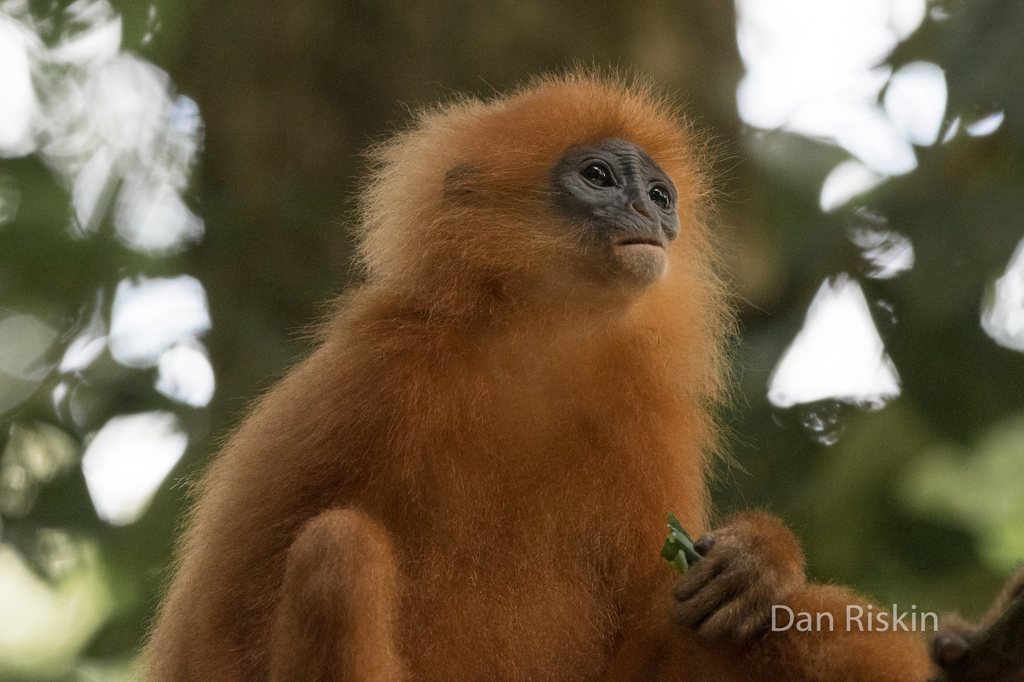
Maroon Leaf Monkey
Presbytis rubicunda
The maroon langur, maroon leaf monkey, or red leaf monkey (Presbytis rubicunda) is a species of primate in the family Cercopithecidae. It is found on the southeast Asian island of Borneo and the nearby smaller Karimata. P. rubicunda mostly live in forests at altitudes below 2,000 m. They feed on leaves (36%), .
From the article Maroon leaf monkey on Wikipedia (CC BY-SA), quoted section by section
Range & habitat
Maroon leaf monkeys (Presbytis rubicunda) are endemic to the island of Borneo in Southeast Asia. Their habitat is dense dipterocarp evergreen forest. Borneo has a healthy tropical rainforest. It also contains shallow swampy areas made up of acidic, decomposed plant matter. These swampy areas have seasonal bouts of dry weather; during the wet season the rivers rise around two meters. Maroon leaf monkeys are arboreal primates and spend most of their time in the canopy. They have a large home ranges and low population densities compared to other primates. This is believed to be because they rely on specific trees which are rare and widely dispersed.
Wikipedia: “Distribution and habitat”
What it does
Maroon leaf monkeys are herbivores. Their main diet is fruits, seeds, young leaves, and flowers. They are selective feeders, as food becomes limited they will feed on certain types of plant matter or seeds during their time of abundance. To maintain a balance in their diet, they will consume topsoil from termite mounds. Their primary food is the young parts of leaves, feeding less frequently on seeds and whole fruits, and occasionally on flowers. Feeding patterns vary seasonally. As the fruit season peaks during June to September, there is an increase of fruit being produced. During this time of abundance, Maroon leaf monkeys feed on large amounts of seeds and fruits. Consumption of young leaves happens primarily from October to June; especially in June. During this dry time of the year, they consume more succulent foliage and are decrease their intake of seeds. Flowers are mostly consumed between March and May. There is only one type of flower that becomes a high-demand resource during December. Food becomes scarce during the rainy season, and at this time of year maroon leaf monkeys feed on mature leaves. During April, June, and August, maroon leaf monkeys consume the topsoil of termite mounds to obtain the minerals needed for a balanced diet. The termite mound soil has high levels of calcium and magnesium and is also a source of potassium and phosphorus. …
Wikipedia: “Diet”
Listen
Looking for field recordings…
Where it lives
Recorded sightings
—
geo-referenced records in GBIF, from museums, herbaria and field observers.
Drag the globe to turn it. Dots are where records exist, not a range map; darker means more records.
In the stacks
Searching the stacks…
Every page naming Presbytis rubicunda in the Biodiversity Heritage Library →
This page is assembled live from iNaturalist, GBIF, Wikipedia, the Source Library and the Internet Archive. It is not yet part of the hand-edited codex. iNaturalist taxon 43502.