- Animals
- ›Chordates
- ›Vertebrates
- ›Mammals
- ›Therians
- ›Placental Mammals
- ›Primates, Rodents, and Allies
- ›Primates
- ›Monkeys, Apes, and Tarsiers
- ›Monkeys and Apes
- ›Apes and Old World Monkeys
- ›Old World Monkeys
- ›Colobines
- ›Langurs, Surilis, and Lutungs
- ›Presbytis
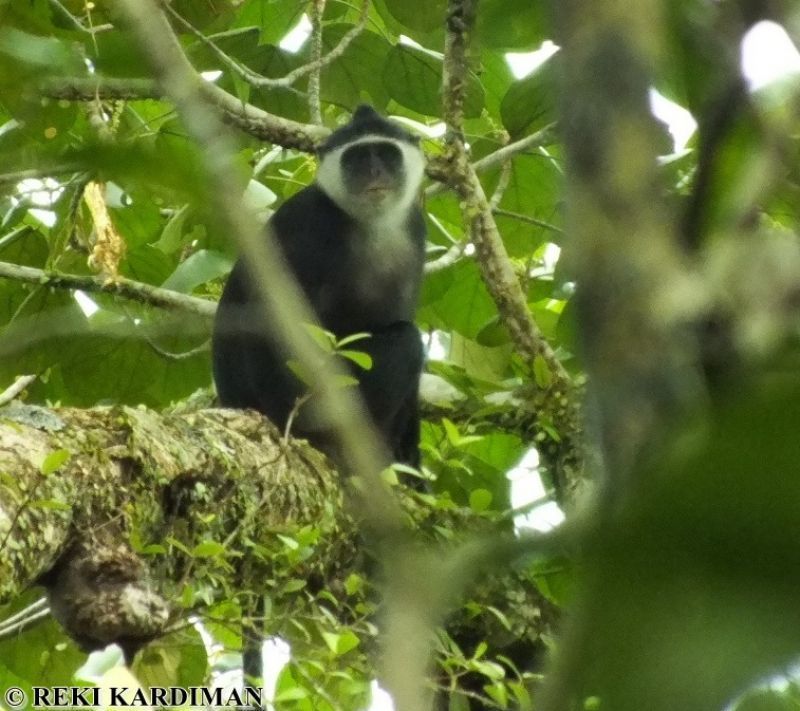
Mentawai Surili
Presbytis potenziani
The Mentawai langur (Presbytis potenziani) is a species of primate in the family Cercopithecidae. It is endemic to the Mentawai Islands in Indonesia. Its natural habitat is subtropical or tropical dry forests. The Siberut langur (P. siberu) was formerly considered a subspecies of the Mentawai langur.
From the article Mentawai langur on Wikipedia (CC BY-SA), quoted section by section
Description
Mentawai langur infants are born with a white pelage. After two to three weeks, the pelage begins to darken and the face becomes darkly pigmented. This change of coloration begins in the dorsal midline and head and ends laterally. After three months, the belly and chest are dark reddish-brown, throat, cheeks, forehead and tip of tail are white and the rest of the body is jet black. Males are differentiated from females by having a white circumgenital patch of fur. Mentawai langurs have a slender body with hind limbs longer than their forelimbs.
Range & habitat
Mentawai langurs are endemic to the islands of Sipora, North Pagai, and South Pagai. They inhabit primary and secondary forests dominated by dipterocarps. The trees used by Presbytis potenziani as sleeping areas are typically 35 metres (115 ft) in height. The langurs sleep in the mid-upper levels of these trees above 20 metres (66 ft), where the canopy density is thickest, with the most common sites being in coconut groves.
Wikipedia: “Distribution and habitat”
What it does
On average, groups of Mentawai langurs travel 540 metres (1,770 ft) each day. Heavy rainfall affects movement patterns light to moderate rainfall does not. The langurs move by quadrupedal running and climbing; they also leap in the mid and upper portions of the canopy and drop when nearer to the ground. Home ranges vary from 11 to 40 hectares (27 to 99 acres). The groups are not migrants. Their social organisation is variable: unimale-unifemale, unimale-multifemale, multimale-multifemale. Mentawai langurs spend more than 80% of their time resting and foraging and only a small portion traveling and conducting social behavior. Such extensive periods of resting and foraging are required for colobines that consume seeds, unripe fruits and leaves to support their digestion. Adult males typically move away from the group in the early morning and give long calls. The langurs feed in the upper portion of the canopy. In some areas, their diet consists of 55% leaves, 32% fruit and seed and 13% other source of food such as flowers, bark, sap, and fungi. but groups that forage in secondary forests have a diet of 70% fruits and seeds and up to 35% "climber" type vegetation. The niche breadth of Presbytis potenziani is 0.22, based on Levin's index.
Wikipedia: “Behavior and diet”
Listen
Looking for field recordings…
Where it lives
Recorded sightings
—
geo-referenced records in GBIF, from museums, herbaria and field observers.
Drag the globe to turn it. Dots are where records exist, not a range map; darker means more records.
In the stacks
Searching the stacks…
Every page naming Presbytis potenziani in the Biodiversity Heritage Library →
This page is assembled live from iNaturalist, GBIF, Wikipedia, the Source Library and the Internet Archive. It is not yet part of the hand-edited codex. iNaturalist taxon 43505.