- Animals
- ›Chordates
- ›Vertebrates
- ›Mammals
- ›Therians
- ›Placental Mammals
- ›Primates, Rodents, and Allies
- ›Primates
- ›Monkeys, Apes, and Tarsiers
- ›Monkeys and Apes
- ›Apes and Old World Monkeys
- ›Apes
- ›Gibbons
- ›Hylobates
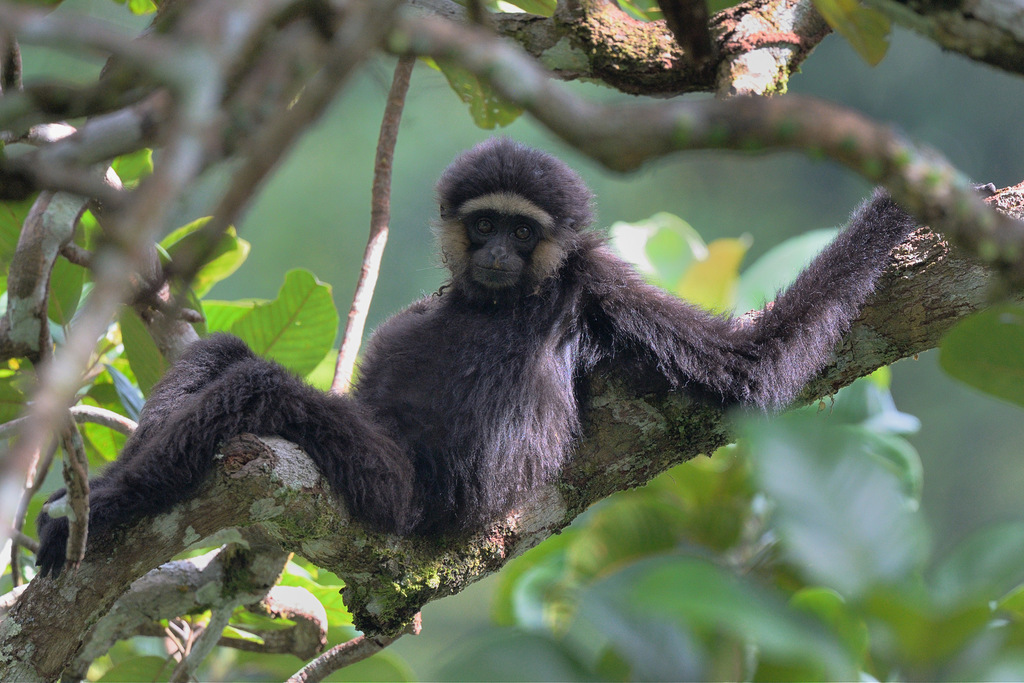
Agile Gibbon
Hylobates agilis
The agile gibbon (Hylobates agilis), also called the black-handed gibbon, is an Old World primate, and is a part of the gibbon family. It is native to Indonesia, specifically, on the island of Sumatra. The agile gibbon can also be found in Malaysia, and southern Thailand. As appointed by the IUCN Red List, this species is endangered, and mainly due to the destruction of their habitat and pet trade.
From the article Agile gibbon on Wikipedia (CC BY-SA), quoted section by section
Description
The agile gibbon has fur varying in color from black to red-brown. The brow is white, and the male can be recognized by his white or light-grey cheeks. Additionally, the male is slightly larger than the female. The agile gibbon weighs from 4 to 6 kg (8.8 to 13.2 lb) with an average of 5 kg (11 lb), though in captivity it can reach 8 kg (18 lb). It has a head and body length of 44–63.5 cm (17.3–25.0 in). Like all gibbons, it is tailless.
Range & habitat
The agile gibbon is found on Sumatra southeast of Lake Toba and the Singkil River, in a small area on the Malay Peninsula, and south Thailand near the Malaysian border. It predominantly lives arboreally in rain forests and rarely comes to the ground.
Wikipedia: “Distribution and habitat”
What it does
With its long arms they swing on branches, brachiating at a fast pace. Like all gibbons, it lives in monogamous pairs in a strict enforced territory, which is defended with vigorous visual displays and songs. The diet of the agile gibbon is generally frugivorous but have also been observed eating leaves, flowers, and insects. Females give birth to a single offspring after seven months' gestation. The young gibbon is weaned at barely 2 years of age. When fully mature, at about 8 years, it leaves its family group in order to look for a mate.
Wikipedia: “Behaviour”
Listen
Looking for field recordings…
Where it lives
Recorded sightings
—
geo-referenced records in GBIF, from museums, herbaria and field observers.
Drag the globe to turn it. Dots are where records exist, not a range map; darker means more records.
In the stacks
Searching the stacks…
Every page naming Hylobates agilis in the Biodiversity Heritage Library →
This page is assembled live from iNaturalist, GBIF, Wikipedia, the Source Library and the Internet Archive. It is not yet part of the hand-edited codex. iNaturalist taxon 43588.