- Animals
- ›Chordates
- ›Vertebrates
- ›Mammals
- ›Therians
- ›Placental Mammals
- ›Primates, Rodents, and Allies
- ›Primates
- ›Monkeys, Apes, and Tarsiers
- ›Monkeys and Apes
- ›Apes and Old World Monkeys
- ›Apes
- ›Gibbons
- ›Hylobates
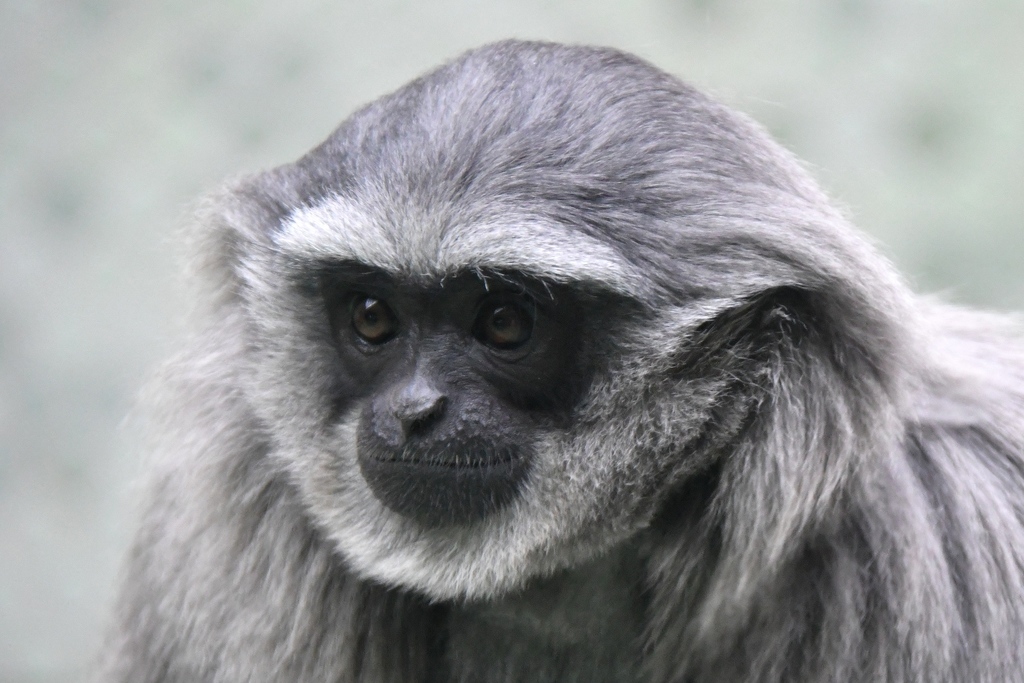
Javan Gibbon
Hylobates moloch
The silvery gibbon (Hylobates moloch), also known as the Javan gibbon, is a primate in the gibbon family Hylobatidae. It is endemic to the Indonesian island of Java, where it inhabits undisturbed rainforests up to an altitude of 2,450 m (8,040 ft). It has been listed as Endangered on the IUCN Red List since 2008, as the wild population is estimated to comprise less than 2500 mature individuals.
Its coat is bluish-grey, with a dark grey or black cap. Like all gibbons, the silvery gibbon lacks an external tail, has dorsally placed scapulae, and reduced flexibility in its lumbar region. It has long, curved fingers and very long forelimbs relative to its hind limbs. On average, it reaches 8 kg (18 lb) in weight.
From the article Silvery gibbon on Wikipedia (CC BY-SA), quoted section by section
What it does
Like all gibbon species, the silvery gibbon lives in pairs and stakes out territory that the pair strongly defends; it has relatively small territories of about 42 acres (17 hectares). Females sing to declare their territory several times a day, and if strangers are spotted, the male screams in an attempt to scare them away. The majority of the solo song bouts or scream bouts are produced by females. The female vocal bouts occur after 0500 hr, with the vocal bout activity peaking around 0600 hr. In contrast, the male vocal bouts primarily occurred before 0500 hr was created in the style of a chorus, with a minimum of three participants. There are choruses around every 8.5 days. It took place sooner and lasted longer than female solo song fights. The majority of male songs begin in the dark, between 0355 and 0440 hours. The males are usually very aggressive toward others.
Wikipedia: “Behaviour and ecology”
Listen
Looking for field recordings…
Where it lives
Recorded sightings
—
geo-referenced records in GBIF, from museums, herbaria and field observers.
Drag the globe to turn it. Dots are where records exist, not a range map; darker means more records.
In the stacks
Searching the stacks…
Every page naming Hylobates moloch in the Biodiversity Heritage Library →
This page is assembled live from iNaturalist, GBIF, Wikipedia, the Source Library and the Internet Archive. It is not yet part of the hand-edited codex. iNaturalist taxon 43592.