- Animals
- ›Chordates
- ›Vertebrates
- ›Mammals
- ›Therians
- ›Placental Mammals
- ›Primates, Rodents, and Allies
- ›Primates
- ›Monkeys, Apes, and Tarsiers
- ›Monkeys and Apes
- ›Apes and Old World Monkeys
- ›Apes
- ›Gibbons
- ›Hylobates
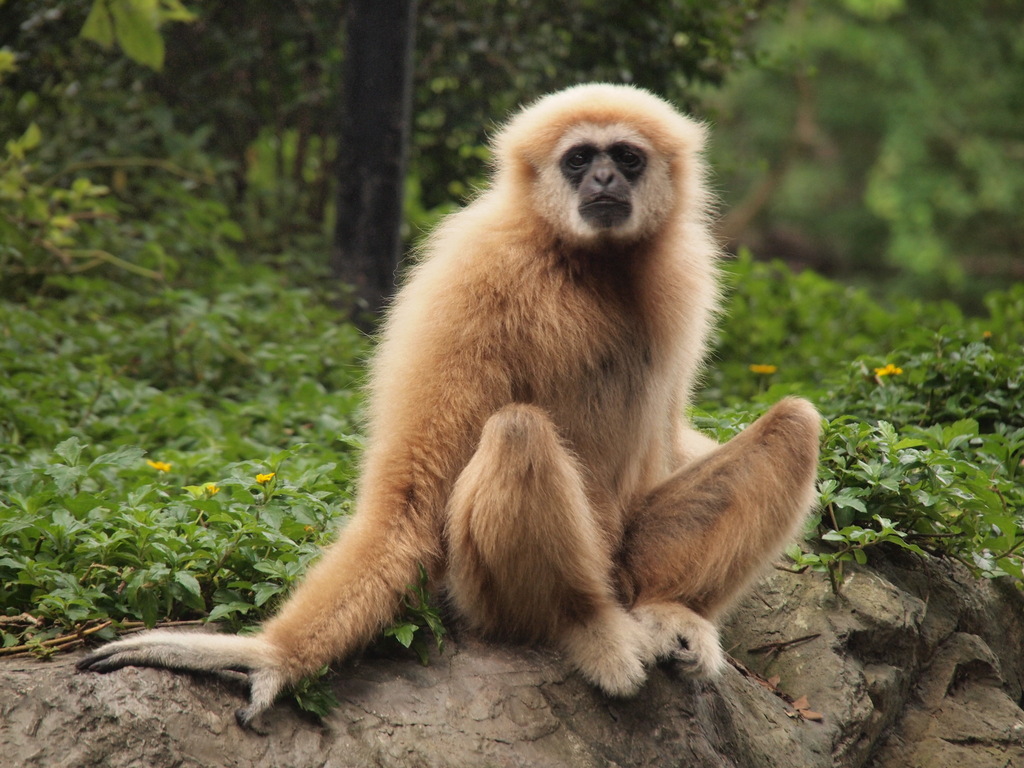
Lar Gibbon
Hylobates lar
The lar gibbon (Hylobates lar), also known as the white-handed gibbon, is an endangered primate in the gibbon family, Hylobatidae. It is one of the better-known gibbons and is often kept in captivity.
From the article Lar gibbon on Wikipedia (CC BY-SA), quoted section by section
Range & habitat
Lar gibbons have the greatest north-south range of any of the gibbon species. They are found in Indonesia, Laos, Malaysia, Myanmar and Thailand. Their range historically extended from southwest China to Thailand and Burma south to the whole Malay Peninsula in primary and secondary tropical rain forests. It is also present in the northwest portion of the island of Sumatra. In recent decades, especially, the continental range has been reduced and fragmented. Lar gibbons are likely extinct in China. However, if any populations persist, they would only be found in southwest Yunnan, their former range. Lar gibbon are usually found in lowland dipterocarp forest, hill dipterocarp forest, and upper dipterocarp forest, including primary lowland and submontane rainforest, mixed deciduous bamboo forest, and seasonal evergreen forest. They are not usually found higher than 1,200 meters (3,900 ft) above sea level. The gibbon genus is highly allopatric, usually separated by large rivers. As a result, their range extends through southern and eastern Myanmar, but only east of the Salween River. They are found through the Malay Peninsula. Lar gibbons also exist west of the Mekong River in northwestern Laos and northern Sumatra. The lar gibbon can be found living in sympatry with several other primates and apes, including orangutans (Pongo pygmaeus), siamangs (S. …
Wikipedia: “Distribution and habitat”
What it does
The lar gibbon is considered frugivorous with fruit constituting 50% of its diet, but leaves (29%) are a substantial part, with insects (13%) and flowers (9%) forming the remainder. In the wild, lar gibbons will eat a large variety of foods, including figs and other small, sweet fruits, liana fruit, tree fruit and berries, as well as young leaves, buds and flowers, new shoots, vines, vine shoots, and insects, including mantids and wasps, and even birds' eggs. During the summer months, when figs and leaves are less available, insect consumption increases twenty-fold relative to the winter. Its dental formula is 2.1.2.32.1.2.3, the generalized formula for Old World monkeys and apes (including humans). The dental arcade is U-shaped, and the mandible is thin and light. The incisors are broad and flat, while the molars have low, rounded cusps with thick enamel. The most noticeable characteristic of the dentition of Hylobates lar is the presence of large, dagger-like canines in both the upper and lower jaw. These canines are not sexually dimorphic.
Wikipedia: “Diet and dentition”
Listen
Looking for field recordings…
Where it lives
Recorded sightings
—
geo-referenced records in GBIF, from museums, herbaria and field observers.
Drag the globe to turn it. Dots are where records exist, not a range map; darker means more records.
In the old herbals & bestiaries

In the stacks
Searching the stacks…
Every page naming Hylobates lar in the Biodiversity Heritage Library →
This page is assembled live from iNaturalist, GBIF, Wikipedia, the Source Library and the Internet Archive. It is not yet part of the hand-edited codex. iNaturalist taxon 43593.