- Animals
- ›Chordates
- ›Vertebrates
- ›Mammals
- ›Therians
- ›Placental Mammals
- ›Primates, Rodents, and Allies
- ›Primates
- ›Monkeys, Apes, and Tarsiers
- ›Monkeys and Apes
- ›Apes and Old World Monkeys
- ›Apes
- ›Gibbons
- ›Hylobates
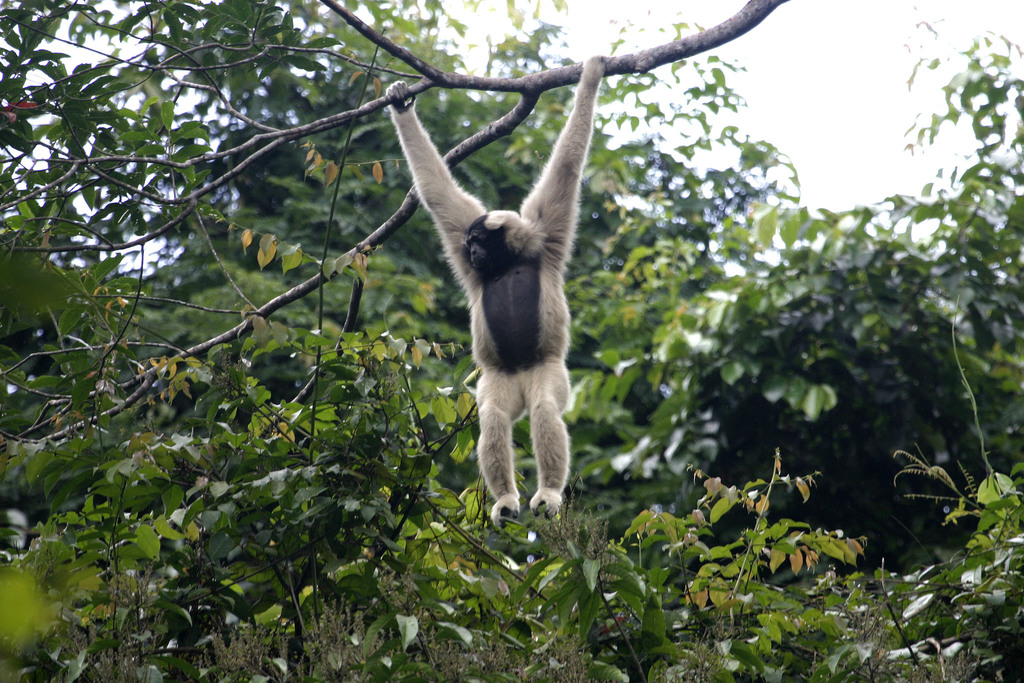
Pileated Gibbon
Hylobates pileatus
The pileated gibbon (Hylobates pileatus) is a primate in the gibbon family, Hylobatidae.
The pileated gibbon has sexual dimorphism in fur coloration: males have purely black fur, while females have buff-coloured or white-grey fur with only the belly and head black. The white and often shaggy hair ring around the head is common to both sexes.
From the article Pileated gibbon on Wikipedia (CC BY-SA), quoted section by section
Range & habitat
The range of the pileated gibbon is eastern Thailand, western Cambodia and southwest Laos. Its lifestyle is much like other gibbons: diurnal and arboreal, it lives together in a monogamous pair, brachiates through the trees with its long arms, and predominantly eats fruits, leaves and small animals. Reproduction habits are not well known, but are presumed to be similar to the other gibbons. Mating pairs also mark their own territory together, with the female and male performing loud vocalisations to show this. The pileated gibbon is found in the following areas. There are about 35,000 individuals in Cambodia and about 30,000 in Thailand.
Khao Yai National Park, Thailand Thap Lan National Park, Thailand Khao Ang Ru Nai Sanctuary, Thailand Khao Soi Dao Sanctuary, Thailand Pang Sida National Park, Thailand Ta Phraya National Park, Thailand Cardamom Mountains, Cambodia (about 20,000 individuals) Bokor National Park, Cambodia (about 1,000 individuals)
Wikipedia: “Range”
Listen
Looking for field recordings…
Where it lives
Recorded sightings
—
geo-referenced records in GBIF, from museums, herbaria and field observers.
Drag the globe to turn it. Dots are where records exist, not a range map; darker means more records.
In the stacks
Searching the stacks…
Every page naming Hylobates pileatus in the Biodiversity Heritage Library →
This page is assembled live from iNaturalist, GBIF, Wikipedia, the Source Library and the Internet Archive. It is not yet part of the hand-edited codex. iNaturalist taxon 43596.