- Animals
- ›Chordates
- ›Vertebrates
- ›Mammals
- ›Therians
- ›Placental Mammals
- ›Primates, Rodents, and Allies
- ›Primates
- ›Monkeys, Apes, and Tarsiers
- ›Monkeys and Apes
- ›New World Monkeys
- ›Sakis, Titis, and Uakaris
- ›Titis
- ›Callicebus
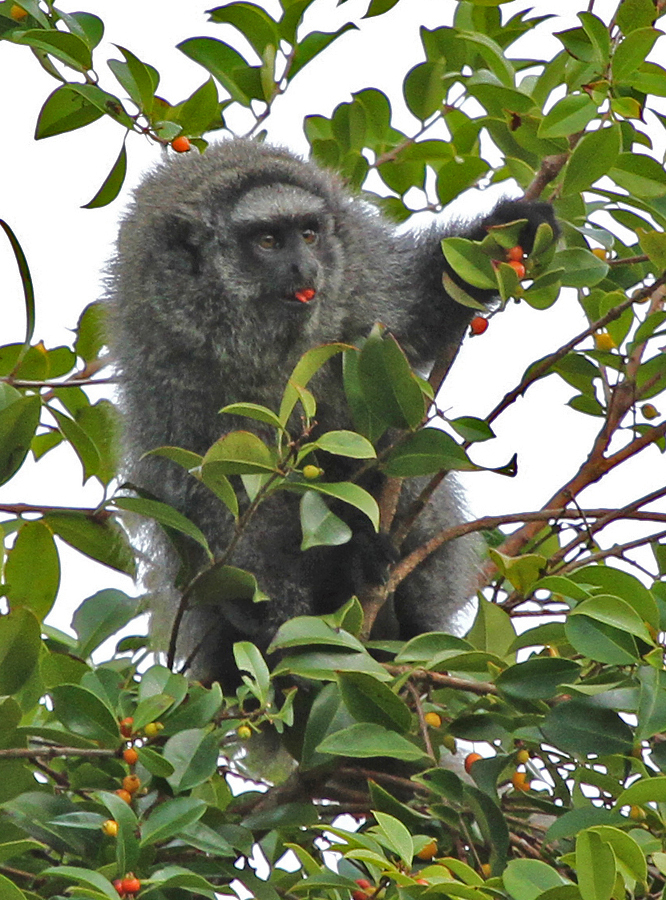
Coastal Black-handed Titi
Callicebus melanochir
The coastal black-handed titi monkey (Callicebus melanochir) is a species of titi, a type of New World monkey, endemic to Brazil.
From the article Coastal black-handed titi monkey on Wikipedia (CC BY-SA), quoted section by section
Description
Coastal black-handed titis are relatively small primates with fluffy fur, a long, bushy tail and a small, roundish head. Like atlantic titis, they can reach a head trunk length of over 40 centimetres and a weight of up to 1.6 kilograms. Their dense fur is predominantly grey or grey-brown in colour, the head and paws are black. The long tail is the same colour as the torso, as with all jumping monkeys it cannot be used as a prehensile tail.
Range & habitat
Coastal black-handed titis are found on the Brazilian Atlantic coast, their range includes the south of Bahia and the north of Espírito Santo. Their habitat is coastal forest.
Wikipedia: “Distribution and habitat”
What it does
Not much is known about the lifestyle of the coastal black-handed titis, but it is probably similar to that of the atlantic titi. They are diurnal tree dwellers that move around on all fours or jumping. A male and a female, who stay together all their lives, form a family group with their offspring. These groups live in fixed territories, which they mark with songs and defend aggressively if necessary. They feed mainly on fruits and to a lesser extent on seeds and leaves. The fathers participate intensively in the rearing of the young, they carry the young around and only leave it to the mother to suckle.
Wikipedia: “Behavioral ecology”
Listen
Looking for field recordings…
Where it lives
Recorded sightings
—
geo-referenced records in GBIF, from museums, herbaria and field observers.
Drag the globe to turn it. Dots are where records exist, not a range map; darker means more records.
In the stacks
Searching the stacks…
Every page naming Callicebus melanochir in the Biodiversity Heritage Library →
This page is assembled live from iNaturalist, GBIF, Wikipedia, the Source Library and the Internet Archive. It is not yet part of the hand-edited codex. iNaturalist taxon 43657.