- Animals
- ›Chordates
- ›Vertebrates
- ›Mammals
- ›Therians
- ›Placental Mammals
- ›Primates, Rodents, and Allies
- ›Rodents
- ›Ctenohystricans
- ›Hystricognaths
- ›Cavies, Agoutis, and Pacas
- ›Agoutis and Acouchis

Agoutis
Dasyprocta
The agouti ( , ə-GOO-tee) or common agouti is any of several rodent species of the genus Dasyprocta, from Ancient Greek δασύς (dasús), meaning "hair", and πρωκτός (prōktós), meaning "anus". They are native to Central America, northern and central South America, and the southern Lesser Antilles. Some species have also been introduced elsewhere in the West Indies and in west Africa (Bénin). They are related to guinea pigs and look quite similar, but they are larger and have longer legs. The species vary considerably in colour, being brown, reddish, dull orange, greyish, or blackish, but typically with lighter underparts. Their bodies are covered with coarse hair, which is raised when alarmed.
The related pacas were formerly included in genus Agouti, but these animals were reclassified in 1998 as genus Cuniculus.
12 branches of this genus, most-observed first · about 12 known species
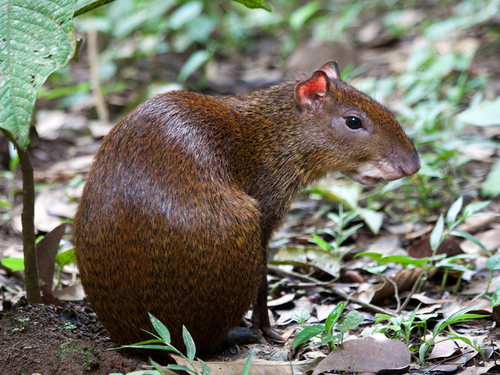
Central American Agouti
speciesDasyprocta punctata
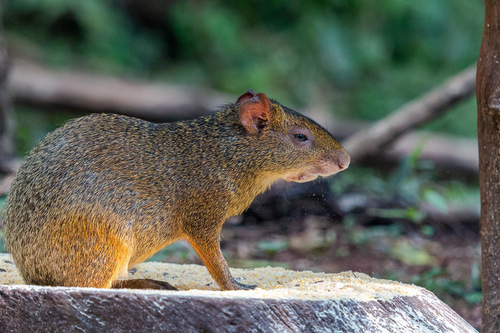
Azara's Agouti
speciesDasyprocta azarae
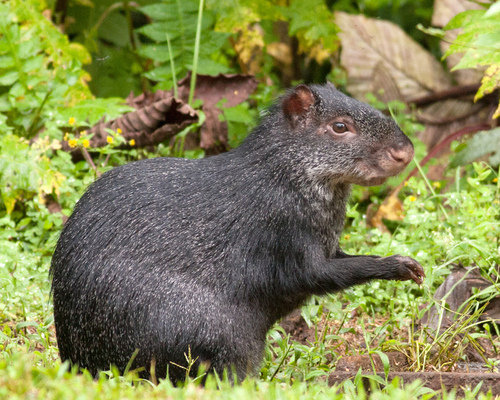
Black Agouti
speciesDasyprocta fuliginosa
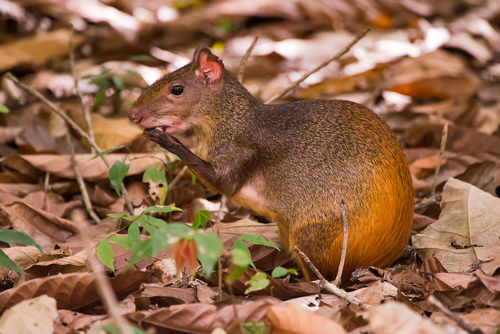
Red-rumped Agouti
speciesDasyprocta leporina
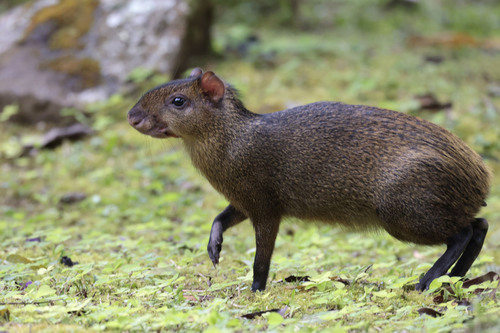
Brown Agouti
speciesDasyprocta variegata
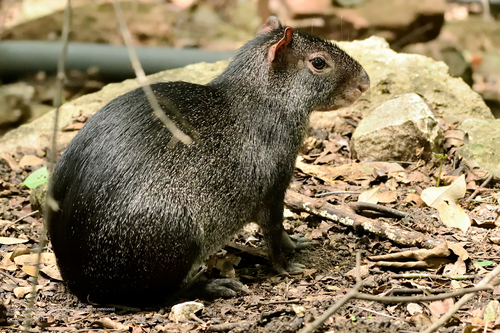
Mexican Agouti
speciesDasyprocta mexicana

Iack's Red-rumped Agouti
speciesDasyprocta iacki

Black-rumped Agouti
speciesDasyprocta prymnolopha

Coiban Agouti
speciesDasyprocta coibae

Kalinowski's Agouti
speciesDasyprocta kalinowskii

Orange Agouti
speciesDasyprocta croconota
Orinoco Agouti
speciesDasyprocta guamara
Where it lives
Recorded sightings
—
geo-referenced records in GBIF, from museums, herbaria and field observers.
Drag the globe to turn it. Dots are where records exist, not a range map; darker means more records.
In the stacks
Searching the stacks…
Every page naming Dasyprocta in the Biodiversity Heritage Library →
This page is assembled live from iNaturalist, GBIF, Wikipedia, the Source Library and the Internet Archive. It is not yet part of the hand-edited codex. iNaturalist taxon 43711.